By Dwayne Ferreira.
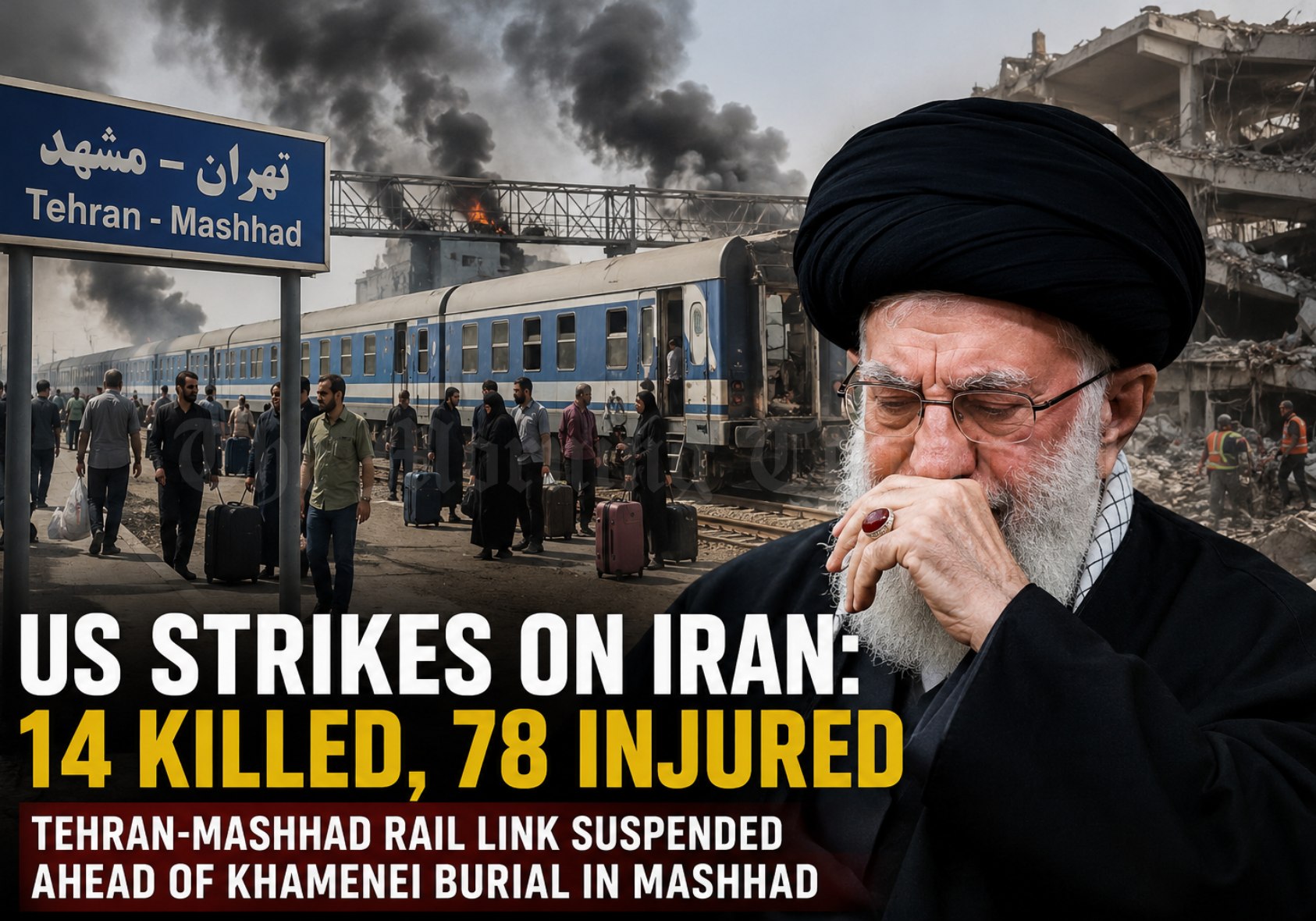
US strikes on Iran have killed at least 14 people and injured 78 others over two days, Tehran says, as trains to Mashhad stopped hours before the burial of late Supreme Leader Ali Khamenei.
Iran said Thursday that American strikes over the previous two days had left 14 people dead and 78 wounded. State media also said trains between Tehran and Mashhad had stopped after strikes on the route.
The disruption came just hours before Khamenei was due to be buried in Mashhad, one of Iran’s most important religious cities. As a result, a day of national mourning became another flashpoint in a fast-widening confrontation.

US Strikes on Iran Disrupt Funeral Travel
Iranian state television said the Tehran-Mashhad railway had stopped after what officials called strikes by the “US-Israeli enemy.” Railway authorities said repair teams had moved toward the affected section. They also arranged road transport for passengers stranded by the suspension.
The rail disruption matters because Mashhad is a major pilgrimage city. It is also the destination for mourners travelling to Khamenei’s burial at the Imam Reza Shrine. The city has become the centre of a mass funeral as American strikes and Iranian retaliation continue.
Iran’s Health Ministry said the latest American attacks had hit several provinces during the past two days. Ministry spokesperson Hossein Kermanpour said 14 people had died and 78 had been injured. He added that 47 wounded people remained in hospital, while others had left after treatment.
Independent sources could not verify the casualty figures. However, they represent one of Tehran’s clearest official updates since the latest round of US strikes on Iran began.
The renewed attacks have placed Iran’s civilian infrastructure, transport system and religious ceremonies under severe strain. The railway suspension also raises fresh questions about the campaign’s impact on civilian movement during one of Iran’s most politically sensitive funerals.
Mashhad Burial Becomes A Symbolic Moment
Khamenei’s burial in Mashhad follows days of mourning across Iran and Iraq. The late supreme leader ruled Iran for decades. He died earlier this year during the wider US-Israeli campaign against Iranian leadership and military targets.
His death triggered a deep crisis inside Iran and across the region. Tehran vowed revenge. Washington, meanwhile, warned against further attacks on American forces and commercial shipping.
The funeral has become a major symbolic moment for Iran’s leadership. Officials are using it to project unity, resistance and continuity. The country also faces renewed military pressure, economic uncertainty and regional isolation.
Washington has framed the latest strikes as a response to Iranian aggression in the Gulf. US officials have cited attacks on commercial vessels and threats to shipping through the Strait of Hormuz. The United States has accused Tehran of endangering civilian crews and disrupting a vital energy corridor.
Iran has rejected Washington’s justification. Officials instead accuse the United States of escalating the war while the country mourns. Iranian leaders have called the attacks an assault on national sovereignty. They have also warned that US bases and allied positions across the region could face retaliation.
Gulf States Watch As Conflict Spreads
The latest developments have also placed Gulf states on high alert. Bahrain, Kuwait and Qatar have been pulled deeper into the confrontation. Iranian missiles and drones have targeted areas linked to US military infrastructure.
Air raid warnings and interception alerts have increased fears that the conflict could spread beyond Iran’s borders. The region is now watching for further retaliation, especially around American bases and shipping routes.
The suspension of the Tehran-Mashhad railway adds another layer to the crisis. The route links the capital to Iran’s northeast. During major religious events, it carries large numbers of pilgrims and mourners to Mashhad.
Any disruption during Khamenei’s burial is likely to deepen anger inside Iran. It may also strengthen the government’s claim that Washington is affecting more than military targets. Officials can now argue that the conflict is reaching Iran’s social and religious life.
The Imam Reza Shrine, where Khamenei was expected to be buried, is one of the most sacred places in Shia Islam. A funeral there carries deep political and religious meaning. That meaning is even greater for a leader who shaped Iran’s domestic politics, foreign policy and military strategy for nearly four decades.
The burial is also expected to intensify calls for revenge among hardline factions and supporters of the Islamic Revolutionary Guard Corps. Public ceremonies have already featured anti-American and anti-Israeli chants. Iranian leaders have promised that the country will not allow Khamenei’s death or the latest strikes to go unanswered.
Civilian Toll Raises Pressure For Diplomacy
At the same time, the growing civilian toll and transport disruption may increase pressure on both sides to consider diplomacy. Regional governments have warned that the conflict could destabilise the Gulf. They also fear it could disrupt energy supplies and trigger a wider war involving several US allies.
Qatar’s Ministry of Foreign Affairs has urged Washington and Tehran to return to diplomacy. International appeals for restraint have also grown louder. However, neither side appears ready to step back.
The United States says it is ready for further military action if Iran continues attacks on shipping or American bases. Iran says it will answer every strike and defend its territory, leadership and strategic interests.
For ordinary Iranians, the immediate reality is fear, disruption and uncertainty. Families heading to Mashhad for Khamenei’s funeral now face suspended trains, alternative road transport and the risk of further attacks. Hospitals are treating the wounded, while state media frames the conflict as a national struggle against foreign aggression.
The latest casualty figures and railway disruption show how quickly the conflict is moving from military confrontation into daily life. Renewed military exchanges have now reached transport routes, pilgrimage movements and the burial of Iran’s most powerful modern leader.
As mourners gather in Mashhad, Iran is burying Khamenei under the shadow of American airstrikes, regional retaliation and the growing threat of a wider Middle East war.