By Roy Denish.
X-Press Pearl compensation case faces a corruption probe after Sri Lanka’s Supreme Court condemned the decision to litigate in Singapore.
The X-Press Pearl compensation case has returned to the centre of a major controversy over environmental justice, legal strategy and alleged high-level corruption in Sri Lanka.
The Morning Telegraph investigations are examining allegations that former Attorney General Sanjay Rajaratnam and then-Justice Minister Dr. Wijeyadasa Rajapaksa were linked to an alleged US$250 million bribe. These allegations remain subject to investigation and have not been established by a court.
Meanwhile, fishing communities continue to carry the consequences of the disaster. The maritime catastrophe involving the MV X-Press Pearl disaster erupted into a chemical and plastic pollution nightmare off Sri Lanka’s western coast in May 2021.
The environmental disaster soon developed into a complex battle involving politics, legal strategy and questions of accountability. At the centre of the dispute was a critical decision: where should Sri Lanka pursue compensation for one of the worst maritime environmental disasters in its history?
Toxic plastic pellets, chemicals including nitric acid, and other hazardous materials polluted the marine environment and coastline. The disaster also damaged the livelihoods of fishing communities that depended on the sea for their income.
Behind the scenes, a serious institutional conflict emerged. Independent scientific and legal experts pushed for Sri Lanka to seek compensation through the domestic legal system. However, the state eventually took the main civil compensation action to Singapore.
That decision created a deep divide between experts who wanted the case fought in Sri Lanka and political and legal authorities who supported foreign litigation.

Experts Wanted the X-Press Pearl Compensation Case in Colombo
The initial compensation strategy came from a specialised panel of 40 legal and scientific experts appointed by the Marine Environment Protection Authority.
The committee spent months studying the scale of the ecological and socio-economic damage. It eventually estimated the total damage at approximately US$6.2 billion.
The experts repeatedly recommended that the state file its main civil compensation claims in the Commercial High Court of Colombo. They argued that Sri Lanka could use the strong provisions available under its domestic Admiralty Jurisdiction Act.
A case before a Sri Lankan court offered the country a major legal advantage. Sri Lanka had not ratified the 1976 Convention on Limitation of Liability for Maritime Claims.
Therefore, under the legal position outlined by the experts, the state could pursue unlimited damages against the relevant shipowners and charterers. That approach could potentially hold responsible parties accountable for the full scale of the environmental and economic destruction.
Singapore presented a different legal environment. Critics warned that international maritime liability rules could limit compensation according to the vessel’s gross tonnage.
In their view, this could reduce Sri Lanka’s potential recovery to only a fraction of the damage calculated by the expert committee.
However, the state ultimately chose a different path.
Attorney General Shifted the Civil Case to Singapore
As the crucial two-year prescription period approached in May 2023, then-Attorney General Sanjay Rajaratnam made the controversial decision to bypass the local court system for the main civil action.
The Attorney General’s Department moved the lawsuit to the Singapore International Commercial Court. The decision shocked members of the local expert panel and environmental campaigners who had supported litigation in Colombo.
Rajaratnam defended the move on enforcement grounds.
The argument was that key defendants connected to the vessel were corporate entities based in Singapore. Therefore, supporters of the Singapore strategy argued that enforcing a future multi-billion-dollar judgment could prove more practical in a recognised global maritime and commercial centre.
The Attorney General’s position was that a judgment secured in Colombo could face prolonged enforcement problems and jurisdictional challenges abroad. Under that argument, Sri Lanka risked securing a legal victory without successfully recovering the money awarded.
Critics strongly rejected that reasoning.
They argued that the government had voluntarily surrendered a significant legal advantage available under Sri Lankan law. They also questioned why the country would take a case involving extensive damage to Sri Lankan waters, beaches and livelihoods into a foreign jurisdiction.
The dispute then moved from legal circles into the political arena.
Justice Minister Accused of Engineering Support for Singapore
Then-Justice Minister Dr. Wijeyadasa Rajapaksa played a central role in defending and advancing the controversial shift in legal strategy.
The scientific community and sections of the public strongly resisted the decision to abandon local courts. Against this background, Rajapaksa organised a closed-door meeting involving senior counsel from the Attorney General’s Department and members of the Marine Environment Protection Authority expert panel.
The meeting became a major point of controversy.
Afterward, Rajapaksa told Parliament that local experts had accepted the argument that Singapore offered the most advantageous forum for enforcing a judgment.
Opposition parliamentarians, environmental lawyers and members associated with the expert process fiercely challenged that account. Critics accused the Justice Minister of misrepresenting the experts’ position and suppressing the significance of their original recommendations.
They also alleged that political pressure had produced an artificial consensus to support Cabinet approval for the Singapore filing.
The controversy intensified as opposition members demanded greater transparency over the decision-making process.
In May 2023, opposition parliamentarians attempted to hold an adjournment debate to examine the Singapore transfer. Rajapaksa intervened against the proposed debate.
He argued that a public parliamentary discussion could violate standing orders concerning matters already before a court. He also claimed that political statements made in Sri Lanka could prejudice the active Singapore proceedings and potentially help defence lawyers challenge the case.
Civil society critics condemned the intervention. They described it as an attempt to prevent parliamentary scrutiny of a decision that could affect Sri Lanka’s ability to recover compensation.
Supreme Court Condemns the Legal Decision-Making Process
While the main civil lawsuit proceeded outside Sri Lanka, the Supreme Court became the central arena for accountability through parallel Fundamental Rights petitions.
Displaced fishermen, environmental justice advocates and religious leaders were among those who pursued legal action.
The five-judge bench eventually delivered a landmark Supreme Court judgment ordering US$1 billion in compensation and establishing mechanisms connected to environmental restoration and compensation management.
However, the judgment went further than environmental remediation.
The Supreme Court of Sri Lanka examined the actions of senior state legal authorities and strongly criticised the process that led to the Singapore litigation strategy.
The bench concluded that the Attorney General had failed to properly discharge fundamental statutory responsibilities. It described the decision to pursue the civil action in Singapore as unreasonable, irrational and arbitrary.
The findings transformed the X-Press Pearl compensation case from an environmental dispute into a much wider question about public administration, legal responsibility and possible corruption.
The judgment also raised serious questions about why Sri Lanka moved away from a legal position that experts considered more advantageous.
Supreme Court Orders Corruption Investigation
The Supreme Court’s response went beyond a conventional judicial reprimand.
The judgment raised concerns that the bypassing of domestic jurisdiction could point towards administrative manipulation and possible systemic corruption. As a result, the five-judge bench directed the Commission to Investigate Allegations of Bribery or Corruption to investigate the circumstances surrounding the affair.
The court also directed the Central Bank’s Financial Intelligence Unit and the State Intelligence Service to assist the investigation.
Their involvement could allow investigators to examine relevant financial trails and question officials connected to the decision-making process.
The anti-corruption investigation now carries significance far beyond the legal battle over compensation.
The MV X-Press Pearl disaster began as an environmental catastrophe. It contaminated coastal areas, disrupted fishing livelihoods and forced Sri Lanka into a complex international fight for compensation.
Years later, the controversy has become a test of whether state institutions acted in the country’s best interests when choosing where to pursue the main civil claim.
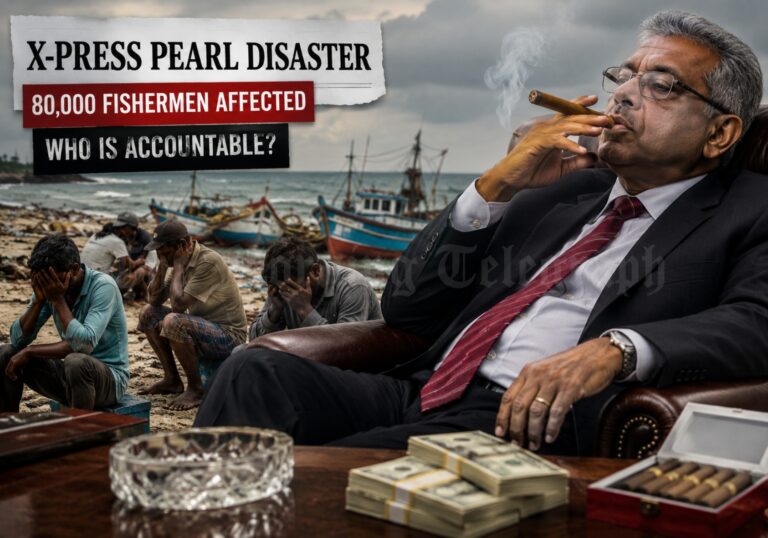
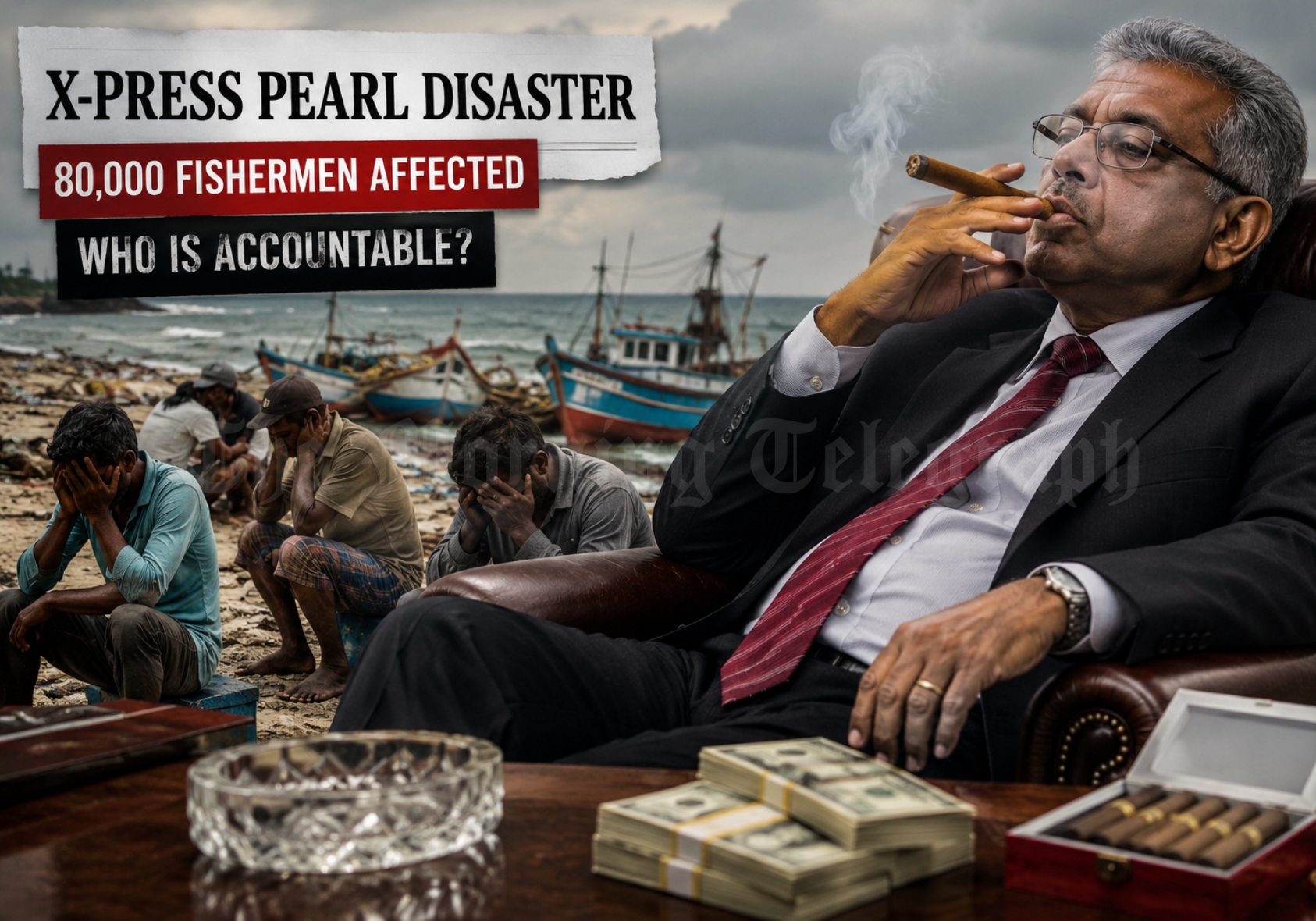
For fishing communities affected by the disaster, the legal arguments carry a direct human cost. Their livelihoods became part of a battle involving environmental destruction, billions of dollars in estimated damage and decisions taken at the highest levels of the state.
The central question is now larger than where a lawsuit should have been filed. Investigators must determine whether the decisions surrounding the compensation strategy resulted from legitimate legal judgment or improper influence.
Until the investigation reaches evidence-based conclusions, allegations against individuals must remain allegations. However, the Supreme Court’s direction for an anti-corruption investigation ensures that the decisions behind one of Sri Lanka’s most consequential environmental cases will face further scrutiny.
The X-Press Pearl compensation case is therefore no longer only about a shipwreck, polluted beaches or a foreign court. It has become a wider examination of institutional accountability, sovereign legal decision-making and whether Sri Lanka’s pursuit of environmental justice was compromised from within.