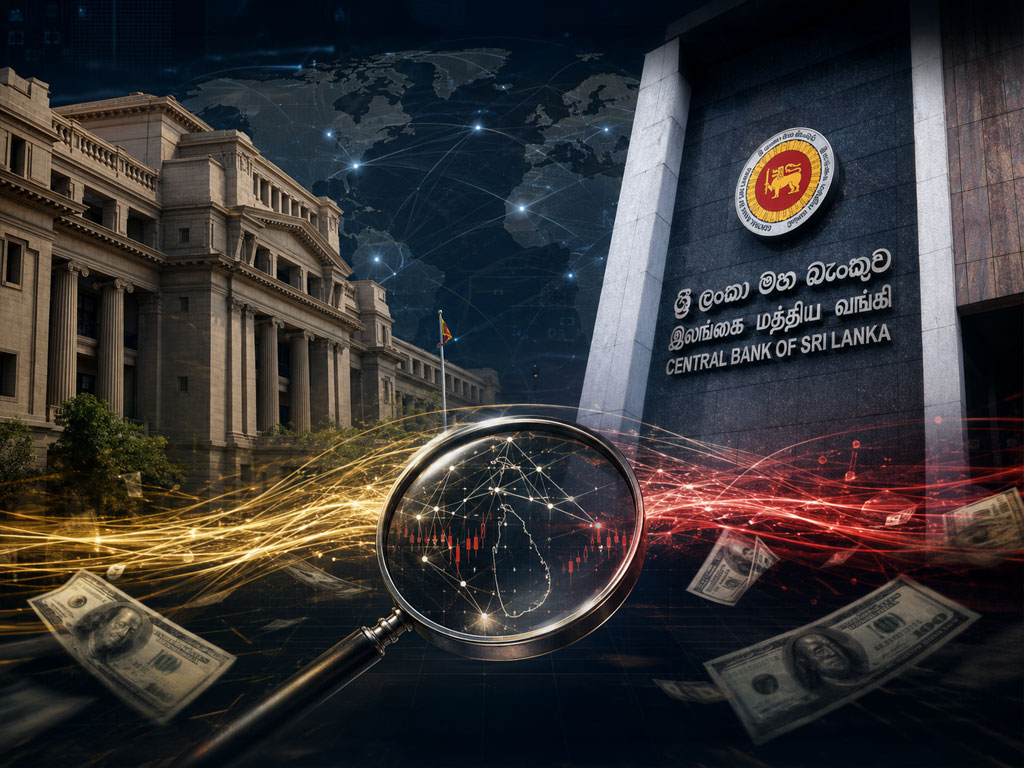
Sri Lanka forex racket investigators trace US$715 million through 105 shell companies as the Finance Ministry and Central Bank trade blame.
The Sri Lanka forex racket involving approximately US$715 million has placed the National People’s Power government under mounting political and administrative pressure.
Authorities are investigating the suspected illegal transfer of hundreds of billions of rupees overseas. The case has been described as one of the largest foreign exchange fraud investigations in Sri Lankan history.
Meanwhile, a dispute has emerged between the Ministry of Finance, Economic Development and Policy Formulation and the Central Bank of Sri Lanka. Both institutions now face questions over how the transactions continued without earlier detection.

Sri Lanka Forex Racket Used 105 Shell Companies
Information presented by the Criminal Investigation Department to the Parliamentary Committee on Public Finance indicates that the alleged operation ran from January 2023 to March 2026.
Investigators identified 105 fraudulently registered shell companies and 227 bank accounts held across 13 state and private banks.
The network allegedly completed nearly 24,300 telegraphic transfers. Businesses described the payments as advances for imports, but the corresponding goods never entered Sri Lanka.
Investigators have also received information suggesting links to organised drug networks based in Dubai. Certain bank officials allegedly assisted the operation.
Evidence presented during the inquiry showed that one individual controlled 43 companies and transferred US$43 million overseas.
Finance Ministry and Central Bank Trade Blame
Deputy Minister of Finance and Planning Dr. Anil Jayantha Fernando told Parliament that the government plans to amend the Foreign Exchange Act No. 12 of 2017.
The proposed changes aim to close legal gaps and restore criminal liability for foreign exchange offences.
However, Central Bank officials told the parliamentary committee that the repeal of the Exchange Control Act in 2017 removed direct powers to prosecute foreign exchange irregularities.
Under the present framework, officials said authorities must connect a transaction to money laundering, drug trafficking or organised crime before taking legal action against an individual.
The disagreement has intensified criticism of Sri Lanka’s financial regulators. Questions remain over why banks and state institutions failed to flag such a large number of transfers despite existing reporting and monitoring requirements.
Two Suspects Returned with Interpol Assistance
Authorities have brought two suspects back to Sri Lanka with assistance from Interpol.
However, COPF Chairman Dr. Harsha de Silva observed that the existing legal framework had made it difficult for investigators to advance the case.
The government is now attempting to strengthen the law. Yet the transfer of hundreds of millions of dollars has already exposed serious weaknesses in the country’s financial regulatory system.
The Sri Lanka forex racket has also renewed debate over financial liberalisation, regulatory supervision and state accountability.
Investigators must now determine who controlled the shell companies, which officials enabled the transfers and whether the funds were connected to wider criminal networks.