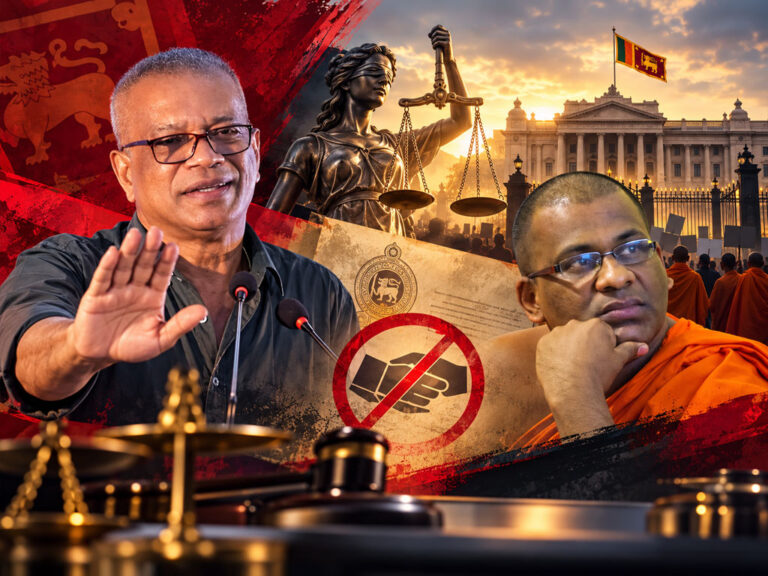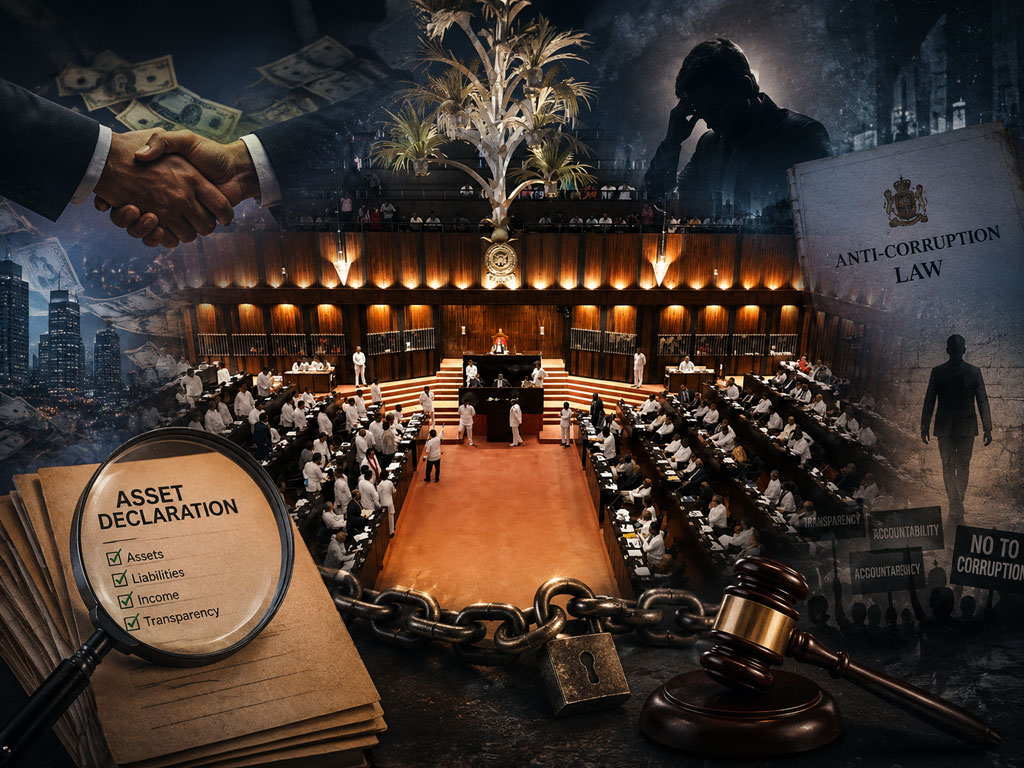
Sri Lanka corruption reform needs stronger institutions, transparent assets and targeted enforcement rather than slogans or sweeping political purges.
Sri Lanka corruption reform must begin with a difficult reality: corruption is not something any government, ideology or charismatic leader can simply eliminate.
Corruption appears wherever people control scarce resources, public money or political authority. No political system is immune. It is not an occasional malfunction that a “good leader” can permanently remove. Instead, it is a permanent institutional risk that governments must manage every day.
What changed during recent decades was opportunity. Privatisation, outsourcing, procurement, tax competition and private political financing created more points where public authority interacts with private money.
Meanwhile, institutions expected to supervise those relationships often struggled to keep pace. Governments changed, but many incentives and vulnerabilities survived.
Get
Breaking News
First
on WhatsApp
Follow The Morning Telegraph for instant alerts, top stories and exclusive updates delivered straight to your phone.

No Political System Is Immune to Corruption
Recent international cases demonstrate that corruption and abuse of office cannot be assigned to one ideology.
In Cuba, former Economy Minister Alejandro Gil Fernández, once a close political ally of President Miguel Díaz-Canel, received a life sentence in December 2025 following convictions that included espionage. A separate case brought a 20-year sentence for offences including bribery, document falsification and tax evasion.
China’s anti-corruption campaign also reached the highest levels of the People’s Liberation Army. In October 2025, authorities expelled nine senior military figures, including Central Military Commission Vice-Chairman He Weidong and Admiral Miao Hua. China’s Defence Ministry said the cases involved serious disciplinary and financial violations.
Democracies offer no automatic protection either.
India and Sri Lanka have experienced repeated allegations, scandals and lengthy investigations. Sri Lanka scored 35 out of 100 in Transparency International’s 2025 Corruption Perceptions Index, ranking 107th among 182 countries. Its score improved by three points from the previous year.
The global CPI also shows why improvement should not encourage complacency. Transparency International says 122 of 182 countries scored below 50 in 2025, indicating widespread perceptions of public-sector corruption internationally.
Left-leaning political movements have faced their own controversies.
In Kerala, India’s Enforcement Directorate named the CPI(M) and several party leaders in proceedings linked to the Karuvannur Service Cooperative Bank money-laundering case. A special court accepted a supplementary chargesheet in June 2026. The party has denied wrongdoing.
The lesson is straightforward. Political ideology does not create immunity from corruption.
Sri Lanka Corruption Reform Faces Its Real Test
That matters particularly for Sri Lanka’s NPP government, which came to office promising a decisive break with corruption.
High-profile investigations and prosecutions may demonstrate activity, but arrests alone cannot become the measurement of success.
Allegations have also touched individuals connected to the Government. However, allegations are not findings of guilt. Every accused person remains entitled to due process and the presumption of innocence.
That distinction is crucial.
When allegations accumulate without credible investigations, prosecutions, acquittals or clear findings, the public cannot separate political accusation from genuine wrongdoing. Trust then deteriorates regardless of whether the allegations are ultimately true.
Sri Lanka therefore needs a system capable of producing answers, not merely headlines.
Systems Matter More Than Anti-Corruption Slogans
Sri Lanka already possesses substantial legislation.
The Anti-Corruption Act No. 9 of 2023 strengthened the legal framework governing bribery, corruption and asset declarations.
Parliament then passed the Proceeds of Crime Act in April 2025, with the Speaker endorsing it on April 30.
But legislation is only the beginning.
Sri Lanka needs a properly resourced and genuinely independent anti-corruption commission. Asset declarations need effective verification and meaningful public scrutiny. Procurement evaluations should be transparent. Political financing requires disclosure. Whistleblowers need protection. Audit findings must produce consequences, while investigations need reasonable deadlines so politically inconvenient files cannot simply disappear.
Enforcement must also remain targeted.
Anti-corruption agencies should investigate specific transactions, decisions and individuals where evidence creates reasonable grounds for scrutiny.
Treating entire institutions as corrupt creates another danger. Officials become frightened to sign documents, procurement slows, decision-making freezes and public administration becomes defensive.
The objective should be to identify corrupt conduct and repair the systems that enabled it, not to presume that every public servant is guilty.
Asset Declaration Changes Raise Fresh Concerns
More troubling are proposals that critics argue could weaken transparency precisely when Sri Lanka corruption reform requires more of it.
Transparency International Sri Lanka has warned that the Anti-Corruption (Amendment) Bill gazetted on July 24, 2026 could restrict how publicly available asset declarations are used for scrutiny. It has also objected to removing the requirement covering assets and liabilities of people who have lived with a declarant for at least six months.
Those concerns deserve serious examination.
A government elected partly on an anti-corruption mandate should make it easier, not harder, for legitimate journalism, civil society and citizens to scrutinise public wealth while protecting genuinely private information from abuse.
The same principle applies to any future changes affecting Right to Information protections.
Process also matters.
Laws developed through meaningful consultation with opposition parties, professional organisations and civil society may take longer. But reforms that command broader institutional legitimacy are harder for future governments to dismantle.
A Moment Sri Lanka Cannot Waste
The NPP government now faces a larger test than prosecuting individual opponents or celebrating new legislation.
It must build institutions that remain credible when investigations involve its own political allies.
Anti-corruption cannot survive as a slogan, campaign identity or claim of moral superiority.
Success will come when evidence determines who is investigated, transparent procedures determine what happens next, and the same standards apply regardless of party, position or political connection.
Sri Lanka does not need leaders promising that corruption will disappear.
It needs institutions capable of managing corruption before corruption begins managing the institutions themselves.
SOURCE:- SRI LANKA GUARDIAN