Abans iPhone 13 complaint raises questions over product history, authorised sales channels, warranty handling and consumer protection in Sri Lanka.
An Abans iPhone 13 complaint has raised serious consumer protection questions after a buyer alleged irregularities involving a device purchased for full payment in April 2025.
The complaint concerns an Apple iPhone 13 purchased from Abans PLC, one of Sri Lanka’s major household and electronics retailers.
According to the consumer, the dispute goes beyond an alleged technical defect. It raises broader questions about product documentation, authorised sales channels, after-sales procedures and the response of regulatory authorities.
The allegations outlined below remain disputed claims made by the consumer and have not been established through a judicial finding.

Abans iPhone 13 Complaint Raises Questions Over Product Timeline
Apple discontinued the iPhone 13 from its global product lineup on September 9, 2024.
However, the consumer claims the device sold as a “Brand New Retail Unit” in April 2025 displayed information indicating a 2025 manufacturing year.
That discrepancy has prompted the consumer to question the phone’s production and supply history.
The consumer has also raised concerns over whether older or surplus inventory could have entered the Sri Lankan market while being sold at premium retail prices.
However, the information provided does not independently establish that the device was surplus stock or intended for a lower-cost market.
According to the complaint, the phone also developed abnormal battery drain and overheating from the date of purchase.
The consumer believes those problems may indicate a manufacturing defect or issues involving internal components.
Again, no independent technical finding establishing that allegation is cited in the material provided.
Questions Over Authorised Sales Channels
The consumer also disputes how the device moved through Abans’ sales network.
According to information cited in the complaint, Apple’s authorised sales information for certain products identifies Abans outlets at Colombo City Centre and One Galle Face.
However, the consumer says the invoice for the disputed device came from the Nittambuwa branch, while delivery took place through the Gampaha branch.
The complaint argues that this raises questions about the authorised distribution process.
It describes the arrangement as potentially inconsistent with Apple’s authorised sales structure, although no independently verified supply-chain agreement establishing a breach has been provided.
When the consumer later took the device to the Abans after-sales service centre at Colombo Racecourse, the service centre reportedly concluded that the phone had no defect.
The consumer rejected that assessment and continued seeking a remedy.
Refund Dispute Escalates
The Abans iPhone 13 complaint then escalated to senior management.
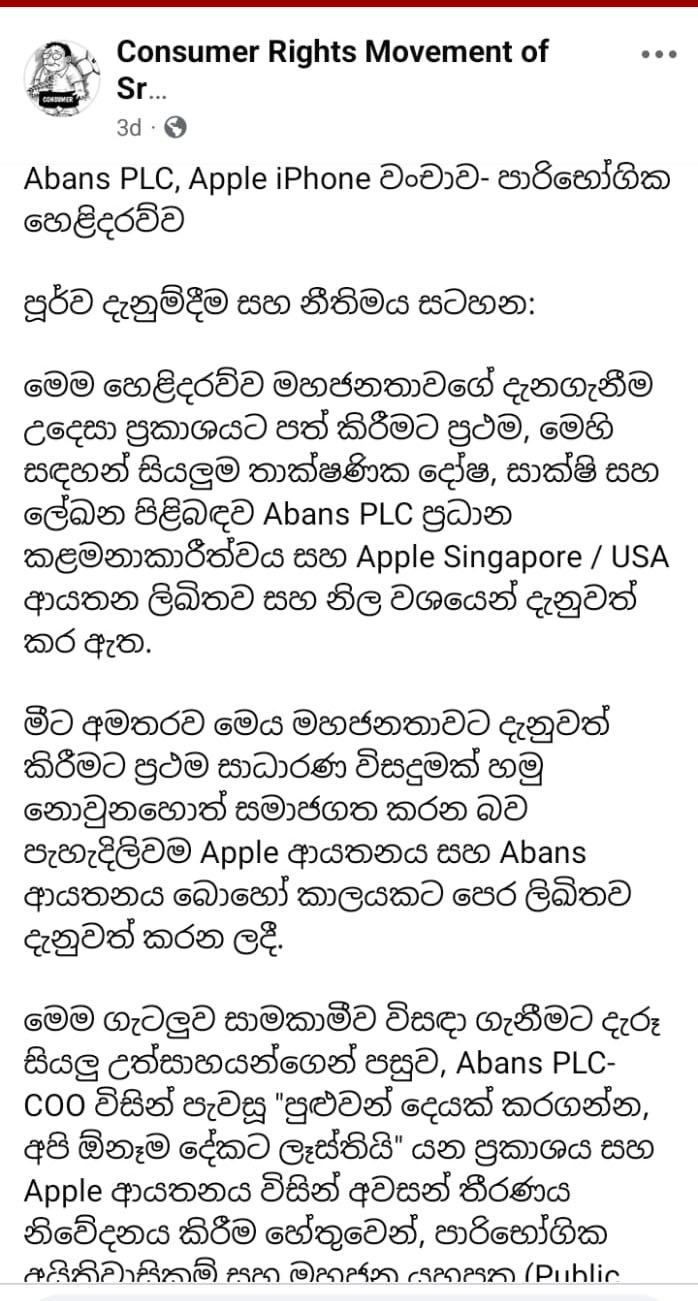
The consumer claims that during a meeting with the company’s Chief Operating Officer, a refund was refused.
The consumer further alleges that a remark equivalent to “do what you can” was made during the discussion.
That account represents the consumer’s version of the exchange.
Later, the consumer issued a letter of demand through a lawyer.
According to the complaint, Abans responded by indicating that it would pursue a counterclaim if legal proceedings were initiated.
The consumer has characterised that response as an attempt to discourage further legal action.
However, the company’s stated legal position and reasons for considering a counterclaim are not reproduced in the material provided.
Consumer Affairs Authority Handling Questioned
The dispute subsequently reached the Gampaha office of the Consumer Affairs Authority.
The consumer alleges that officials handling the complaint appeared more receptive to Abans’ position.
The consumer also says a request to independently verify documents submitted by the company with Apple was not accepted.
Further concerns arose when the consumer sought investigation documents under the Right to Information Act.
According to the complaint, officials advised that the request should be made through a lawyer.
The consumer argues that such a requirement was unnecessary and restricted access to information.
The material also refers to communications allegedly involving Apple Singapore representatives.
According to the consumer, those communications raised questions about the authenticity of an authorisation letter reportedly submitted by Abans to the Consumer Affairs Authority.
The supplied information does not independently establish that the document was forged, and that allegation would require formal verification.
Apple Refund Discussions and Confidentiality Agreement
The consumer says the dispute was later escalated internationally.
The planned steps reportedly included complaints to Apple EthicsPoint and the US Federal Trade Commission, as well as preparation of a technical white paper.
According to the consumer, Apple Singapore subsequently became involved in discussions over a refund.
The complaint states that a refund agreement was proposed, accompanied by a confidentiality agreement.
The consumer alleges that the document carried an earlier date than the date on which it was presented.
The original article describes this as corporate fraud, but the available material does not establish criminal wrongdoing. The issue is therefore more accurately presented as an allegation requiring verification.
The consumer says additional legal protections were then requested before signing the agreement.
According to the complaint, Apple subsequently withdrew from the proposed refund and closed the matter.
The wider significance of the Abans iPhone 13 complaint lies in the questions it raises about product traceability, after-sales remedies and the ability of consumers to challenge large corporations.
The consumer says relevant recordings, documents and other evidence may eventually be made public if existing regulatory and corporate processes fail to resolve the dispute.
The case therefore highlights the importance of transparent documentation, independent technical verification and effective consumer-protection mechanisms when disputes arise between individual buyers, retailers and multinational technology companies.