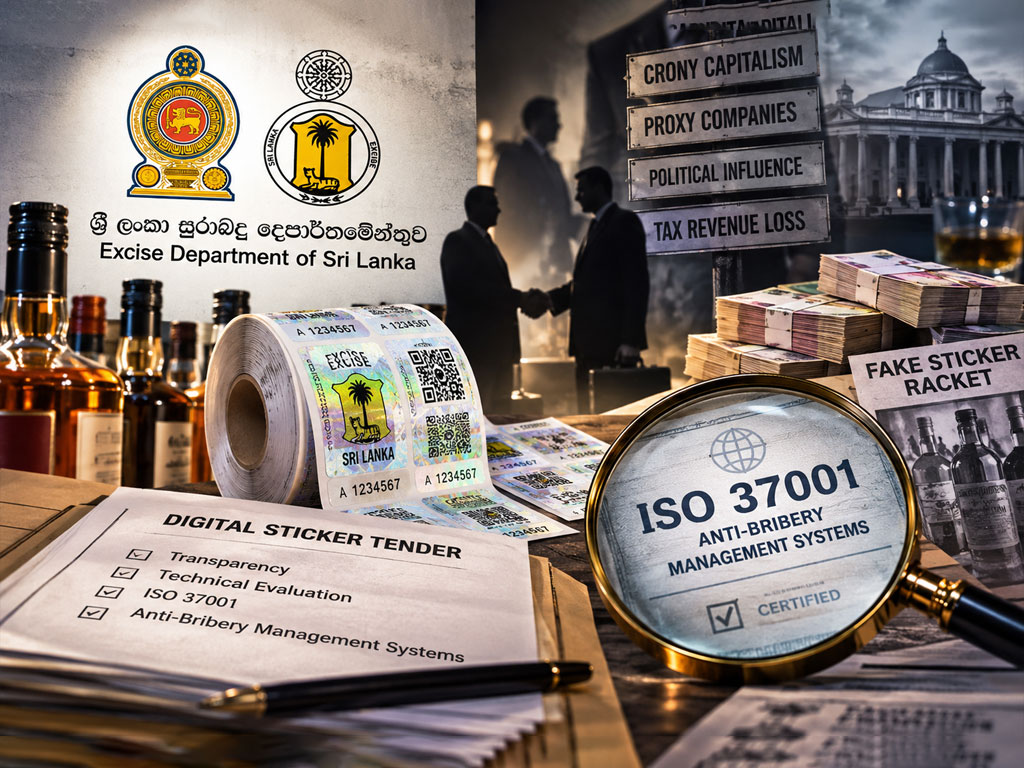
Liquor tax sticker tender faces scrutiny over ISO 37001, alleged proxy companies and claims that anti-bribery safeguards could favour bidders.
The liquor tax sticker tender recently revised by the Sri Lanka Excise Department may, at first glance, appear to strengthen transparency in liquor production.
Known as the Digital Sticker Tender, it covers the digital security feature management system used for liquor production. One notable feature is the decision to award additional technical evaluation marks to companies holding ISO 37001 Anti-Bribery Management Systems certification.
On paper, that appears to strengthen safeguards against bribery. However, this commentary questions whether the certification requirement could instead help conceal what it alleges is a wider exercise in crony capitalism within state procurement.
The allegations and suspicions raised here require independent verification. They should not be interpreted as established findings of corruption against any company or individual.

Liquor Tax Sticker Tender and Alleged Proxy Companies
The company that implemented the previous liquor tax sticker tender faced serious allegations concerning its operations. Questions were raised by the Excise Department, Parliament’s COPA Committee and the executive.
This commentary argues that companies linked to the previous process are again competing for the latest tender.
More seriously, it alleges that another “proxy” company connected to the same interests has also submitted a bid. According to the argument presented, such an arrangement could provide an alternative if legal or administrative problems emerge over previous allegations.
Against that background, the introduction of ISO 37001 into the evaluation process raises further questions.
If only two current applicants hold the ISO 37001 certification that attracts additional marks, the commentary asks whether those bonus points could effectively favour a narrow group of bidders.
It also recalls that senior Excise Department officials had previously asked the President to temporarily remove ISO 37001 as a mandatory requirement.
The certificate may no longer operate as an absolute requirement. However, the commentary questions why it now attracts additional technical marks and whether that could influence the outcome.
These questions, however, do not by themselves establish manipulation of the tender or wrongdoing by ISO-certified bidders.
Anti-Bribery Certification as an ‘Ideological Fantasy’
The commentary then examines the tender through a psychoanalytic interpretation.
From this perspective, ISO 37001 is presented not simply as a technical transparency mechanism but as an “ideological fantasy” that could conceal what the author describes as the existing corrupt reality, or “The Real.”
The argument is that society may recognize possible corruption within a process while behaving as though that corruption does not exist.
Under this interpretation, ISO 37001 becomes a “Fetish” object. The implied reasoning is: “We know that this tender process is a highly politicized and corrupt one, but since there is an international anti-bribery certificate for it, we are willing to be deceived by that transparency.”
The commentary describes this as a symbolic cover capable of misleading the public.
It similarly presents the ISO standard and relevant international institutions as the “Big Other.”
According to this interpretation, officials could distance themselves from responsibility by arguing: “It was not we who decided; the tender was given to those who have the international certificate.”
The author’s argument is that corruption occurring at an individual level could then become obscured within an institutional and structural process through the very certification intended to combat bribery.
Aravinda de Silva and the Battle for the Tender
The commentary also points to the people allegedly interested in the tender to examine what it describes as the capitalist dynamics surrounding the process.
It specifically names former Sri Lankan cricketer Aravinda de Silva, whose name the article says was recently connected to a controversial incident, and claims he is among those making a major effort to secure the tender.
The article provides no evidence establishing wrongdoing by de Silva, and his alleged interest in the tender does not itself demonstrate improper conduct.
Why, then, are so many parties interested?
According to the commentary, the attraction does not lie simply in the direct profits available from printing tax stickers.
Instead, it claims the greater financial opportunity could emerge through what it describes as “residual/illicit trade,” including fake stickers and influence over the liquor market after securing control of sticker printing.
The commentary argues that such abuse could ultimately deprive the state of billions of rupees in tax revenue.
However, these claims concerning fake stickers, market control, proxy bidders and potential revenue losses remain allegations within the supplied commentary rather than proven findings against any particular bidder.
The central question therefore goes beyond whether an international anti-bribery certification appears in a tender document. It is whether procurement safeguards genuinely produce competition, transparency and accountability in practice.
For the author, the liquor tax sticker tender is more than a procurement exercise or a piece of paper attached to a bottle. It is presented as a mirror of how crony capitalism can operate in Sri Lanka.
The commentary concludes that only greater public scrutiny can expose what may exist behind the symbolic protections offered by certification and other institutional safeguards.