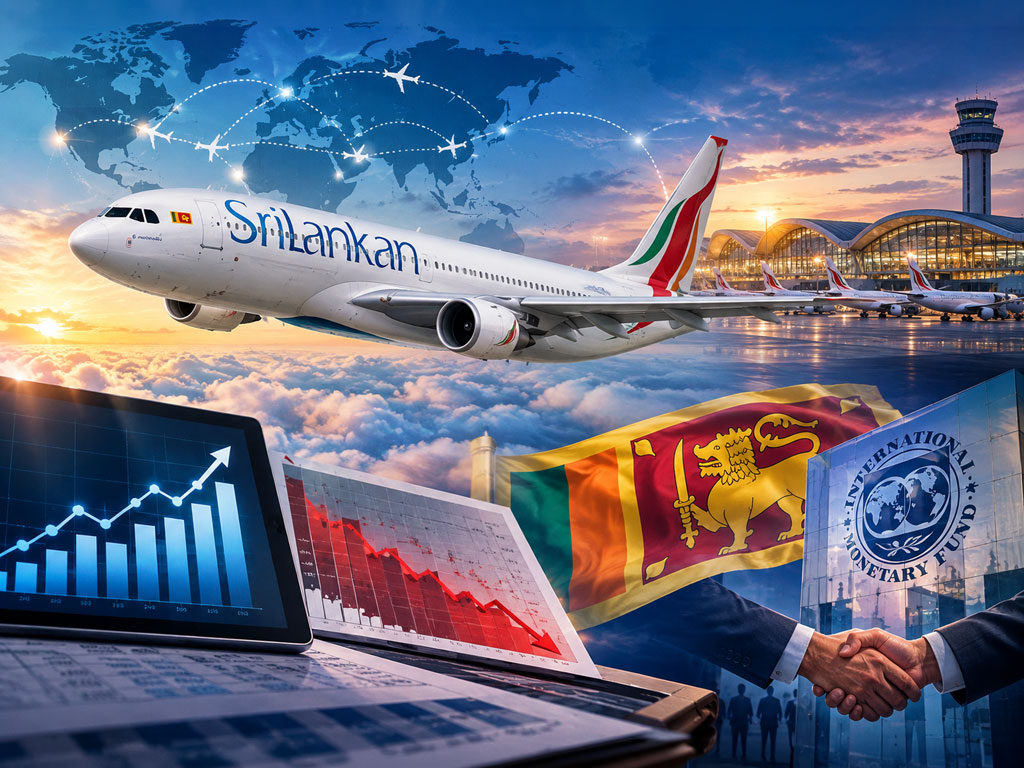
SriLankan Airlines restructuring is back in focus as revenue improves, legacy losses persist and Transwell proposes a private-led turnaround.
COLOMBO — SriLankan Airlines’ improving operating performance has not erased the financial damage accumulated over decades, leaving the national carrier confronting legacy losses running into hundreds of billions of rupees as the Government weighs its long-term restructuring options.
The financial picture is more complicated than the airline’s rising revenue alone suggests.
SriLankan has rebuilt traffic and strengthened operations following the severe disruption caused by the pandemic and Sri Lanka’s economic crisis. Yet its balance sheet continues to carry the consequences of years of accumulated losses, debt and negative equity.
Audited accounts for the year ended March 31, 2025 show that SriLankan Airlines Limited recorded accumulated losses of Rs. 616.31 billion, while accumulated losses at group level stood at Rs. 596.46 billion.
The company also reported negative equity of Rs. 403.17 billion, with current liabilities exceeding current assets by Rs. 368.30 billion.
Those figures illustrate the central challenge confronting the airline: stronger commercial performance does not automatically eliminate liabilities built up over many years.
Against that backdrop, a Hong Kong-based private equity company, Transwell Corporation Limited, has submitted a proposal for an investor-led restructuring of SriLankan Airlines, setting out a 24-to-36-month turnaround programme intended to remove future financing requirements from the Treasury.

Revenue Recovery Meets a Damaged Balance Sheet
The source material for this article cites operating revenue exceeding Rs. 333 billion and an operating profit above Rs. 26 billion, alongside passenger growth of 13%.
Those figures indicate an improvement in the carrier’s underlying commercial activity, but they should not be confused with the airline’s accumulated financial position.
Revenue measures money generated from operations. Operating profit reflects earnings after operating expenses but before some financing and other costs. Accumulated losses, by contrast, represent the cumulative financial outcome carried on the balance sheet from previous years.
An airline can therefore produce substantial revenue, or even an operating profit in a particular period, while remaining financially weakened by historic losses and debt.
SriLankan’s audited 2024/25 accounts illustrate that distinction.
At group level, the airline recorded a net loss of Rs. 2.74 billion for the year, compared with a Rs. 7.93 billion profit a year earlier.
For SriLankan Airlines Limited itself, the net loss was Rs. 7.59 billion, compared with a profit of Rs. 3.87 billion in the previous financial year.
The Auditor General highlighted a material uncertainty related to the group’s ability to continue as a going concern, drawing attention to accumulated losses, negative equity and the extent to which current liabilities exceeded current assets.

Can Acting CEO Vipul Misra Resurrect SriLankan Airlines From Its Shallow Slumber?
COLOMBO – Vipul Misra has inherited far more than the title of Acting Chief Executive Officer of SriLankan Airlines. He has inherited an airline burdened by years of financial strain, fleet limitations, operational disruption, political interference allegations, strong trade union influence and the enormous expectations attached to carrying the national flag.
Read MoreLegacy Debt Remains Central to Restructuring
Debt has long complicated attempts to restore SriLankan to sustainable profitability.
The source material cites annual interest expenditure of approximately Rs. 24 billion. That figure requires confirmation against the relevant audited financial period before being treated as the airline’s current annual financing cost.
What is clear is that resolving SriLankan’s legacy debt remains part of the Government’s broader reform programme.
In March 2026, the airline completed the restructuring of its US$175 million international bond. The IMF subsequently described the transaction as notable progress in Sri Lanka’s wider debt restructuring process.
The Government has also committed to implementing a medium-term strategic plan intended to restore SriLankan’s operational viability.
That makes the airline’s future more than a question of increasing passenger numbers or improving route revenue. Management must also contend with financing costs, aircraft availability, fleet investment, operating efficiency and liabilities inherited from previous years.
Allegations Over Ticket Commissions Disputed by Airline
Separate allegations have been made about commissions connected with tickets sold through SriLankan’s Internet Booking Engine.
Reports based on claims by a former senior employee alleged that commissions were being paid to General Sales Agents in some overseas markets even where customers purchased tickets through the airline’s online booking channel.
Those allegations should not be presented as established financial leakage.
SriLankan Airlines has publicly disputed the claims.
In a right-of-reply issued in April, the carrier said General Sales Agents provide local sales infrastructure and human-resource support in markets where the airline does not maintain a direct office. According to SriLankan, their responsibilities can include sales generated through the Internet Booking Engine.
The airline described claims made in the earlier report as misleading and provided its explanation for the commission structure.
No material reviewed for this article establishes that the commission arrangements constitute corruption, fraud or an unlawful diversion of airline revenue.
Any determination that such payments were improper would require evidence from an audit, investigation or other competent authority examining the contractual arrangements and payments involved.
Airbus Case Remains Part of Airline’s Troubled History
SriLankan’s governance record has also been overshadowed by the long-running Airbus affair.
Investigations into aircraft procurement have generated criminal proceedings and allegations involving payments connected with the airline’s acquisition of Airbus aircraft.
Those matters remain distinct from the airline’s present commercial performance and from the Transwell proposal.
They nevertheless form part of the historical governance context in which current restructuring efforts are being assessed.
The central challenge for any future ownership or management model will therefore extend beyond injecting capital. Strong procurement controls, transparent commercial arrangements and effective corporate governance will also be required if the airline is to avoid repeating earlier failures.
IMF Programme Increases Pressure for SOE Reform
Sri Lanka’s IMF-supported economic programme has added urgency to the restructuring of state-owned enterprises.
It would, however, be inaccurate to say that the IMF programme has “completely deprived” the Government of the ability to provide financial support to SriLankan Airlines.
The Government has continued dealing with the airline’s legacy obligations while pursuing reforms intended to reduce future fiscal risks.
IMF documents state that the authorities are implementing a medium-term strategic plan to restore SriLankan’s operational viability.
The programme also places broader emphasis on stronger SOE governance, financial transparency, fiscal discipline and accountability through measurable performance targets.
In its September assessment, IMF staff again stressed the importance of prudent policies and reforms to preserve fiscal and external stability.
For SriLankan, that environment makes an indefinite dependence on Treasury support increasingly difficult to reconcile with the Government’s wider fiscal objectives.
Transwell Proposes Private-Led Turnaround
Transwell Corporation Limited entered the debate in August with a proposal for a private investor-led turnaround.
The Hong Kong-based private equity firm proposed a roadmap aimed at achieving sustainable profitability within 24 to 36 months.
According to details reported when the proposal was submitted, the plan seeks to shift future financial liabilities away from the Treasury while maintaining SriLankan as a commercially viable national carrier.
Among its reported features is a strict performance-based approach to network expansion.
New routes would be assessed against commercial targets within a defined period rather than maintained indefinitely regardless of performance.
The source material describes a 180-day benchmark, under which newly introduced routes would be expected to demonstrate profitability within six months or face cancellation.
Another component envisages the State retaining a strategic equity interest, allowing the Government to preserve a role in the airline for national and emergency requirements.
The proposal should not be confused with an approved privatisation agreement.
It is an investor proposal and would require Government evaluation, due diligence and agreement before any of its terms could become binding.
The Real Test Is What SriLankan Keeps
SriLankan’s improving revenue performance changes the restructuring debate but does not resolve it.
A carrier capable of generating hundreds of billions of rupees in annual revenue has considerable commercial value. Yet revenue alone does not determine whether the business is financially sustainable.
Aircraft costs, financing, fuel, labour, maintenance, distribution, network efficiency and legacy liabilities all determine how much revenue ultimately translates into sustainable profit and cash flow.
That is why scrutiny of commercial expenditure matters.
If allegations of unnecessary commissions or other financial leakages are substantiated, eliminating them could improve margins without requiring additional passenger growth. If the payments are contractually justified and commercially beneficial, the airline should be able to demonstrate that through transparent records and measurable results.
The same principle applies to routes.
A purely commercial airline cannot indefinitely operate services that consistently destroy value. A national carrier, however, may also be expected to serve strategic, tourism or connectivity objectives that cannot always be measured through route-level profit alone.
Any restructuring plan will therefore have to establish where that balance lies and who bears the cost when national policy objectives conflict with commercial returns.
Restructuring Decision Still Belongs to Government
Transwell’s proposal offers one possible model, but it does not settle the future of SriLankan Airlines.
The Government must determine whether private capital, a strategic partnership, continued state ownership or another restructuring structure provides the most sustainable outcome.
That assessment should include the value of the airline’s assets and network, its debt position, future fleet requirements, employee obligations and the strategic importance of maintaining international connectivity.
SriLankan’s recent performance provides evidence that the airline can generate substantial commercial activity.
Its balance sheet provides equally strong evidence of how difficult the legacy problem remains.
The decisive question is therefore no longer simply whether SriLankan can generate revenue. It is whether the airline can convert that revenue into sustainable profitability while preventing debt, financing costs, inefficient expenditure and weak governance from consuming the gains.
Until the Government completes its evaluation of the airline’s restructuring options, including the Transwell proposal, that remains the central test facing SriLankan’s next chapter.