By Roshan Jayasinghe
An Observation on Money, Measure and a Dignified Human Life
There is a memory I return to often from my younger years travelling through rural Sri Lanka, long before I understood anything about economies, when the people of a village would come out on a weekend morning with mammoties and woven baskets to mend a stretch of road that the rains had broken and that no office in Colombo had yet found the money to repair, and the work would go on through the heat of the day with tea passed hand to hand and children carrying small stones beside their fathers, and at the end of it nobody was paid and nobody had expected to be, because the road belonged to the people who walked it and the need was reason enough. We called it Shramadana, the giving of one’s labour, and I have come to think that what I was watching then was a small and temporary economy working perfectly well without a single coin passing between anyone, held together by the plain understanding that the wellbeing of the people around us was the whole point of the effort.

I do not tell this to suggest that we can run a nation on goodwill and borrowed tools, because we cannot, and a village road is not a hospital or a power grid or a harvest that must feed millions. I tell it because it reminds me of something we seem to have misplaced over the centuries, which is that money was never meant to be the point. It was a tool we made, a useful one, allowing value to move between people who may never know one another and who may not need what the other directly has to offer, so that work, skill, produce and service can be carried across distance and time and through many different forms of exchange. At its root money is a human agreement, a way of recording value and trust so that what one person contributes can be returned in another form by someone else, and its usefulness lies in making exchange among us easier.
Somewhere along the long road of our history the tool began to hold the hand that made it. Those entrusted with issuing, managing and guarding it discovered that it could be used not only to ease exchange but to gather, and what was gathered could become influence, and influence could shape the rules under which the next gathering took place. I have written before about how service becomes status, how a title that once described a duty can slowly come to describe a person’s importance, and I see the same drift in public office. We elect our leaders to serve us, yet across many nations and many generations the arrangement can quietly reverse itself, so that the people chosen to take responsibility for the population begin to be elevated by the very system they were placed there to steward.
What troubles me most is not that some individuals are greedy, since greed is an old human companion and no arrangement will ever remove it entirely. What troubles me is the way the constructs surrounding money, supply and demand, markets and regulation, debt, ownership and public finance, can be presented to ordinary people as though they were weather, natural forces that simply happen to us and must be endured, rather than human arrangements created for reasons people once believed useful and which can still be examined by the people living inside them. When a family cannot afford to see a doctor and the explanation ends with the words that is the economy, the phrase can arrive with such weight that it closes the conversation rather than opening the more important question of what the economy was meant to accomplish for the human beings living within it.
I have begun to notice how much of what fills our days exists to keep that machinery turning rather than to make anyone’s life fuller. We are invited to want things we did not know we lacked, goods are sometimes replaced before their usefulness is exhausted, and new services appear to solve inconveniences created by earlier layers of consumption, so that enormous amounts of human effort can be directed toward producing more because more itself has become the expected result. We then measure success by whether the numbers are larger than they were the year before, growth becomes progress almost automatically, and I find myself asking whether a life spent constantly feeding demand, including demand deliberately created for us, is necessarily the same thing as human advancement.
I see this from inside my own working life. I work in the car wash industry among people who take real pride in their craft, and the commercial logic is straightforward, which is to wash more cars this year than last. Membership programs encourage customers to return frequently, budgets rise on the expectation of greater volume, and success is naturally measured by cars washed and revenue produced. There is nothing wrong with wanting a clean and protected vehicle, and modern washes can reclaim water and use resources far more efficiently than before, but every additional wash still requires water, energy, equipment and human time, and I have begun to wonder at what point the added human benefit grows smaller while the consumption continues. A car that is already clean can pass through the tunnel again and the transaction still counts as success, because another wash has been added to the total, even when its practical benefit is far smaller than it was the first time.
The same question appears in food. Human beings need nourishment, but commercial success depends on continuing to sell more of it, and so in some parts of the world enormous effort goes into encouraging consumption beyond nutritional need while elsewhere people remain unable to obtain enough. Food has value far beyond calories, because it carries enjoyment, family, culture, hospitality and celebration, and I would not want to strip any of that from human life, yet there is still a point worth examining where additional consumption brings less human benefit while requiring more production, transport, packaging, labour and natural resources. The existence of excess in one place does not mean that wasted food could simply be carried across the world and handed to someone who is hungry, because poverty, conflict, infrastructure, local markets and governance all stand between production and access. The contradiction remains, however, that we have built systems capable of encouraging excess consumption in one population while failing to secure enough for another.
This has made me realise that the economy and the human being are sometimes counting different things, since the economy measures transactions while human life experiences consequences. A second or third purchase raises the economic number even as the human benefit it brings grows smaller, and if those two measures keep moving apart, then I think the Human Continuum has reason to stop and ask what exactly we have begun calling progress.
The deeper trouble, I think, lies in what we have agreed to count. We measure a nation’s wealth largely through money, and so a country can be described as poor even when its people live among fertile land and rivers and forests, among skilled hands and inherited knowledge and families who would give their last meal to a guest, because much of that does not register clearly on the scale we have decided matters most. The greatest wealth of any nation has always seemed to me to be its people and the living ground beneath them, and a dignified human life was never meant to be measured only by how much a person can collect. It is closer to having enough to eat and a safe place to sleep, care when the body fails, meaningful work, the ability to raise a family with security, and time enough to be with the people we love before our own turn is over.
The same question reaches into how we treat the earth itself. A person may hold an enormous area of land because a legal and economic arrangement has made that ownership possible, though the land was not created by the money used to purchase it and neither was the human being whose name appears on the title. I have stood on enough open ground on long rides to feel how strange that arrangement can seem when you look at it plainly, since the land existed long before the title, the currency and the person named on the document. That does not automatically make ownership wrong, because ownership can bring responsibility, protection, investment and care, but it does make ownership another human construct worth examining by what it enables, what it protects and what consequences it creates for everyone else.
A million acres was never among the necessities of a human life, and when one person can control such an expanse while many others have nowhere secure to live, I find myself wanting to examine the human arrangements that made those two conditions possible at the same time. Human beings will never live identical lives, make identical choices, take identical risks or produce identical results, and difference itself is not my concern. What interests me is the point where difference becomes domination, or where one person’s accumulation comes to sit comfortably beside another person’s deprivation without the arrangement ever requiring us to question it.
We are often told that poverty is one of the old conditions of human life from which modern economic systems have gradually been rescuing people, and there is truth in the fact that hunger, disease and hardship existed long before modern money or markets. Scarcity itself is also real, since land in certain places is limited, water can be scarce, and energy, medicine, skilled labour, materials and infrastructure cannot always be produced immediately or without limit, while drought, war, disease and natural disasters can create very real shortages. I do not want to erase those realities simply because I am questioning the systems surrounding them.
Yet modern deprivation cannot always be explained by physical absence alone. In 2022, according to United Nations estimates, more than a billion tonnes of food were wasted at household, food service and retail level, close to a fifth of the food available to consumers, while hundreds of millions of people were living with hunger. That does not prove that scarcity itself is artificial, but it does show that deprivation cannot always be explained by saying that humanity has not produced enough, because distribution, purchasing power, waste, conflict, infrastructure and the priorities built into our economic arrangements also decide who actually reaches what has been produced.
The same human capacity that carried us from the earliest shelters to medicine, engineering, global transport, communication and now intelligent machines has enormously expanded what we are able to produce and coordinate. That does not mean everything can be made unlimited, but it does mean that our ability to provide a dignified human life is not what it was thousands of years ago, and when suffering exists beside that capacity, I think it is reasonable to ask whether the difficulty lies only in what the earth can provide or partly in the systems through which we decide who receives what has already been produced.
Consider what we call work. A person rises before dawn and gives some of the best hours of the day to producing something of value, and part of that value rightly pays for wages, equipment, investment, risk, management and everything else that allowed the work to happen. Part of it can also accumulate as profit and ownership, and when accumulation becomes large enough it can purchase influence over the conditions under which future work takes place. What interests me is not whether somebody should profit from creating something useful, but the moment when economic reward begins converting itself into power over the people whose work helped create it.
There is another part of this that I am beginning to see more clearly. Human time is itself one of our resources, perhaps the one we notice least because we cannot put it back once it has been spent. If technology allows something that once took eight hours to be accomplished in two, then from a human point of view we have recovered six hours of life, yet inside an arrangement where survival depends heavily on selling our time, those six hours can appear not as progress but as unemployment. The machine has become more efficient and the work requires less human effort, and still the person may become less secure, because the economic system does not necessarily know how to recognise liberated human time as wealth. Those six hours could become time to raise our children and care for our parents, to learn and look after our bodies, to create something or help another person, or simply to sit quietly enough to understand ourselves, and I can think of few better measures of whether our advancement has actually reached the human being.
I am not suggesting that human beings should stop working or that everything beyond bare necessity is waste, because beauty, recreation, craftsmanship, travel, music, sport, good food and invention are part of what makes human life worth living. The question I am asking is different. Before we celebrate how much more we have produced, perhaps we should ask what human benefit the additional production created, what natural resources and human time it required, and whether the life of the human being became meaningfully better because of it. Productivity by itself tells us that we have become better at producing something, but it does not tell us whether producing more of that thing improves human life, and so a human system should ask not only whether an activity creates value but whether the additional value justifies the human time and natural resources required to create it.
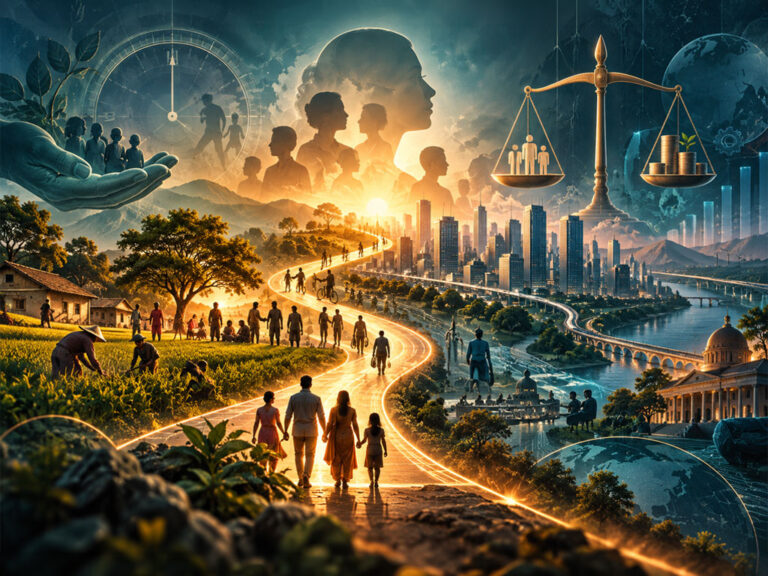
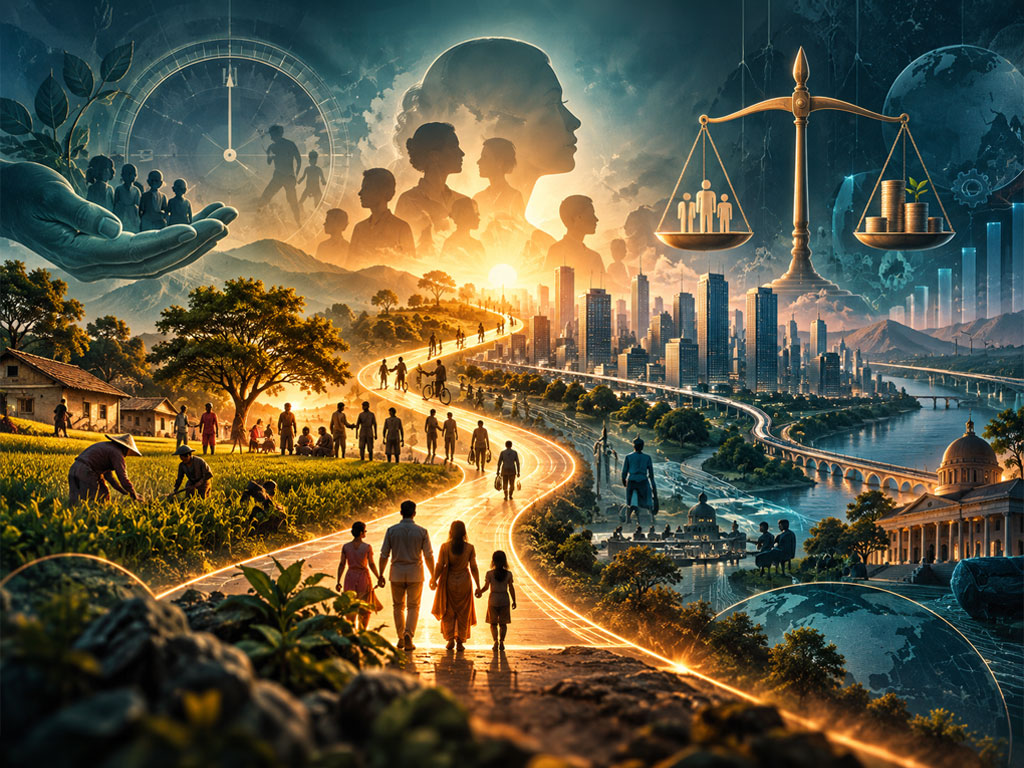
I keep returning to a simple image of a scale. On one side I place human beings and on the other the worth of a human life, and in a just arrangement I would expect those sides to come to rest somewhere close to balance, each person carrying the same basic human worth even though their possessions, abilities, ambitions and circumstances may be entirely different. What troubles me about much of the world we have built is how easily accumulated wealth can begin carrying more practical weight than the human being standing beside it, since money can buy access, influence, legal representation, land, education, healthcare, political attention and time itself, while someone with little of it can possess exactly the same human worth and still find almost every door harder to open.
The scale of present inequality makes that question difficult for me to ignore. The World Inequality Report 2026 finds that the richest tenth of the world holds roughly three quarters of personal wealth while the poorer half shares around two percent, and that fewer than sixty thousand people now hold about three times the wealth of the poorest half of humanity combined. I do not read those figures as proof that every wealthy person has done something wrong. I read them as a reason to examine what happens when economic difference becomes large enough to produce completely different levels of influence over the same human world.
That is where the measure begins to trouble me, not because every person must own the same amount, or because effort should go unrewarded, or because invention, risk and achievement should disappear, but because I do not think human worth and financial worth should ever be confused as though they were the same measurement. A dignified human life does not require a person to be more powerful than everyone around them. It requires enough security to live without constant fear of falling through the floor, with shelter, food, care, education, some meaningful way of contributing and some reasonable freedom to shape one’s own life, and beyond that people will still build different things, pursue different ambitions and live differently from one another, which I see nothing wrong in. The question is whether difference must require deprivation, and I think humanity has accepted that it must far too easily.
I am not writing against any person, and I do not imagine that everyone who helped build our economic systems was driven by bad intent. Most human systems were created because people were trying to solve real problems with the knowledge available to them at the time. Markets solve certain problems remarkably well, property can protect responsibility and encourage investment, laws can protect people from arbitrary power, governments can coordinate responsibilities far beyond what individuals can manage separately, and money allows enormous amounts of exchange to happen between strangers. Their usefulness is not what I am questioning. What I am questioning is the belief that usefulness makes a construct permanent or places it beyond examination, because a belief can become so old and so widely shared that we stop recognising it as a belief at all.
We have changed deeply established arrangements before. Forms of slavery that were once defended within law and commerce came to be prohibited, even though exploitation and modern forms of slavery have still not disappeared, and working people fought over generations to establish limits on working hours where extraordinarily long days had once been treated as normal. In my own country, Sri Lanka’s Land Reform Law of 1972 placed ceilings on agricultural landholding, twenty-five acres where a holding consisted only of paddy land and fifty acres otherwise, an attempt, whatever one thinks of how it was carried out, to reconsider how much agricultural land should remain concentrated under one owner. Bhutan has deliberately developed Gross National Happiness as a broader measure of development, and New Zealand’s 2019 Wellbeing Budget explicitly tried to judge government priorities through social and environmental wellbeing alongside conventional economic measures. None of these examples gives us a finished answer, and their value to me is simpler, since they show that human arrangements which once appeared permanent have been examined and altered, and that the alterations themselves must then remain open to examination.
I once wondered whether money itself could simply be issued in some agreed relationship to population, because if government creates and recognises the currency, then perhaps each human being should begin with some basic claim upon the system into which they are born. I still find the thought worth examining, but I no longer think the important question is how much money should be printed, because money only represents access to what human beings actually make, grow, build and provide, and a number placed in someone’s account cannot substitute for a house that does not exist, food that has not been grown or medical care with no one available to provide it.
The deeper question is whether every nation should recognise a measurable human threshold beneath which none of its people are allowed to fall, and whether every human being should enter the economic arrangement with some minimum claim upon the society whose laws, institutions and resources govern their life. That claim might be met through money or through services, through healthcare, housing, education and infrastructure, or through some combination we have not yet properly designed, and the mechanism should remain open to evidence and correction. The principle beneath it is what matters to me, which is that no person should be treated as economically disposable inside a society whose authority ultimately comes from its people, and that before a society allows its shared means to accumulate without limit elsewhere, it has a responsibility to ask whether those people are able to live with basic dignity.
That brings me back to government. When I remove the ceremony surrounding political office and look at what has actually happened, I see human beings temporarily transferring certain authority to another human being, because some responsibilities cannot reasonably be managed by millions of people individually, and roads must be built, public safety organised, laws administered, agreements made, and resources and institutions kept working. That authority did not fall from the sky but was delegated, and so the people we elect are not our rulers but our appointed caretakers, holding something that belongs collectively to those who entrusted them with it. The office is not personally theirs, and neither is the country, the treasury or the institutions they manage, and even the authority they exercise is held only for a time, on behalf of those who granted it. Seen that way, public office becomes less about status and much more about responsibility, and the greater the authority entrusted to someone, the greater their obligation to show what was done with it and whom it served.
That is another place where the tool can become the master. Political office can begin as service and slowly become status, and status can open access, which turns into influence, which turns into wealth that in turn reinforces the influence, until the person entrusted with serving the population has become separated from the conditions under which most of that population actually lives. I do not think the answer is simply to replace one group with another, because the machinery can shape whoever enters it.
Nature has always carried destruction within its creativity. The same warm seas that feed the rains can gather into hurricanes, and the rivers that make land fertile can rise and take it back, and our histories are full of storms, droughts, earthquakes and floods that came without human intent. What sets us apart is that we have learned to observe them. We learned to watch the sky and track a gathering storm, to build differently, to warn one another and to move people out of danger, and over generations we have saved lives because observation became knowledge and knowledge became action.
The storms we create for ourselves are of another kind, because greed and the hunger for power carry intention, and the rules we design and the economic arrangements we maintain carry consequences. When we can see those consequences forming and continue walking toward them simply because the arrangement has become familiar, our responsibility is different from the one we carry toward a hurricane, since a hurricane cannot reconsider itself and we can. That is why every safeguard we build against our own destructive tendencies has to remain under examination, because laws can weaken, institutions can be captured, good intentions can harden into privileges, and a protection established by one generation can be quietly dismantled by the next. Like a levee or a warning system, our human safeguards have to be maintained, tested and repaired, because the older patterns do not disappear merely because we recognised them once.
This is where the Human Continuum becomes important to me, because if something was created by human thought, then human thought should remain capable of examining it, and that applies not only to people but to the structures we live inside, to money and government, ownership and work, debt and law, education, markets, institutions and technology. None of these should be protected merely because earlier generations handed them to us, and none should be destroyed simply because it is imperfect. Each can be examined by its purpose and its consequence, by asking what human necessity caused us to create it, what useful work it still performs, where it has moved away from that purpose, who benefits from leaving its consequences untouched and who pays for them, and what can be changed while preserving what remains useful. Where the purpose was sound it can be kept, where power has gathered in the place responsibility was meant to stand the imbalance can be corrected, and whatever replaces an old arrangement must then face exactly the same discipline rather than being protected simply because it is new.
This is the same discipline I have been trying to apply to myself. I do not want an idea to remain in the Living Human Manual simply because I once believed it, but because it still survives examination, and if better information corrects it, then the correction should become part of the Manual rather than a threat to it. I increasingly feel that our larger human constructs deserve the same treatment, so that no system continues unchanged just because our grandparents lived under it, and no measure goes on deciding human worth only because we have grown used to reading it. We should never become subordinate to a construct we created to serve us without periodically asking whether it still serves the human purpose that justified creating it.
I think again of that road and the mud drying on our feet in the late afternoon, and of how nobody there needed to be told what the work was for, because everyone could see the people who would walk on it the next morning. No one became more human for carrying more stones or less human for carrying fewer, because there was work to be done and its purpose remained visible all day. Perhaps that visibility is what we lose when our societies grow so large that the people making decisions no longer see the faces of those who live with the results, and perhaps the answer is not to abandon everything we have built but to make the purpose visible again, so that of every budget, law, market, institution and business we can ask what we once could have asked standing beside that village road, whom it is for, whether it is truly serving that need, how much human time and natural resource it costs, and what prevents us from correcting it if the purpose and the result have moved apart.
I do not know what the final economic arrangement of humanity should look like, and I would distrust myself if I claimed that I did. What I do know is that money, government, markets, laws, ownership and institutions are all things we made, and however useful they have become, none of them arrived before the human being. The human being came first, and if we ever reach the point where the tool matters more than the person it was created to serve, then I think we should have enough human understanding to put the tool back in our hands.
Author’s Note
I write this observation without claiming an economic solution or asking another person to accept my conclusion. I am trying to remain conscious of the difference between questioning something and believing that I have already solved it. The Human Continuum, as I am developing it, requires me to keep my own thoughts available for the same examination I am asking of the systems around me. If evidence shows that part of what I see is incomplete, then I want the understanding to change rather than protect the words I have already written. My concern is not to arrive at a position and defend it. It is to continue looking for the point where human knowledge, human capability and human intention can meet with enough clarity that what we build serves life rather than requiring life to serve what we have built.