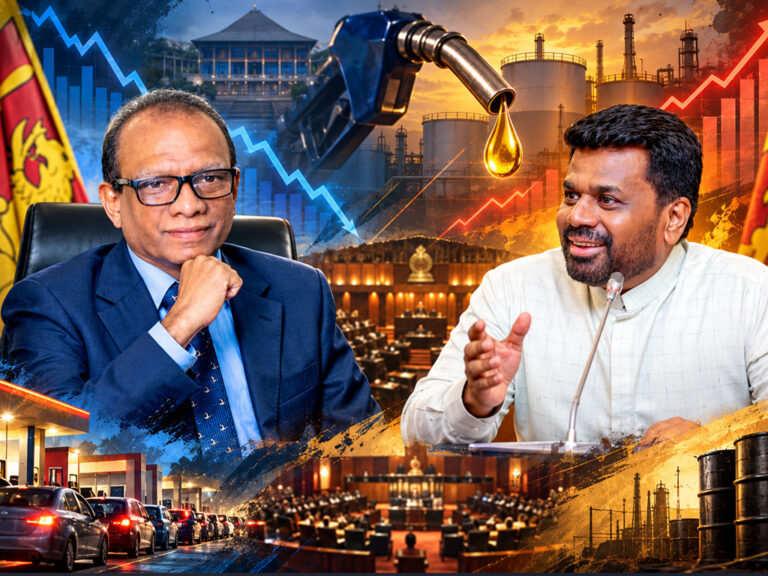
COLOMBO, October 19, 2026 — Energy Minister Anura Karunathilaka has clarified that private fuel suppliers cannot increase prices without complying with the Government’s pricing mechanism, days after President Anura Kumara Dissanayake challenged their pricing demands and pledged to expand the Ceylon Petroleum Corporation’s retail network.
Energy Minister Anura Karunathilaka has clarified that private fuel suppliers cannot increase prices at will, following President Anura Kumara Dissanayake’s criticism of pricing practices and supply restrictions in Sri Lanka’s petroleum market.
The Minister’s latest explanation, published in an interview with The Sunday Morning on October 18, has drawn attention to apparent differences between his earlier defence of private operators’ contractual pricing rights and the President’s insistence that consumers must be protected from excessive increases.
One private supplier has calculated that diesel would need to be sold at approximately Rs. 570 per litre to recover its costs, nearly Rs. 180 above the prevailing domestic price of approximately Rs. 392.
Karunathilaka acknowledged the financial pressures facing private suppliers but maintained that any price revision must comply with the fuel pricing mechanism introduced in 2022.
The clarification follows the President’s announcement that the Government intends to establish 75 additional Ceylon Petroleum Corporation (CPC) filling stations in areas where consumers have limited alternatives to privately operated outlets.
Together, the developments expose a policy challenge facing the administration: how to preserve competition and attract private investment while preventing supply disruptions and shielding consumers from steep fuel price increases.

Minister’s Earlier Position on Private Pricing Rights
The dispute has developed against the backdrop of rising international petroleum prices and mounting complaints from private distributors about the profitability of supplying fuel at prevailing domestic rates.
Operators including Lanka IOC, Sinopec and RM Parks, which operates in association with Shell, have sought greater flexibility to recover their import and operating costs.
Karunathilaka previously defended the pricing rights provided to private fuel companies under existing contractual arrangements.
His remarks, including those made during discussions involving container transport operators, prompted criticism that the Government was allowing private suppliers excessive freedom to determine retail prices.
The original commentary argues that such an approach would leave consumers exposed to substantially higher prices while requiring the CPC to absorb the financial burden of keeping fuel affordable.
That criticism reflects a legitimate concern about unequal pricing conditions. However, the existence of contractual pricing rights does not establish that the Minister authorised unlimited price increases or acted on behalf of private companies.
The precise scope of those rights depends on the agreements signed with operators and the applicable regulatory framework.
Recent reporting indicates that private suppliers have also complained of losses, creating a dispute involving both consumer protection and the financial sustainability of fuel distribution.
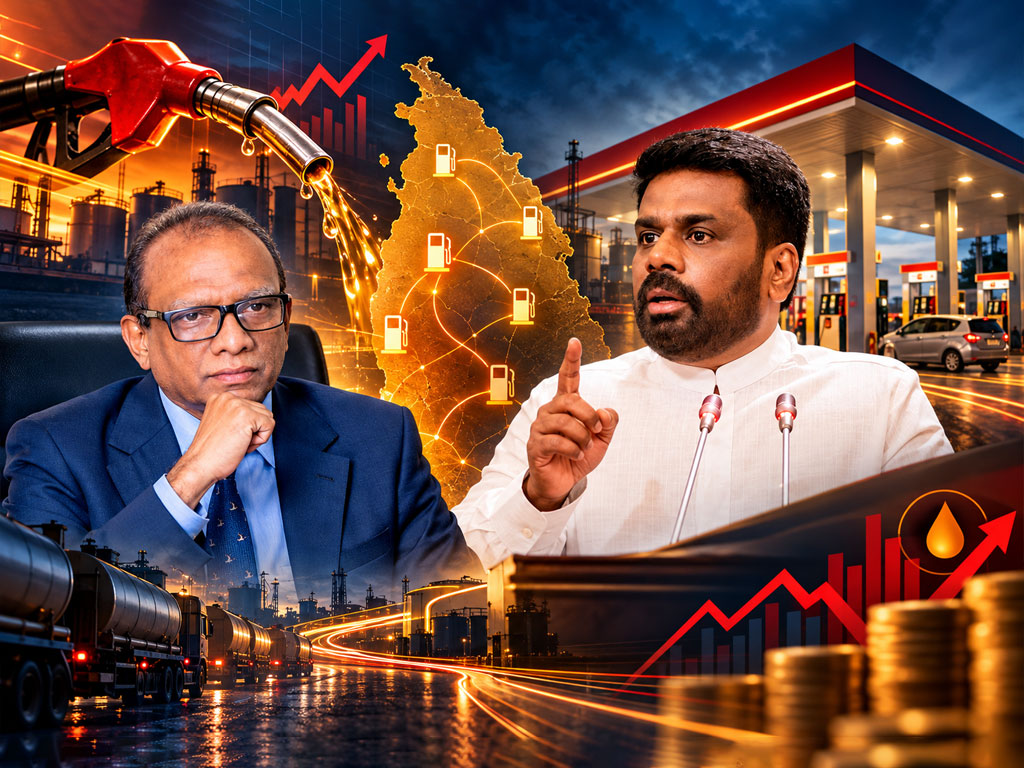
President Anura Kumara Dissanayake has challenged private fuel suppliers over pricing demands and distribution restrictions, while Energy Minister Anura Karunathilaka maintains that existing agreements allow those companies to set their own prices. The Government now faces questions over how it intends to reconcile contractual obligations with consumer protection.
Read MorePresident Challenges Rs. 132 Diesel Price Increase
President Dissanayake publicly challenged private fuel suppliers after some operators reportedly sought diesel price increases of between Rs. 116 and Rs. 132 per litre.
During public remarks in October, he argued that competition should provide consumers with better choices rather than expose them to substantially higher prices or unreliable supplies.
The President drew attention to communities heavily dependent on private filling stations, including areas such as Dehiattakandiya, where motorists may have fewer opportunities to purchase fuel from the CPC.
His response included a commitment to establish 75 additional CPC filling stations, particularly in locations where privately operated outlets dominate.
The proposed expansion is intended to provide motorists with a State-owned alternative when private suppliers restrict distribution or seek higher prices.
Dissanayake also announced plans to revise agreements signed with private petroleum companies under previous administrations.
He argued that certain contractual provisions had limited the Government’s ability to intervene effectively when suppliers reduced deliveries or failed to maintain adequate supplies.
The President’s criticism was therefore directed not only at prices but also at the structure of the agreements governing Sri Lanka’s liberalised petroleum market.
Although his position appeared more interventionist than the Minister’s earlier remarks, the available evidence does not establish that Dissanayake formally overruled Karunathilaka or ordered him to retract a policy decision.
Rs. 570 Diesel Proposal Exposes the Scale of the Dispute
The financial pressure on the petroleum market became clearer in Karunathilaka’s October 18 interview.
He disclosed that one private operator had calculated a diesel selling price of approximately Rs. 570 per litre after accounting for landed costs and other expenses.
With the prevailing domestic selling price around Rs. 392, that represented an increase of approximately Rs. 178 per litre.
The Minister explained that international fuel prices had risen substantially faster than domestic retail prices, leaving some suppliers reporting losses since March.
According to the figures he presented, international petroleum prices had risen by approximately 120%, while domestic increases had been limited to about 55%.
These percentages were given by the Minister to explain the financial pressure faced by fuel importers.
The Rs. 570 figure was a calculation submitted by one operator, not an approved national diesel price or a common demand made by every private supplier.
Karunathilaka insisted that companies could not implement increases arbitrarily.
Under the mechanism introduced in 2022, operators must submit proposed prices and supporting cost calculations for examination by the Energy Ministry.
The Ministry is expected to assess whether the proposed revisions comply with the established formula.
This clarification establishes an important distinction between the right to request a price increase and the authority to implement one without regulatory scrutiny.
CPC Could Gain Customers From Higher Private Prices
Karunathilaka also acknowledged the commercial consequences facing operators that charge substantially more than the CPC.
If private companies raise diesel prices significantly while the State supplier maintains lower rates, motorists are likely to shift their purchases to CPC filling stations wherever alternatives exist.
Such a change could reduce private operators’ market share and strengthen the CPC’s position.
The President has already cited the CPC’s growing share of diesel distribution as evidence of the State supplier’s importance during the current dispute.
Yet the strength of this competitive response depends on geography and availability.
In areas served predominantly by private distributors, consumers may have little immediate choice but to purchase from the available supplier or travel elsewhere.
That is why the proposed 75-station CPC expansion is central to the Government’s response.
Competition cannot effectively protect consumers where practical alternatives are absent.
At the same time, additional stations will need sufficient fuel stocks and a reliable distribution network to prevent supply shortages from merely shifting between operators.
State Corporation Expected to Cushion Consumer Costs
Another distinction between State and private suppliers concerns the CPC’s broader revenue structure.
Karunathilaka explained that the corporation can offset losses on certain petroleum products through earnings from other activities, including aviation fuel sales and refinery operations.
Private importers, which depend more heavily on the sale of imported refined products, do not necessarily possess the same opportunities to balance losses across their operations.
The Government has also approved substantial financial support to contain diesel prices amid international market volatility.
A Rs. 41 billion fuel subsidy package covering three months was announced, including support of Rs. 70 per litre of diesel sold under the relevant arrangements.
Such measures can ease immediate pressure on consumers, although subsidies also create financial obligations that must ultimately be supported by public revenue or other financing.
The central question is whether the Government can maintain affordable prices without undermining the long-term viability of the CPC or leaving private suppliers unable to maintain reliable distribution.
Neither unrestricted private pricing nor indefinite financial support offers a complete solution without credible regulatory arrangements and sustainable financing.
Fuel Policy Requires a Consistent Government Position
The Minister’s latest explanation narrows the apparent gap between his earlier defence of private pricing rights and the President’s opposition to substantial increases.
Both now publicly acknowledge that operators face financial difficulties and that the Government must consider consumers’ ability to pay.
The disagreement lies in how existing contracts should be interpreted, how much flexibility private suppliers should receive and when State intervention becomes necessary.
The original commentary portrays Karunathilaka’s latest remarks as a political retreat forced by the President.
That interpretation is understandable given the sequence of statements, but the evidence does not establish a formal reversal of policy.
Karunathilaka has clarified that private companies cannot raise prices without complying with the 2022 mechanism, while Dissanayake has called for contractual changes to strengthen the Government’s ability to protect consumers and maintain supplies.
The more consequential test will be whether those commitments result in enforceable rules.
Sri Lanka’s fuel market cannot function effectively if consumers face unpredictable prices, private distributors cannot recover legitimate costs and the State supplier is repeatedly required to compensate for disruptions elsewhere.
The Government must therefore establish how the proposed contract amendments will operate, what pricing safeguards will apply and when the 75 additional CPC filling stations will become operational.
Until those questions are settled, the dispute will remain a test of whether Sri Lanka’s petroleum market can reconcile private investment, fair competition and public protection.