COLOMBO — The visit of Thailand’s Deputy Prime Minister and Minister of Commerce, Suphajee Suthumpun, to the historic Mihintale sacred site has become the subject of a political dispute, with opposition parties accusing the Sri Lankan Government of failing to extend appropriate diplomatic courtesies to the visiting dignitary.
The Ministry of Foreign Affairs has rejected the criticism, maintaining that Suthumpun travelled to Sri Lanka in a private capacity to participate in a Buddhist religious ceremony and that the arrangements requested by the Royal Thai Embassy were provided.
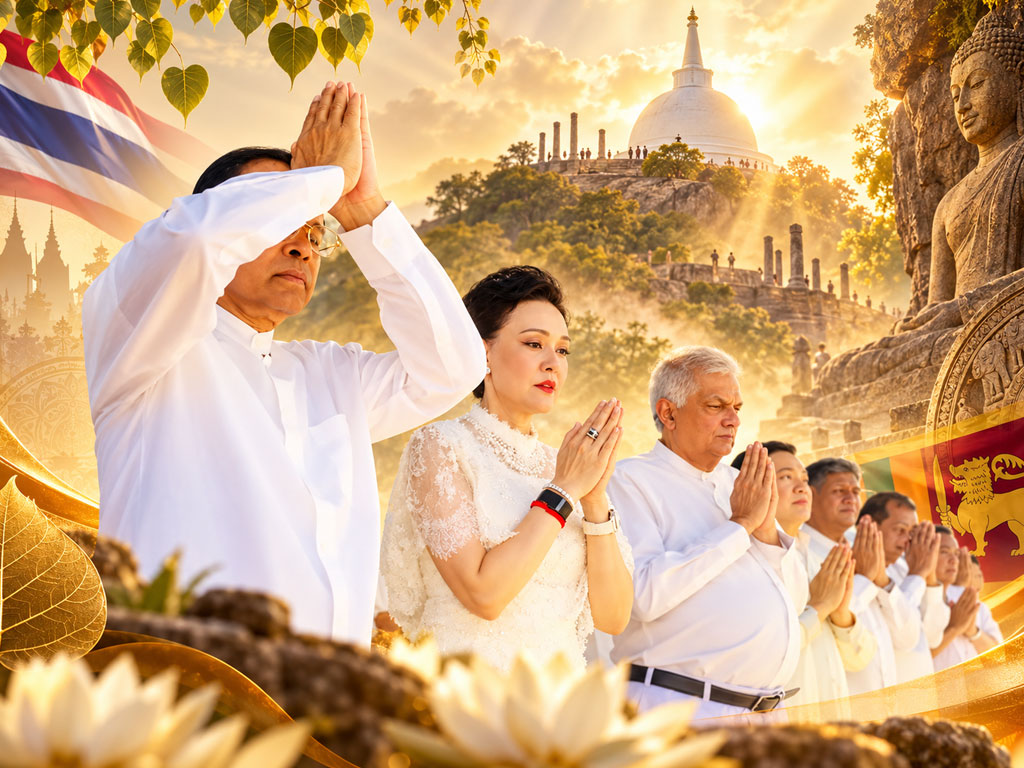
The controversy follows the October 18 ceremony marking the unveiling and enshrinement of the new pinnacle and crest gem at the historic Mihindu Maha Seya in Mihintale.
Opposition figures argue that the significance of the event, together with Suthumpun’s position in the Thai Government, warranted greater official recognition.
The disagreement has also reached Parliament, where Sarvajana Balaya leader and Member of Parliament Dilith Jayaweera has reportedly sought an adjournment debate to examine the Government’s handling of the visit.

Opposition Questions Diplomatic Reception
Jayaweera has criticised what he describes as the Government’s failure to extend appropriate diplomatic recognition to Thailand’s Deputy Prime Minister during her attendance at the Mihintale ceremony.
According to the account supplied, the parliamentarian has proposed an adjournment debate, arguing that the treatment of a senior representative of a longstanding friendly nation deserves formal parliamentary scrutiny.
He reportedly expressed his dissatisfaction during the religious event and maintained that the matter should be placed on the parliamentary record.
The specific document relating to his proposed debate has not yet been independently verified.
Separately, the United National Party (UNP) publicly criticised the Government on October 19, alleging that Suthumpun had not received an appropriate diplomatic welcome or adequate security arrangements.
The party argued that visiting foreign leaders should be accorded suitable courtesies regardless of whether their journeys are official or private.
It also drew attention to Thailand’s involvement in the religious ceremony, including contributions associated with the sacred pinnacle and crest gem.
Opposition criticism has therefore focused not simply on airport reception arrangements but on whether the Government adequately recognised the visiting dignitary’s official standing and the importance of the occasion.

Foreign Ministry Says Visit Was Private
Responding to the allegations, Sri Lanka’s Ministry of Foreign Affairs explained that Suthumpun had travelled to Mihintale as a Buddhist devotee rather than as the head of an official government delegation.
Foreign Ministry spokesperson and Director General of Public Diplomacy Thushara Rodrigo said the Deputy Prime Minister’s participation was exclusively connected to the religious ceremony.
The Ministry also clarified that no other government officials accompanied her as part of an official delegation.
According to the Government, the Royal Thai Embassy requested access to airport VIP facilities and other diplomatic courtesies, which Sri Lankan authorities granted.
The Ministry further stated that Suthumpun had undertaken similar private visits to Sri Lanka previously for religious purposes.
Its position is that the arrangements were consistent with the nature of the visit and the requests communicated by the Thai diplomatic mission.
The distinction between official and private visits is significant because the protocol arrangements applicable to visiting dignitaries can differ according to the purpose of travel and the arrangements agreed between the countries concerned.
Diplomatic Protocol Comes Under Examination
The disagreement has highlighted the distinction between a foreign official’s constitutional or ministerial position and the capacity in which that individual undertakes a particular journey.
Sri Lanka’s Foreign Ministry maintains separate administrative procedures for official, private, working and transit visits.
Its published protocol guidelines require diplomatic missions requesting access to the Laksiri VIP Lounge at Bandaranaike International Airport to identify the purpose of a visit, the accompanying delegation and the officials responsible for reception arrangements.
Consequently, a private visit by a serving foreign minister or deputy prime minister does not automatically constitute a formal state or official visit.
Nevertheless, opposition parties argue that appropriate security and diplomatic courtesies should reflect both the visitor’s status and the importance of the occasion.
The central disagreement is therefore whether the facilities supplied were sufficient, rather than whether the Deputy Prime Minister was legally entitled to a full state reception.
No independently verified finding has established that Sri Lanka breached a binding diplomatic protocol requirement during the visit.
Mihintale Ceremony Highlights Historic Buddhist Ties
The ceremony at Mihintale carried particular religious and cultural significance for both Sri Lanka and Thailand.
Mihintale is traditionally associated with the introduction of Buddhism to Sri Lanka by Arahant Mahinda Thero and remains one of the country’s most important Buddhist pilgrimage sites.
Thailand and Sri Lanka share longstanding connections through Theravada Buddhism, religious scholarship, monastic traditions and cultural exchanges.
Thai Buddhist devotees and institutions have participated in numerous religious activities and restoration initiatives associated with Sri Lankan sacred sites.
Suthumpun’s attendance at the Mihindu Maha Seya ceremony formed part of these wider religious relationships.
The involvement of Thai devotees in providing elements for the sacred monument also strengthened the symbolic importance of the occasion.
While the Opposition regards the event as deserving higher-level diplomatic recognition, the Government insists that its religious character was precisely why the visit was treated as private.
Parliamentary Scrutiny and Bilateral Relations
The reported request for a parliamentary debate introduces another dimension to the controversy.
A debate would allow opposition representatives to question the Government about the arrangements made for Suthumpun’s arrival, security, reception and attendance at Mihintale.
It would also provide an opportunity for the Foreign Ministry to explain the communications received from the Royal Thai Embassy and the basis on which the relevant protocol decisions were made.
However, the submission of a proposal does not necessarily mean that Parliament has approved or scheduled a specific debate.
The available parliamentary business schedule does not independently establish that Jayaweera’s proposed discussion has been allocated a sitting date.
The controversy also carries implications for the conduct of political debate concerning foreign relations.
The Opposition is entitled to question government decisions, particularly where matters of diplomatic courtesy and international friendship are concerned.
Equally, allegations of misconduct or diplomatic embarrassment require evidence establishing what arrangements were requested, what facilities were provided and whether any established obligation was neglected.
Sri Lanka and Thailand maintain longstanding diplomatic, religious and cultural relations extending beyond individual governments and political disagreements.
The immediate question is whether parliamentary scrutiny will clarify the protocol arrangements surrounding the October 18 visit.
Until the relevant communications and any proposed debate are formally examined, the Government’s assertion that all requested courtesies were provided and the Opposition’s claim that the reception was inadequate remain the competing positions in the dispute.