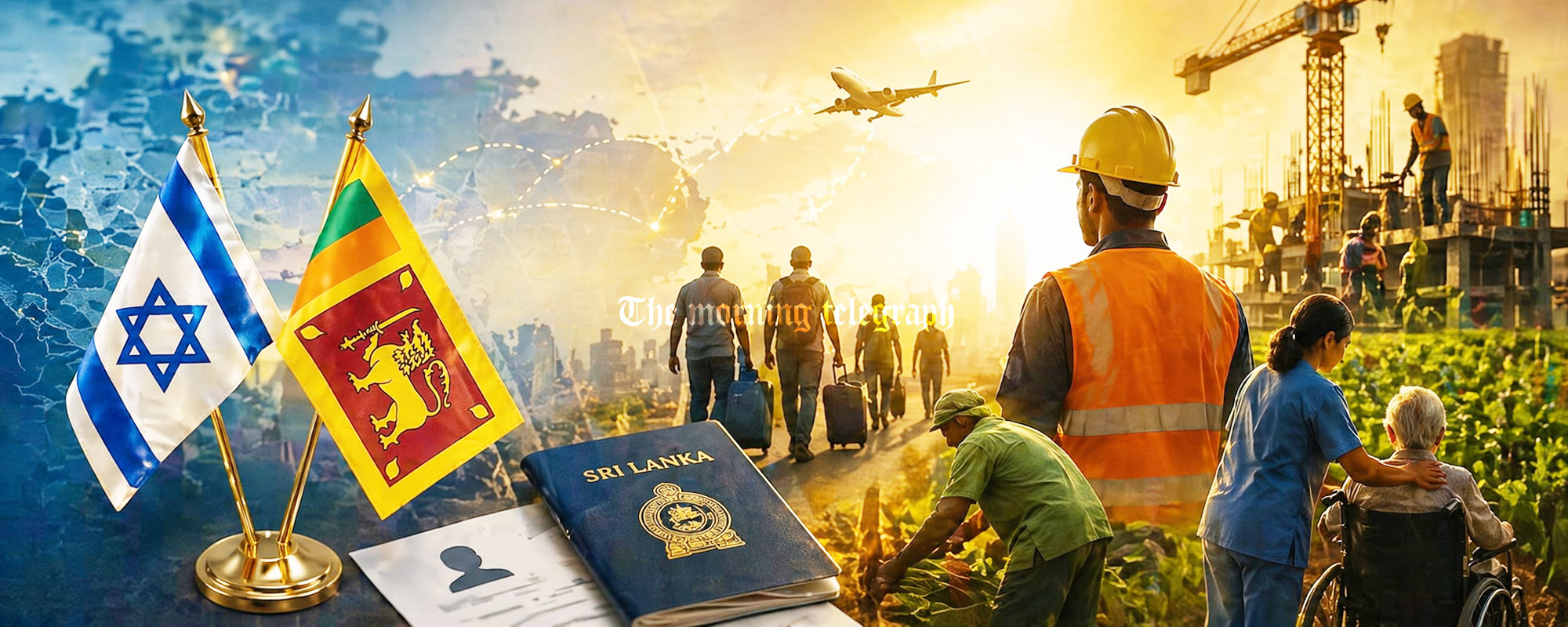
Sri Lankans in Israel approach 30,000 as job demand rises across key sectors, raising concerns over illegal workers and migration trends.
Sri Lankans in Israel have climbed to nearly 30,000 by the end of December 2025, marking a significant migration shift as thousands of workers continue to enter key sectors of the Israeli economy.
Latest figures show a total of 29,352 Sri Lankan migrant workers are now employed across multiple industries. The data highlights how Sri Lankans have become deeply embedded in essential sectors such as construction, caregiving, agriculture, and hospitality, reflecting a sustained demand for foreign labour.

The largest share of Sri Lankans in Israel is concentrated in construction, with 12,353 individuals employed in the sector. Caregiving roles follow with 6,651 workers, while agriculture accounts for 2,819 Sri Lankans. The hotel sector employs 1,600 workers, with additional employment spread across restaurants, renovation projects, and infrastructure development. This wide distribution indicates a growing diversification of job roles among Sri Lankan workers.
However, the figures also reveal that 3,593 individuals are classified under illegal status. This raises concerns about irregular migration patterns and overstaying within the labour system. The presence of undocumented workers continues to highlight gaps in monitoring and enforcement, and questions remain about how these numbers may evolve.
In 2025 alone, migration through bilateral agreements accounted for 8,693 workers. These agreements covered sectors such as agriculture, caregiving, construction, hospitality, and infrastructure, which continue to drive demand for Sri Lankan labour abroad. Alongside this, an additional 4,555 Sri Lankans entered employment through private sector channels during the same year, mainly in construction, industry, commerce, and service related roles.
The total number of documented new entries for 2025 reached 13,248 workers, underscoring a strong annual inflow driven by labour demand agreements and private recruitment networks. This trend reflects both external demand and internal economic pressures that are pushing more Sri Lankans to seek opportunities overseas.
The rapid growth of Sri Lankans in Israel signals a major transformation in migration patterns, but it also raises questions about regulation, worker protection, and long term sustainability. What happens next could be critical as authorities address the balance between labour demand and migration control.