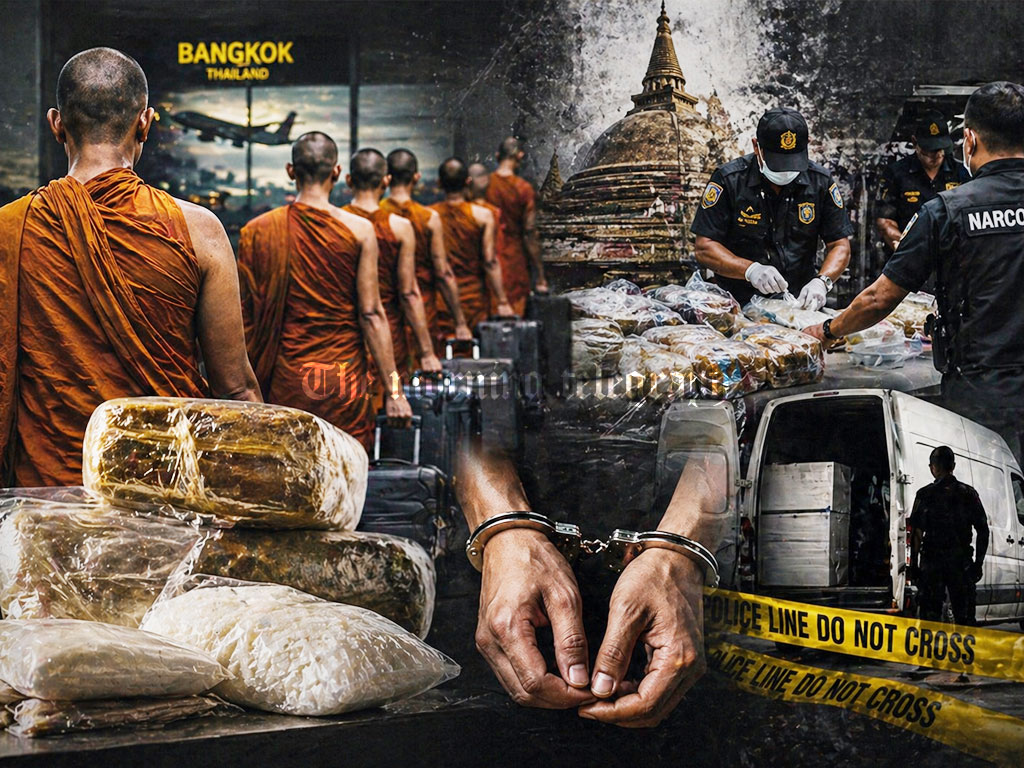
Rammuthugala monk drug case shocks Sri Lanka as Amithanananda linked to 110kg Kush and Hash smuggling using young monks and Bangkok routes.
The Rammuthugala monk drug case has stunned Sri Lanka as investigations reveal that a network led by Amithanananda orchestrated the smuggling of over 110 kilograms of Kush and Hash using young monks, raising serious concerns about exploitation and organized crime.

Twenty two robed individuals who transported the drugs into Sri Lanka are now in custody under seven day detention orders. The main suspect, identified as Amithanananda of the Rammuthugala Temple, was arrested in the Gampaha area, and authorities believe the entire operation was coordinated by a small group that included him and two other monks.
The most disturbing element in this case is the profile of those involved. Many of the monks recruited into the operation are between the ages of 19 and 28. Investigators say that through WhatsApp groups, traffickers including Amithanananda targeted young monks from economically vulnerable areas, luring them with promises of foreign travel and luxury experiences in Bangkok, Thailand.
Once in Thailand, the recruits were reportedly given accommodation and comforts before being handed 22 suitcases filled with drugs to bring back to Sri Lanka. Authorities say that Amithanananda was waiting outside the airport with a van to collect the consignment, but the plan was disrupted by the intervention of an alert police officer.
However, questions remain about how such a large scale operation could be executed with so many individuals involved without raising earlier suspicion.
Investigations have also uncovered that this was not an isolated incident. Officers have confirmed that the same group had previously used 12 monks on two separate occasions to transport drugs from Bangkok. The narcotics from those operations were allegedly delivered to a house in the Athurugiriya area, which is now under investigation by the Anti Narcotics Bureau.
The case has exposed how traffickers may have exploited the respect and reduced scrutiny often afforded to Buddhist monks in Sri Lanka, particularly at airports and security checkpoints. This raises concerns about systemic vulnerabilities and the misuse of religious identity for criminal purposes.
Another troubling question emerging from the investigation is why young monks would risk involvement in such a serious crime for relatively small financial incentives, reportedly around Rs. 80,000. At the same time, the issue of how these monks were able to travel abroad without proper authorization from a chief prelate has drawn attention.
While some have attempted to frame the incident as a conspiracy, investigators point out that the scale of the operation makes such claims difficult to sustain, especially given the number of identical suitcases transported at once.
What remains unclear is the identity of the higher level operators behind the network and the buyers of the drugs within Sri Lanka. What happens next could be critical in determining whether authorities can dismantle the full network behind this operation or whether key figures will remain hidden.