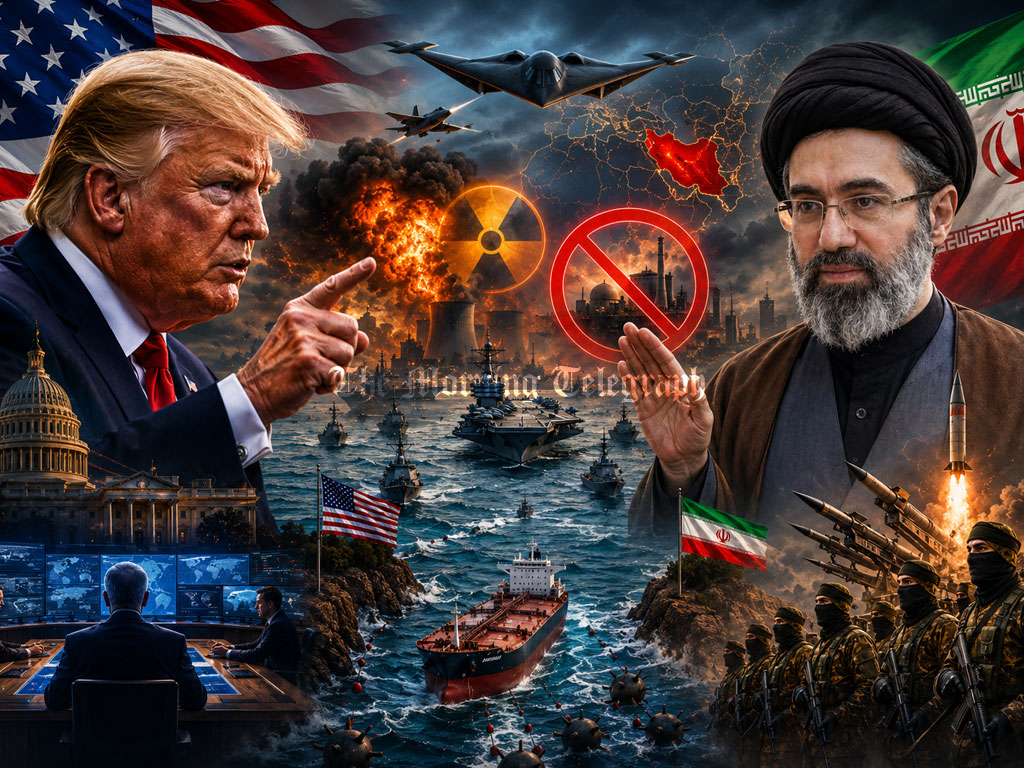
Trump demands Iran formally abandon nuclear weapons as Tehran rejects US claims, blockade statements, and coercive language.
Trump demands Iran formally agree never to possess nuclear weapons, even as Tehran rejects Washington’s latest claims and denies any final agreement.
US President Donald J. Trump has emphasized that Iran must officially agree that it will never possess a nuclear weapon.
He has also demanded that the Strait of Hormuz be opened immediately for unrestricted naval navigation, without immigration taxes or obstruction.
Issuing a lengthy statement, President Trump said steps would be taken to remove the remaining naval mines in the strategic sea lane through coordination between Iran and the International Atomic Energy Agency.

He also announced that the US naval blockade currently operating in the region would be lifted immediately.
Trump further declared that nuclear materials buried underground after previous attacks by US B-2 bombers would be excavated and destroyed under joint coordination by the United States, Iran, and international inspectors.
According to the President, no financial transfers have been approved so far.
However, he hinted that an agreement had already been reached behind closed doors on several additional undisclosed conditions.
The US President also said he was retreating to the White House’s special situation room to make a “final decision” on the matter.
Accordingly, a decisive step regarding Iran is expected to be announced in the coming days.
Iran Rejects Trump’s Claims
Iran immediately rejected Trump’s statements, saying no final agreement has been reached with the United States.
Commenting on the matter, Ismail Baghaei, spokesperson for Iran’s Ministry of Foreign Affairs, said Tehran was not prepared to obey orders from foreign countries.
“Iran bid farewell to the language of ‘must’ and commands based on orders 47 years ago. No Western party can use such coercive language when speaking with the Islamic Republic,” Mr. Baghaei said.
He added that while message exchanges with Washington are continuing, no final decision has been reached.
Dispute Over Naval Blockade
Responding to Trump’s announcement that the naval blockade would be lifted, the Iranian spokesperson said the sea blockades had been illegal from the beginning.
He said they violated the ceasefire agreement that came into effect on April 8 and also breached international naval freedom.
“We can see practically whether they will actually put their words into action or whether this is just a propaganda tactic,” he said.
The Iranian side also emphasized that no new discussions on the nuclear issue have taken place so far.
Tehran described Trump’s nuclear claims as baseless.
Current Negotiations Continue
Ongoing discussions between the two countries are reportedly being mediated by Pakistan and facilitated by the state of Qatar.
The talks are said to be based on a 14-point proposal submitted by Iran.
The main objectives include stopping US-Israeli naval aggression and releasing frozen Iranian financial assets.
As one of the most serious geopolitical conflicts in recent history reaches a critical stage, global attention is now focused on Washington and Tehran.
Reports indicate that an unusual and continuously escalating state of unrest is spreading across the Middle East region.
Pentagon Warns of Possible Attacks
US Defense Secretary Pete Hegseth, the Pentagon chief, has warned that if a successful agreement cannot be reached with Iran, the United States is prepared to launch further attacks against the country.
The Defense Secretary made the statement as representatives from both sides continued negotiations aimed at resolving major disputes between Washington and Tehran.
Speaking at the Shangri-La Dialogue security conference in Singapore on Saturday, May 30, Hegseth said:
“We have the full capability to restart the attacks if necessary.”
“Our weapons stockpiles in the relevant region as well as around the entire world are well equipped for that. Therefore, we are in a very strong position.”
Addressing Asia-Pacific defense chiefs, military officials, and diplomats at one of the region’s leading security summits, he said the US had not abandoned its attention to the Asia-Pacific region despite being engaged in a conflict with Iran.
“We can do two things at once. We are rapidly strengthening our defense industrial base. Accordingly, we are working to double, triple, or quadruple ammunition and weapons production in a very short period to ensure that all our operational plans around the world are properly resourced and facilitated,” Mr. Hegseth said.
He also noted that President Trump hopes to reach an agreement ensuring Iran does not possess a nuclear weapon.
According to Hegseth, the President is approaching the matter with great patience.
Background to the Conflict
President Trump stated last Friday that he would hold discussions in a special secure room at the White House to make a final decision on a proposal to end the Iran war.
This proposal is expected to extend the temporary ceasefire agreement reached in early April by another 60 days.
The extension would give negotiators more time to search for a permanent solution to the conflict.
The war, jointly initiated by the United States and Israel on February 28, has resulted in thousands of deaths, mainly in Iran and Lebanon.
Iran’s decision to close the Strait of Hormuz has also caused energy prices to rise in the world market.
That has severely affected the global economy.