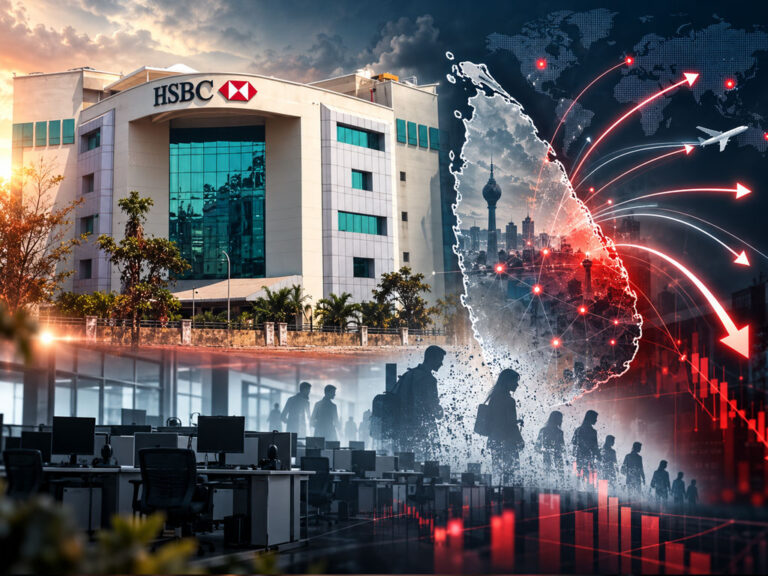
Secret Chennai meeting report raises security concerns over Sri Lanka’s vulnerabilities, Islamic finance links, and alleged ISI networks.
A secret Chennai meeting has raised fresh questions about Sri Lanka’s security vulnerabilities, regional Islamist networks, and Pakistan’s alleged efforts to weaken India from within.
Pakistan’s aggressive attempts to weaken India domestically and internationally have long been documented. Seen through a security lens, every such report carries weight because, in the global power struggle, intentions are rarely open or transparent.
Startling revelations published by a Tamil Nadu-based media outlet have now pointed to a secret meeting in Chennai focused on interest-free banking in South India. Among those reportedly present was a newly appointed cabinet minister from a key coalition party in Tamil Nadu.

Adding further intrigue to the report, two Sri Lankan Muslim politicians, known to be long-time rivals, were also said to have been seated at the same table.
According to the report, the meeting was organised by a “third man,” described as an intermediary and a high-level executive of a powerful Saudi-backed international Islamic federation.
More alarmingly, the same figure is reportedly under intense global surveillance due to alleged deep-rooted links with Pakistan’s Inter-Services Intelligence, better known as the ISI.
He is also said to have brokered a truce between two rival political figures on Indian soil.
“Seated side by side, sharing a meal and smiles, were two high-profile individuals from a neighbouring country. Back home, these men are bitter, hereditary political rivals, leaders of factions whose cadres engage in violent street battles,” the outlet reported.
The report went on to identify the Saudi-linked executive as Dr. M.L.A.M. Hizbullah, a high-ranking member of the Muslim World League, headquartered in Saudi Arabia.
Based on that identification, one can infer the identity of the rival politicians from the neighbouring country. For this author, the old saying still applies: there is no smoke without fire.
Who Is M.L.A.M. Hizbullah?
In Sri Lanka, M.L.A.M. Hizbullah is a controversial politician, businessman, and former minister and governor of the Eastern Province.
He comes from Kattankudy, a Muslim-majority town in the Batticaloa District, often described as the centre of Wahhabism in Sri Lanka.
It was in Kattankudy that Zahran Hashim, the mastermind of the Easter Sunday bombings, rose to prominence.
After the attacks, some Buddhist leaders and parliamentarians alleged that Hizbullah’s ties to Riyadh had contributed to jihadist activity in Kattankudy. Hizbullah denied those allegations.
However, his long involvement in Arabization projects has been well documented.
Through the Hira Foundation, run by him and his son Hiras, Hizbullah led several projects, including the controversial Batticaloa Campus, widely referred to as a “Sharia university,” funded by Saudi donors.
Official financial statements showed income of only $31,000 between 2014 and 2018.
Yet Hizbullah told Parliament that the foundation had received $2 million from foreign donors.
Later, he claimed that most of the funds had come from the Juffali family, a prominent Saudi merchant dynasty.
Bank records, however, showed that the Sheikh Ali Abdullah Al Juffali Foundation Charity had wired approximately $24.5 million to the Batticaloa Campus between 2016 and 2017.
This evidence highlights the deepening connections between Sri Lankan Muslim politicians and Saudi foundations.
Hizbullah’s political activity declined after the Easter Sunday attacks, but he later returned to active politics, reconciled with the Sri Lanka Muslim Congress, and eventually secured a parliamentary seat in 2024.
Easter Attacks And The Security Wake-Up Call
The Easter Sunday bombings shattered Sri Lanka’s complacency.
Before those attacks, few believed that jihadist networks had infiltrated sections of Sri Lankan Muslim communities to such a dangerous extent.
That failure to act, despite prior warnings from India, explains why authorities did not take the threat seriously enough.
In this context, Sri Lankan authorities cannot afford to casually dismiss reports of Islamic agendas, even when such reports are published by less mainstream outlets.
The issue is not merely Hizbullah’s alleged presence at a secret Chennai summit.
As the Tamil Nadu media report emphasized, the submission for interest-free banking and the clandestine meeting should not be seen as isolated events, but as part of a dangerous continuum.
The outlet warned: “As central and state intelligence agencies, along with the RBI, tighten their net around these shadow alliances, one question remains: will Tamil Nadu remain a ‘Haven of Peace,’ or is it being groomed to become a dangerous playground for international syndicates?”
From this author’s point of view, the question is not only about Tamil Nadu.
It is also about Sri Lanka.
Rabita Trust And Global Terror Links
Can the defence community afford to take such reports lightly?
As reported, “The Saudi-linked executive present at the meeting, Dr. M.L.A.M. Hizbullah, is a high-ranking member of the Muslim World League. From this entity emerged the Rabita Trust.”
United Nations databases confirm that the Rabita Trust, a Pakistan-based NGO, has provided logistical and financial support to Al-Qaida, listed as QDe.004.
It has also maintained close links to Al-Qaida leaders and other listed individuals and entities.
These include Ayman al-Zawahiri, Sobhi Abdel Aziz Mohamed el Gohary Abu Sinna, who is deceased, Makhtab al-Khidamat, and the Armed Islamic Group.
Pakistan’s aggressive efforts to weaken India domestically and globally are well known.
Against this background, transnational terrorism must be understood in two dimensions.
The first is “hard” terror operations involving direct violent attacks.
The second is “soft” operations, which infiltrate societies through covert networks, ideological influence, financial channels, and false narratives.
South India has long been vulnerable to this second form of infiltration.
South India As A Soft Target
The pattern is clear.
In 2014, Sri Lankan Tamil national Arun Selvarajan was arrested in Chennai by India’s National Investigation Agency on charges of spying for Pakistan’s ISI.
He was the third Sri Lankan to be detained over alleged ISI links within a single year.
Just months earlier, Mohammed Sakir Hussain had been arrested in Chennai in April 2013.
He was followed by Mohammed Hussain Suleman Hussain, who was arrested in Malaysia one month later.
Investigators later revealed that their alleged plot involved recruiting Maldivian nationals to carry out attacks on the United States and Israeli consulates in Chennai and Bangalore.
According to the NIA, Selvarajan was part of a spy ring recruited by a Pakistani diplomat in Sri Lanka.
The ISI’s focus on South India has been underlined by multiple arrests and alleged plots over the years.
Linguistic and cultural proximity, Tamil Nadu’s history of anti-state sentiment, and the ideological survival of the Liberation Tigers of Tamil Eelam, despite their military defeat in Sri Lanka, have together created fertile ground for infiltration.
These conditions have also provided space for banned groups and covert networks to operate.
For these reasons, South India remains a soft target for ISI operations.
For Sri Lanka, the warning is even more serious.
The island sits at the intersection of Indian Ocean geopolitics, religious radicalisation concerns, foreign-funded ideological projects, and fragile post-war ethnic politics.
A secret meeting in Chennai involving Islamic finance, Saudi-linked networks, alleged ISI shadows, and Sri Lankan political actors cannot be brushed aside as just another regional rumour.
It must be examined carefully, not with panic, but with strategic seriousness.
Because if such networks are ignored until violence occurs, Sri Lanka will once again be forced to ask the same painful question it asked after Easter Sunday: why were the warning signs missed?