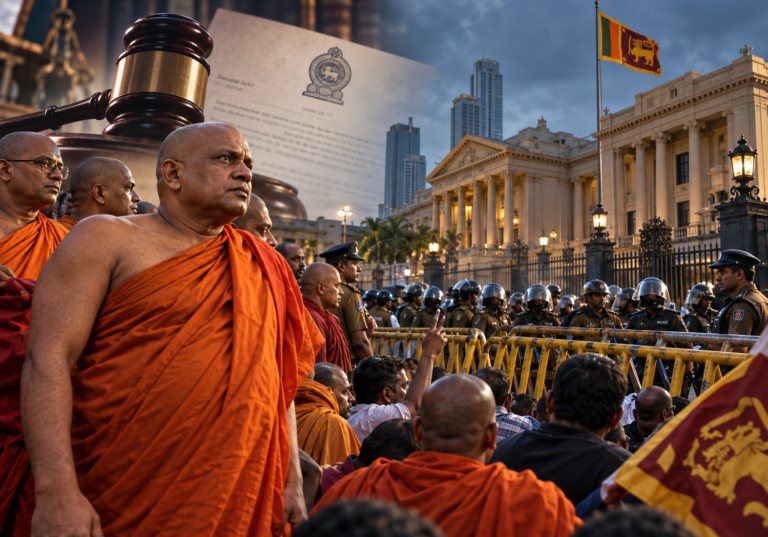
Judges’ retirement age will not be extended, Justice Minister Harshana Nanayakkara says, amid concern over courts, vacancies, and seniority.
The judges’ retirement age will not be extended, Justice and National Integration Minister Harshana Nanayakkara has said, rejecting a controversial proposal that had sparked serious discussion within Sri Lanka’s legal community.
According to a report by The Sunday Morning, the minister has firmly dismissed claims that the government intends to increase the retirement age of Supreme Court and Court of Appeal judges. The issue had drawn strong attention after concerns were raised by several parties, including the Bar Association of Sri Lanka.
Responding to an inquiry by The Morning newspaper regarding the proposal, the Justice Minister said there was no active move to proceed with such a change.

“I have no knowledge of any such matter, and I do not believe there is any active proposal or discussion taking place regarding an extension of the retirement age of judges at this time,” he stated.
Case backlog, judge recruitment, and digitization
Statistics presented during parliamentary proceedings show that the number of cases currently piled up within Sri Lanka’s judicial system has exceeded 1.1 million, standing at 1,131,818. The shortage of judges has been identified as one of the major reasons behind these long delays. The discussion on extending the retirement age emerged against this background.
However, clarifying the government’s position, the Justice Minister told the newspaper that recruitment is already taking place to strengthen the judiciary.
“More judges are currently being recruited. Considering our current financial situation and the time taken by the recruitment process itself, it is difficult to reach the globally accepted judge-to-population ratio. However, these ratios could change with the implementation of the new digitization programme designed to make the system faster and more efficient,” he said.
He further noted that although the Judicial Service Commission has not yet reached a final agreement on the matter, recruitments are continuing. However, the specific upper and lower limits of that process have still not been determined.
Opposition from bar associations
Under Articles 107 and 108 of the Constitution, the retirement age of a Court of Appeal judge is 63 years, while the retirement age of a Supreme Court judge is 65 years.
The Colombo High Court Lawyers’ Association, in a letter addressed to President Anura Kumara Dissanayake, warned that altering these constitutionally prescribed age limits would deny opportunities for advancement to new and talented judges. The association also stated that such a move could demoralize the entire judicial service.
It further cautioned that the public may view such a change as executive influence over the judiciary, raising concerns over the independence and credibility of the legal system.
Who will be the next Chief Justice?
With the Justice Minister’s statement effectively closing the debate on extending the retirement age, attention in the legal field is now shifting to the next major question: who will be the next Chief Justice of Sri Lanka?
By confirming that the government will not extend the retirement age, the existing constitutional tradition of making appointments based on seniority to fill the vacancy that will arise after the current Chief Justice retires appears to have been preserved.
An analysis of the present composition of the Supreme Court and the traditional seniority list places Justice Murdu Fernando as the foremost judge eligible for the position of Chief Justice. She is currently the senior-most judge of the Supreme Court and is widely regarded as an experienced legal scholar, having served as Acting Chief Justice on several occasions.
Following her in the order of seniority are Justice S. Thurairajah and Justice A.H.M.D. Nawaz.
One of the main reasons bar associations strongly opposed any extension of the retirement age was the fear that it would block this natural progression process. The Bar Association had argued that the career advancement of many excellent individuals should not be sacrificed merely to preserve the tenure of a select few.
If the retirement age had been extended beyond 65 years, the senior judges currently eligible for the next Chief Justice position would have naturally lost that opportunity due to their own retirement.
Therefore, the current government’s position is expected to preserve the seniority tradition of the Supreme Court while also strengthening public confidence in the rule of law.