
By Roy Denish
Kinross Sports Club’s collapse exposes a painful story of coastal erosion, committee corruption, abandoned workers, and the slow destruction of one of Colombo’s most treasured public spaces.
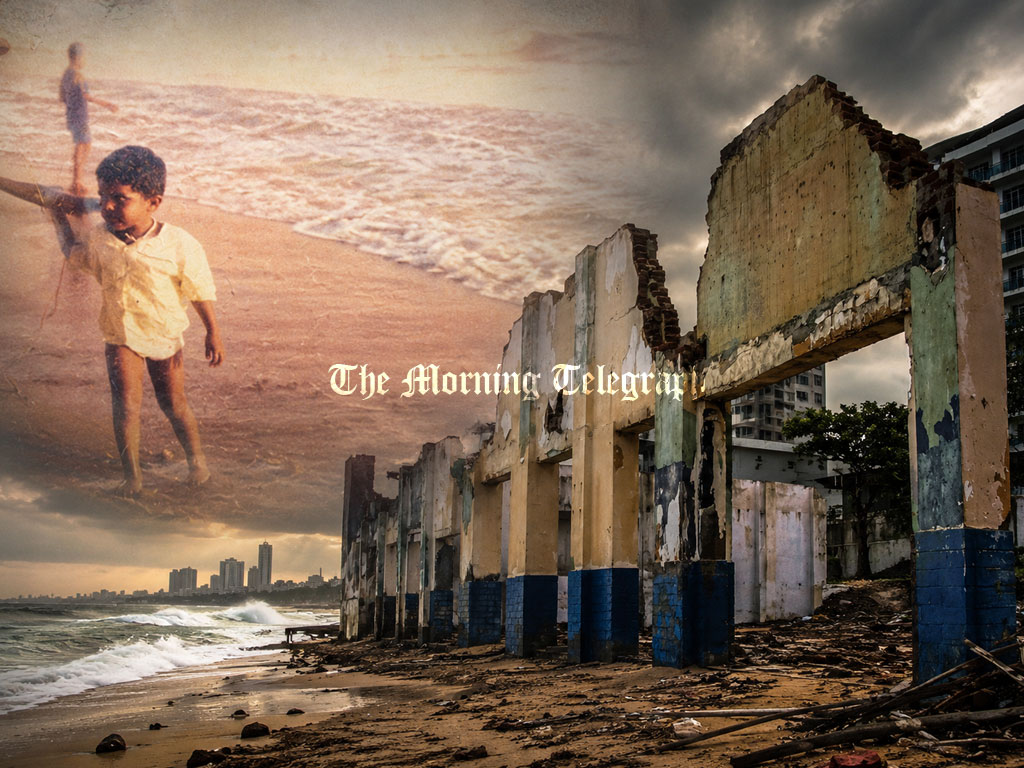
Kinross Sports Club, the iconic recreational bar and restaurant that once stood majestically on the oceanfront of Wellawatte beach, is gone. It did not vanish into thin air, nor did it simply drift away with the changing tides. Its demise is the direct result of gross mismanagement, bureaucratic bungling, and bitter infighting among its committee members. In a final, shameful act of betrayal, tenders were formally called for the sale of the club, yet the keys were ultimately handed over to the lowest bidder. Driven by the toxic influence of corrupt committee members and grease-lubricated by the buyer’s political and commercial connections, the club was bartered away. Today, the ghosts of this arcadian past are swallowed by a desolate present, a mere rusting skeleton of what it once was. The once-vibrant shoreline is now a casualty of an unnatural disaster, a man-made Waterloo that serves as a chilling indictment of civic neglect, institutional corruption, and corporate greed.

For generations, Kinross Beach was more than just a stretch of sand; it was the vibrant heart of a community. It was the training ground for national athletes, the backdrop for countless family picnics, and the stage for sporting legends. Mornings here were filled with the whistle of sea breezes and the shouts of swimmers cutting through the surf. Families strolled along the sand, vendors sold tea, gram, prawn vada, juicy pineapple sprinkled with tajin, and young men and women trained in swimming and lifesaving under the watchful eye of mentors. It was a family-oriented haven where the sand under our feet, the athletic drills at sunrise, and the cooling sea breeze shaped who we were.

This was a unique sanctuary where scuba divers and local fishing folks sat together, the salt still drying on their skin, humming baila songs over glasses of strong lager and double distilled arrack. To complement the drinks, the kitchen served the iconic British fish and chips, wok-fired rice, and fiercely spiced devilled pork, chicken, and beef, alongside freshly caught fish cooked straight from the ocean to its patrons. It was a home for lively social events hosted by many rugby clubs in the area, a melting pot where raw athletic grit met coastal camaraderie. The Kinross Swimming and Life Saving Club boasted a history worth fighting for, born out of tragedy in 1941 after a spate of drownings highlighted the urgent need for organized water safety. The vision came from Guy Thiedeman, a champion athlete, but it was Mike Sirimanne, along with his friends Herbert Pathiwela, Elmo and Lou Spittel, Anton Selvam, Ron Kellar, Basil Misso, and Hugh Stewart, who turned that vision into reality. These pioneers trained under Thiedeman and later under Australian surf lifesaver Harry Nightingale, who introduced modern life-saving methods to Sri Lanka. With their own hands, they built the club’s first headquarters, a humble shack on the beach, as a symbol of civic spirit. By 1955, a permanent clubhouse was erected, and Kinross became a beacon for swimming, lifesaving, and beach recreation. The founders believed in a simple truth: the beach belonged to the people. The loss of that beach is not just physical erosion; it is the erosion of the very ideals on which Kinross was built.
Today, that golden expanse has been reduced to a narrow strip of eroded shoreline, lashed daily by breaking waves and littered with plastic bottles, torn wrappers, and debris where children once played. The most haunting sight is a stranded fishing trawler, now a rusting skeleton baking under the scorching sun, an accidental monument to inaction. But make no mistake: this is a man-made catastrophe. Reports warning of this disaster has been gathering dust for decades. From 1997 onward, the Coast Conservation and Coastal Resource Management Department published at least four major studies predicting severe littoral drift issues and catastrophic beach erosion if unregulated sand mining and haphazard construction continued. In 2013, the Central Environmental Authority’s Environmental Impact Assessment flagged multiple risks tied to illegal structures and hotel construction blocking the natural longshore sediment transport and sand flow. Between 2016 and 2019, the Presidential Task Force on Coastal Zone Management, NARA’s 2018 sediment transport study, and the Coastal Zone Management Plan all warned of irreversible damage to our marine environment.
Yet, these urgent alarms were methodically shelved in favor of short-term commercial interests. Meanwhile, the Marine Environment Protection Authority did little more than issue press releases after each environmental mishap. Instead of decisive action, we witnessed half-hearted rock-dumping and revetment projects that simply shifted the rip currents and erosion down-shore, exposing Wellawatte and Dehiwala to even greater bathymetric vulnerability and wave energy. This is not mere administrative failure; it is active collusion. Committee members signed off on permits for private developers to build right up to the high-water mark, destroying the berm and narrowing the natural coastal buffer zone. It is time to name those responsible: the coastal engineers who approved illegal structures, the environmental officers who looked away, and the politicians who pocketed campaign donations from the very firms dredging our sand for profit. Accountability must be personal, not abstract. A few token beach nourishment projects every five years are not solutions; they are photo opportunities.
The narrative of Kinross Beach extends far beyond its vanishing shoreline; it is a metaphor for the broader threats against our public infrastructure. The same destructive forces and apathy that allowed Kinross to crumble now imperil the very foundations of our coastal city. The Colombo to Galle railway line, hugging the eroding coastline, is increasingly at risk. Each meter of lost sand brings the tracks closer to collapse, already forcing authorities to slow or suspend trains during high tides when the sea water breaches the tracks. Marine Drive, celebrated as a solution to Colombo’s traffic congestion, is now an exposed, vulnerable strip that could be underwater within decades. The government spends billions on expressways but fails to protect the basic public spaces of its citizens. This history of ignored advice exposes a disturbing pattern where the short-term gains of a select few are prioritized over the long-term well-being of the public.
If Kinross is a warning, we are ignoring it at our peril. Sri Lanka’s coastline is a vital economic and cultural asset. Its loss directly impacts commuters, tourists, and entire communities who depend on fishing and recreation for their livelihoods. We cannot afford to keep responding with piecemeal fixes. To reverse this course, we must move beyond lament and demand radical action. We need a nationwide commitment to audit and expose every decision made by coastal management and club committees that facilitated corruption and worsened erosion. We must hold specific individuals accountable, not just faceless institutions, for negligence, complicity, and illicit under-the-table deals. We must restore natural defenses like mangroves, dunes, and reefs, rather than relying solely on concrete seawalls and boulders. Furthermore, waste management must be overhauled, and a nationwide campaign launched to end littering on beaches. Future development must be planned intelligently, with foresight and genuine community benefit at the heart of every project.
The waves will not wait for committee meetings. The sea water is advancing every day, taking with it our history, our culture, and our shared spaces. Kinross was a place where we learned to respect the ocean, to read the swells, and to live with the tides. Today, it stands as a testament to what happens when we abandon that respect and allow complacency, corruption, and complicity to govern our response. If we do not act now, we will wake up one morning to find not just our beaches gone, but the railway, the coastal livelihoods, and the remaining trust in our public institutions washed away with them. The ocean is not the enemy. Our failure to act is.
The ultimate tragedy of Kinross is not just the loss of its brick and mortar, or even the slow retreat of its shoreline under the assault of the sea water; it is the utter human devastation left in the wake of its collapse. The committee members who structuralized this downfall were hand-picked sycophants, appointed not out of merit or a shared commitment to the club’s historic legacy, but simply to sit in chairs and occupy space without bearings, vision, or a shred of professional responsibility. While they engaged in petty infighting and signed off on under-the-table deals, the lifeblood of the establishment—its dedicated workers—were callously left in the lurch. Today, the devastating cost of this administrative failure is on full display. Loyal staff members, many of whom originally migrated from the outskirts of Colombo to dedicate their lives to serving families, scuba divers, and local athletes, have been abandoned without a safety net. Forced onto the pavement by gross institutional betrayal, these workers now roam the streets of Colombo in desperate, heartbreaking search of alternative employment. Their displacement stands as a searing, final indictment of the hand-picked committee’s greed and incompetence. It serves as a grim reminder that when public spaces and community institutions are surrendered to unprincipled management, it is always the most vulnerable who pay the heaviest price, long before the waves finish washing away what remains.




So sad to see the club in it’s present state. Nostalgic memories keep flooding back of this once iconic institution .
Sad to hear this. I was a member until I left Sri Lanka in 1996.
I had been a Life Member since 1984 and I am very sad now that the club premises had been ruined by uncontrolled sea erosion. Some said the sea erosion was caused by the extension of PORT CITY approximately a kilo meter into the sea in Galle Face front.
Whatever may be it’s a great loss of a A Life Saving and Swimming Club.
🥲
T SAM DHARMACHANDRA
Life Membership No: 17
Coastal erosion is a natural phenomenon. Archaeologists have found fossils of marine life some 4 kms inland on the Souhern coast indicating that possibly thousands of years ago such areas were under the sea.
Nature then “gave back” those areas to become land. Similarly, the sea is now taking those areas back!
The only thing the authorities can do is to have a time-line… say 50 years from now; where all residents and businesses on the coastline will have to move and give the land back to the sea.
As a born-and-bred ‘native’ of Wellawatte who as a toddler in the early 1950s first dipped his toes in the Indian Ocean in the vicinity of ‘Kinross’, I was saddened to read this report. It did, however, awaken many happy memories of Sunday mornings spent in the sea at Wellawatte beach. Finally, I must compliment Roy Denish on the quality of his writing. Congratulations, and keep up the good work.
This is indeed quite a tragedy that this once great institution has been allowed to just vanish without any accountability, whatsoever.
In the 60’s, as a swimmer and diver, I would visit the club with Graham Arndt, usually for a social drink and what an atmosphere it had.
I met some of Colombo’s then remarkable gentlemen such as Dr George De Bruin, Wahab Deen & his brothers Farook and Raffai, as well as many others.
No doubt that many others, like me, would be saddened at the demise of Kinross.
The tender to lease the land by the Railway has not been finalized as yet. So no keys were given to the lowest bidder The club came to this plight because of poor management It was like a public bar Anyone could walk in give a waiter a tip and order a drink .Later when the club had no funds to run the bar it became BYOB. I am told the management did not pay any gratuity taking shelter under a clause where if the number of employees were less than 15 it is not compulsory to pay
The club came to this state when a Patron with some members ousted the group that ran the club well after resurrecting after the Tsunami
Clubs have to take care when enrolling members