By Roy Denish
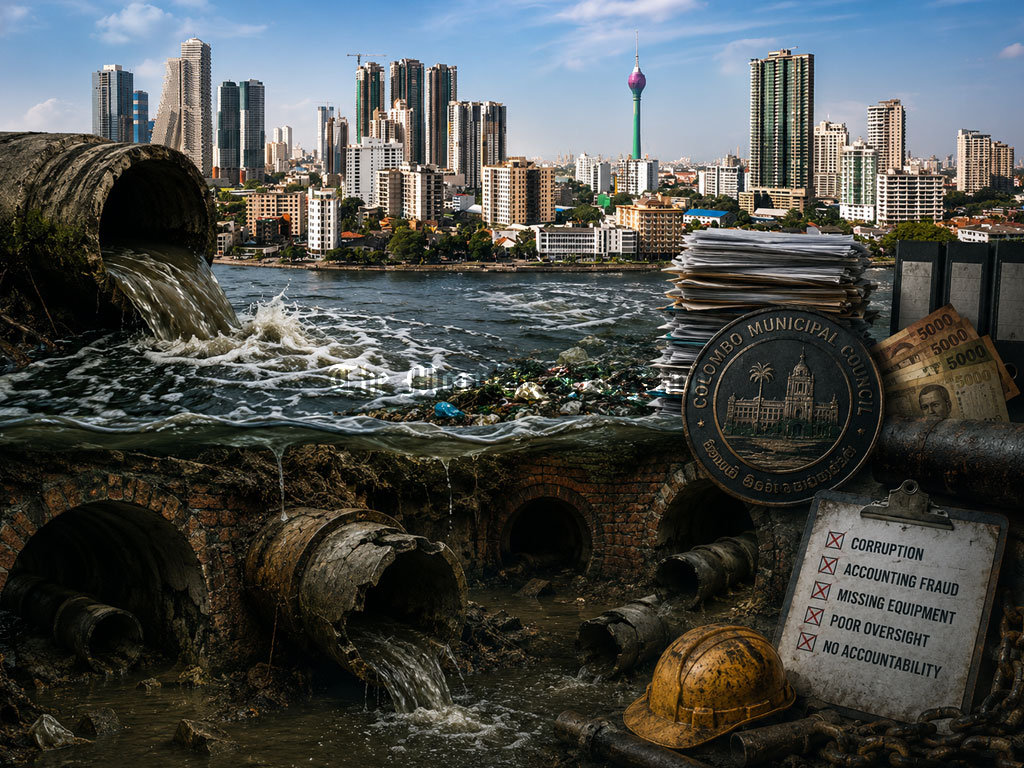
Behind Colombo’s modern skyline, a century-old sewer system is buckling under pressure. Allegations of corruption, missing equipment, accounting irregularities, and weak oversight have exposed deep failures within the city’s wastewater management network, raising concerns over public health, environmental safety, and the misuse of taxpayer funds.
Behind the luxury high-rises reshaping the coastal skyline of the capital lies a fracturing, century-old subterranean network on the verge of environmental failure. The Colombo Municipal Council is facing critical scrutiny over systemic corruption, procurement anomalies, and administrative paralysis that have stalled the containment of the city’s escalating sewage crisis. At the center of the breakdown is the capital’s central wastewater grid, segments of which were engineered between 1906 and 1920. Originally built to handle a minor fraction of today’s urban density, the network is crippled by chronic structural failures, severe marine erosion at key coastal pumping facilities like Bambalapitiya, and localized sewer collapses along major conduits such as Galle Road.

The capital’s capital-intensive rehabilitation strategy is driven by the Greater Colombo Water and Wastewater Management Improvement Investment Program, a multi-tranche modernization facility valued at 300 million dollars. The initiative relies on funding from the Asian Development Bank, backed by a 70 million dollar credit allocation from the Agence Française de Développement and extensive capital assistance from the European Investment Bank. On the municipal level, severe accounting gaps obscure the precise track of local tax revenue. Parliamentary financial oversight reviews and Auditor General inspections into the municipal council revealed that capital assets totaling over 591 million rupees were misclassified as operational expenses in a single fiscal window rather than capitalized as fixed infrastructure assets. Furthermore, state auditors flagged a deep accounting mismatch involving 73 distinct contractor accounts totaling 1.47 billion rupees, where operational costs and fixed capital values were inflated by 670 million rupees and 808 million rupees respectively due to ledger irregularities.
Heavy maintenance machinery and sewer flushing fleets utilized by the municipal council are predominantly imported from Western Europe, Japan, and China under specialized International Competitive Bidding frameworks linked to foreign loan conditions. While formal procurement calls are processed through international channels—including the recent network expansion contract secured by the state-owned Power Construction Corporation of China for the Kirula and Narahenpita sewer grids—the downstream logistics and inventory management of physical assets suffer from severe internal friction.
National audit reports indicate that four specialized high-pressure jetting and vacuum trucks, alongside imported spare parts and critical system components valued at more than 164 million rupees, have regularly slipped off active tracking registries or faced prolonged non-utilization. Oversight teams observed that high-specification machinery frequently sits idle in municipal yards due to a shortage of certified technical operators, while emergency field interventions are subsequently outsourced to private service providers at highly inflated operational rates. Furthermore, severe site delays at four vital pumping stations—including Vystwyke, Borella, Thimbirigasaya, and Maligawatta—left high-value equipment imported in 2016 uninstalled for years, forcing the capital to rely on temporary bypass pumping methods that release untreated effluent directly into local water channels.
Enforcement against commercial property developers for structural wastewater code violations remains rare due to institutional gaps, with formal penalties usually confined to nominal administrative fines or public nuisance citations rather than strict penal prosecution. When judicial intervention occurs, it is generally catalyzed by external enforcement entities rather than proactive municipal planning. In a notable public nuisance action filed in the Colombo Magistrate’s Court, state enforcement bodies, including the Marine Environment Protection Authority and the Environmental Police, intervened to halt commercial vacuum bowsers from illegally discharging raw sludge and industrial wastewater directly into marine outfalls through the Madampitiya Sewerage Pumping Station in clear violation of municipal environmental permits.
While municipal field inspectors occasionally issue stop-work orders or defer occupancy certification for high-density residential developments over illicit sewer line tie-ins, deep-seated structural issues within localized building approval sections mean that most private developers bypass long-term legal consequences through out-of-court regularizations and minimal compensatory payments.
The persistent failure to hold accountable the municipal employees responsible for inventory leakages, missing spare parts, and flawed site handovers stems from deep-seated regulatory and administrative barriers within the local government structure. Under current public sector guidelines, disciplining municipal workers requires navigating a complex, multi-layered domestic inquiry process governed by regional public service regulations. These internal mechanisms are frequently hindered by deliberate administrative delays, union interventions, and a lack of independent investigative mandates. Because technical oversight of wastewater assets is distributed across fractured municipal sub-districts, establishing individual accountability for the misplacement of high-value tools or the underutilization of imported vacuum fleets becomes legally difficult.
Furthermore, accountability is heavily diluted by the widespread use of temporary internal transfers. When oversight bodies expose severe inventory shortages or unauthorized asset diversion within a specific pumping zone, the standard institutional reaction is to reassign the implicated supervisors or engineering personnel to different municipal divisions rather than initiating formal disciplinary or criminal procedures. This pattern of internal reassignment effectively insulates errant employees from legal consequences, shields the underlying networks of municipal collusion, and leaves the capital’s taxpayers to absorb the compounding debt of an unmitigated subterranean crisis.