By Roy Denish
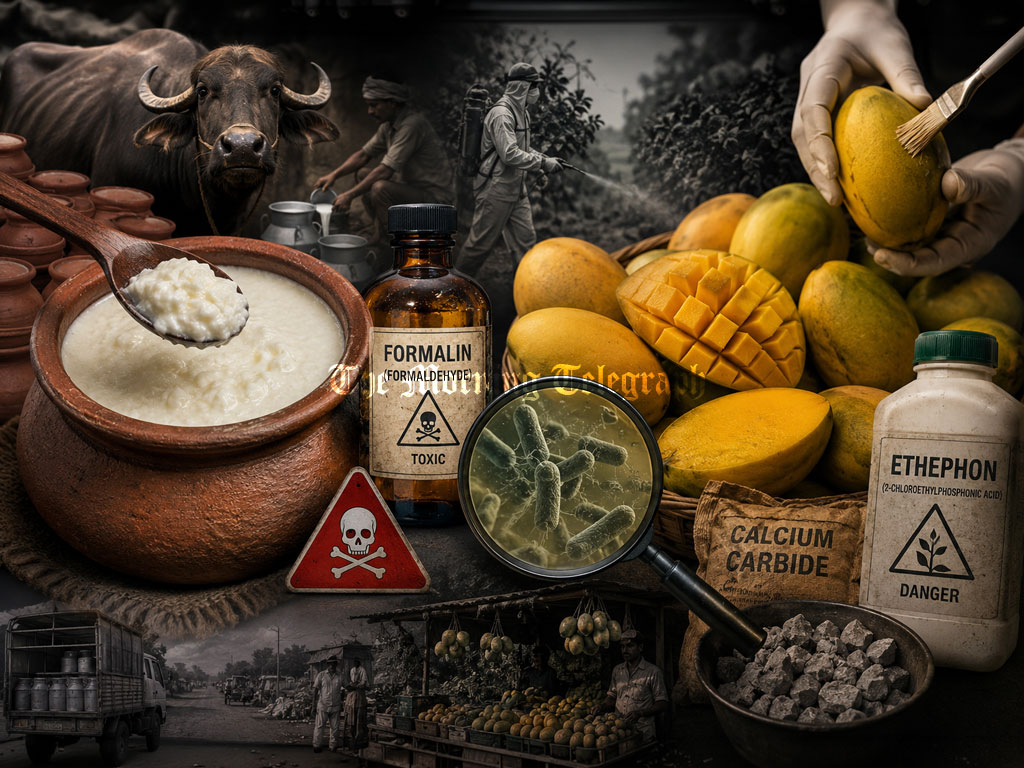
Could the food you eat every day be harming your health? A Morning Telegraph investigation reveals concerns over formalin-tainted buffalo curd and chemically ripened mangoes, exposing serious gaps in food safety, consumer protection, and agricultural infrastructure in Sri Lanka.
Along the sun-baked stretches of the southern highway, rows of red clay pots stacked at roadside stalls present a picture-perfect image of Sri Lanka’s traditional culinary heritage.
For generations, the deep south, particularly the Hambantota and Matara districts, has been the undisputed capital of buffalo curd, locally celebrated as Ruhuna meekiri.
Yet behind this iconic cottage industry lies an escalating crisis of chemical adulteration, as small-scale dairy farmers and middlemen increasingly turn to toxic industrial preservatives like formalin to survive a harsh economic climate and systemic infrastructure failures.

Formalin, a solution of formaldehyde gas in water typically reserved for preserving biological specimens in laboratories and mortuaries, has quietly become a weapon of convenience in the southern dairy belt.
In the intense tropical heat of Hambantota, where temperatures routinely soar, raw buffalo milk spoils within a few hours of milking.
For rural farmers lacking immediate access to refrigeration, the chemical offers a cheap, immediate fix.
By introducing minute amounts of formalin, collectors can halt the growth of lactic acid bacteria entirely, artificially locking the milk in its liquid state for days without the need for a cold chain.
This chemical intervention allows supply chains to stretch across dozens of kilometers from remote inland pastures to busy coastal retail hubs, long past the point where unpreserved milk would have naturally soured.
The roots of this adulteration crisis are deeply tied to the rapid environmental and economic transformation of the Southern Province.
Traditionally, southern buffalo herds roamed freely across vast public plains and harvested paddy fields.
Over the last decade, large-scale infrastructure projects, expanding urban development, and intensified year-round cultivation have drastically consumed these historic grazing grounds.
Forced into marginal lands and facing chronic fodder shortages, local indigenous buffaloes produce low and highly seasonal milk yields.
When prolonged dry spells hit the south, the price of pure buffalo milk skyrockets, creating an intense economic temptation to manipulate the product.
To meet market demand and maximize profits, some operators dilute the premium buffalo milk with water or cheaper cow’s milk, using formalin to chemically alter protein structures so the final curd still appears thick and firm inside the clay pots.
The persistence of formalin in southern curd highlights a significant gap in regional infrastructure and food safety enforcement.
While major dairy processors operate chilling centers along main transportation routes, the deep interior villages where artisanal curd production begins remain largely disconnected from modern cold storage.
Public health inspectors face immense logistical challenges in monitoring a highly decentralized industry made up of thousands of independent backyard kitchens and mobile collectors.
Although national food regulations strictly prohibit any formaldehyde in food products due to its classification as a human carcinogen capable of causing severe gastrointestinal and renal damage, roadside testing remains rare.
Until localized chilling networks are established to bridge the gap between rural fields and highway stalls, the southern curd industry remains caught in a dangerous balance between preserving a centuries-old tradition and relying on chemical shortcuts to survive.
The chemical manipulation of the food supply is not confined to the dairy sector, as fruit vendors across Sri Lanka face a similar battle against time and transport logistics.
Mangoes are highly perishable, and allowing them to ripen naturally on the tree often results in heavy losses from birds, bats, fruit flies, and premature drops during transport.
To protect their margins, many commercial farmers harvest mangoes while they are completely raw, green, and hard.
By transporting the fruit in an unripened state, vendors can minimize bruising along bumpy rural roads before subjecting the produce to rapid artificial ripening immediately before it hits the retail market.
This tactical manipulation allows traders to synchronize large batches of fruit to look perfectly ripe simultaneously, capturing high early-season market prices.
To achieve this accelerated color transformation, local traders rely on industrial chemical agents, most notably calcium carbide and ethephon.
Industrial-grade calcium carbide, cheap and readily available, reacts with environmental moisture to produce acetylene gas, which mimics the natural plant ripening hormone ethylene.
However, this industrial byproduct is frequently contaminated with trace amounts of arsenic and phosphorus hydrides, toxic compounds that pose severe neurological hazards to fruit handlers and can leave dangerous residues on the mango skins.
Increasingly, vendors also use liquid ethephon solutions, an organophosphate compound that breaks down directly into ethylene gas.
While cleaner than carbide, the improper application of these chemicals, including the illegal direct dipping or spraying of raw fruits, leaves consumers exposed to unregulated chemical residues.
The international repercussions of lax agricultural quarantine and processing protocols were recently felt across the region when Japan’s Ministry of Agriculture, Forestry, and Fisheries suspended all fresh mango imports from India.
This sweeping restriction abruptly halted peak-season shipments of premium varieties including Alphonso, Kesar, Langra, and Banganapalli.
While domestic public anxieties frequently center on the risks of artificial ripening agents and pesticide contamination, Japanese plant protection authorities clarified that the enforcement action was triggered by critical compliance failures at export processing centers.
Inspectors discovered severe deficiencies in fumigation and disinfection measures at a major Vapour Heat Treatment facility in Uttar Pradesh.
This specialized heat process is strictly mandated under bilateral trade agreements to eradicate fruit fly larvae and prevent the introduction of invasive pests into Japanese domestic agriculture, demonstrating that a failure to maintain rigorous chemical and biological control standards can instantaneously shut down access to premium global markets.
The widespread use of unauthorized chemical agents in everyday dietary staples presents a silent but severe public health crisis for local consumers.
Ingesting formalin via adulterated curd can trigger immediate gastrointestinal inflammation, leading to stomach pain, severe nausea, vomiting, and ulcers.
Over time, chronic exposure places a heavy burden on filtering organs, leading to irreversible kidney and liver damage while significantly elevating the long-term risk of developing gastrointestinal cancers.
Similarly, consuming mangoes forced to ripen with industrial-grade calcium carbide carries physiological risks due to heavy metal contaminants like arsenic.
Exposure can cause immediate dizziness, headaches, and throat irritation, while long-term ingestion is toxic to the nervous system, potentially leading to memory loss and peripheral neuropathy.
The misuse of ethephon as a direct dip or spray further compounds these dangers, causing acute respiratory discomfort and digestive distress if the fruit skins are not thoroughly handled.
Protecting oneself from these contaminated foods requires a combination of sensory awareness and changes in purchasing habits.
Genuine southern buffalo curd set naturally in a clay pot should have a rich, slightly off-white or yellowish tint, a thick but delicate texture that breaks cleanly when scooped, and a pleasant, characteristically sour aroma.
If a curd pot has no sour smell despite sitting at room temperature, displays an artificially glossy or unnaturally stiff consistency, or refuses to spoil after several days outside a refrigerator, the presence of formalin is highly likely.
For mangoes, consumers must look past superficial skin color.
A chemically ripened mango often displays a uniform, flawless yellow exterior, yet the fruit remains hard near the stem, and the flesh lacks its natural sweetness, tasting bland or chemically bitter.
Naturally ripened mangoes possess a strong, sweet fragrance at the stem end, show a gradual variance in color, and yield slightly to gentle pressure when fully ripe.
Editor’s Note: This investigative exposé by The Morning Telegraph is not intended to undermine the tireless efforts of the farming and harvesting communities who work through immense hardship to put food on our dinner plates.
Farmers remain the true backbone of this nation.
Instead, our objective is to create vital public awareness and strongly insist that state and local authorities step forward to provide the necessary financial support, modern cooling infrastructure, and proper equipment.
Only by bridging these systemic gaps can we help our farmers sustain their livelihoods, protect consumer health, and stay in business safely for generations to come.