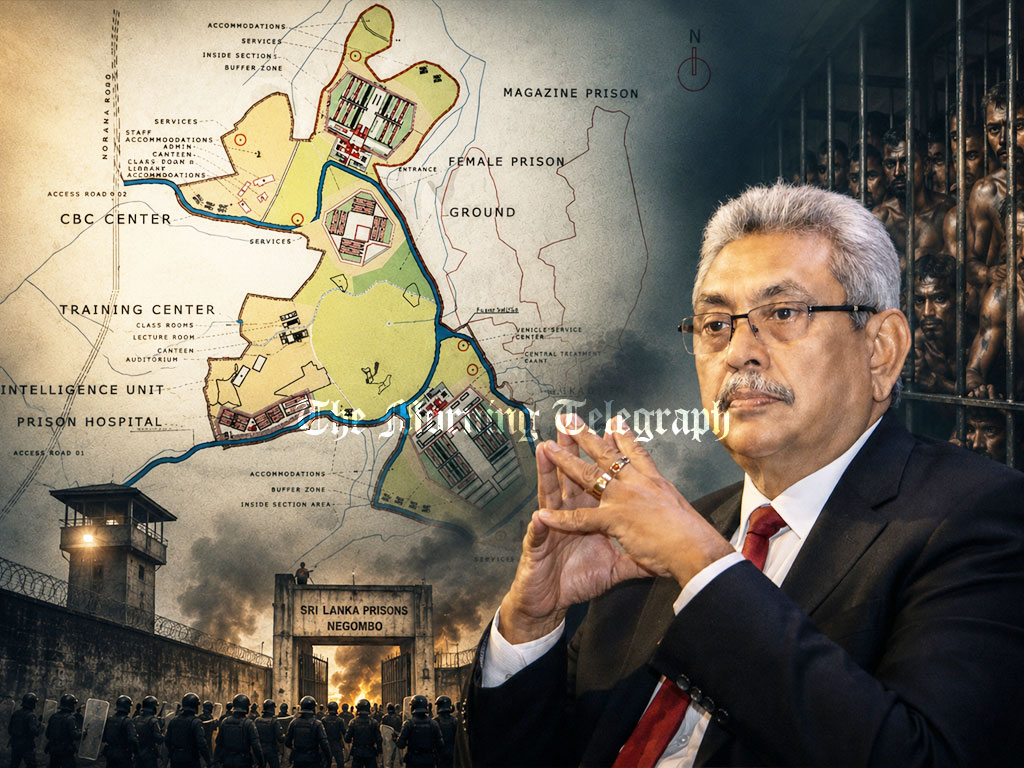
Sri Lanka prison reform faces fresh scrutiny as Negombo deaths expose the gap between Gotabaya’s blueprint and emergency fixes.
Sri Lanka prison reform has returned to the centre of national debate as today’s overcrowding crisis collides with an earlier blueprint for modern correctional hubs.
For decades, Sri Lanka’s prison system has struggled with overcrowding, ageing buildings and operational pressure. Successive governments have promised reform, but the system has continued to deteriorate.
A major attempt to address those structural problems emerged under the previous government through a Five-Year Action Plan from 2021 to 2025. It aimed to transform prisons from a largely punitive system into a rights-based correctional model focused on rehabilitation, modernization and international standards.
The plan was introduced during the presidency of Gotabaya Rajapaksa. It formed part of a wider effort to restructure Sri Lanka’s correctional system after the difficult period of the COVID-19 pandemic.
Government officials, planners and technical teams were then working under intense conditions. They had to maintain essential services while advancing national recovery efforts.
Against that backdrop, the prison reform agenda sought to move beyond outdated infrastructure. It aimed to build a modern correctional framework based on rehabilitation, stronger institutional capacity and international standards.

Sri Lanka Prison Reform and the Millewa Plan
The reform agenda placed the relocation and redevelopment of major prisons at the centre of its strategy.
The proposed relocation of the Welikada Prison complex from Borella to Millewa, Horana, became the largest part of that vision.
The project was not designed merely as a prison expansion plan. It aimed to restructure the correctional system through new infrastructure, rehabilitation facilities, professional training for prison staff and the regeneration of valuable urban land.
However, the deadly Negombo Prison violence, which caused 28 deaths and more than 100 injuries, has pushed the current government toward emergency interventions.
Instead of advancing the planned centralized prison complex, authorities have turned to existing buildings and historical facilities to create more capacity.
This change has raised serious questions about the future of long-term prison modernization. It also raises the question of whether the original reform framework will continue or be replaced by short-term crisis management.
The 2021 to 2025 Five-Year Action Plan responded to persistent prison overcrowding.
At the time, prisons were operating at around 173 percent capacity. That created severe pressure on infrastructure, inmates and prison officers.
The plan identified overcrowding as a central cause of instability inside correctional institutions.
Horana Complex Was Designed as a Modern Hub
One key proposal involved relocating urban prisons, including Welikada and Magazine prisons, to a new 200-acre complex in Millewa, Horana.
The proposed facility was intended to meet international standards, including principles in the Nelson Mandela Rules. These rules set minimum standards for the treatment of prisoners.
The Environmental Impact Assessment for the Prison Relocation Project gives more detail about the scale of the proposal.
It involved a 256-acre site in Millewa. It sought to replace the colonial-era Welikada complex with a modern therapeutic environment.
The project also aimed to free the Borella location for urban regeneration.
Authorities selected Horana because of its expressway access, suitable terrain and proximity to industrial areas. Those industrial zones could support vocational training for inmates.
The proposed complex was planned to include Magazine, Female, Remand and Welikada prisons. It also included a hospital, training centres and staff quarters.
The project addressed long-standing rehabilitation needs. One major feature was a 2,000-bed rehabilitation centre for drug addicts.
That component reflected the role of drug-related offences in the prison population. Nearly 21,000 inmates are currently linked to drug-related cases.
Environmental and Social Planning
Environmental planning formed a major part of the Horana proposal.
According to the EIA report, the site contained 227 plant species and 291 faunal species. Several endemic species were also recorded.
The Mawak Oya and local springs were identified as important habitats for threatened aquatic species, including native fish varieties.
The design included measures to address these concerns.
A wastewater treatment plant with a capacity of about 2,000 cubic metres per day was proposed. It would use anaerobic, anoxic and oxic technology before treated effluent reached the Mawak Oya.
Solid waste plans included composting biodegradable waste and using approved contractors for non-biodegradable and clinical waste.
The relocation project also carried social implications.
The EIA identified the need to relocate 57 households. These included six families living within the project footprint and 51 families in a designated resettlement area in Millewa Watta.
A Compulsory Resettlement Scheme prepared by the Urban Development Authority included new housing, statutory payments and compensation for affected estate workers.
Local stakeholders mainly raised concerns about employment, access to information and protection of resources such as the Mawak Oya.
The report recorded that community representatives did not oppose the project. However, they wanted assurances about local impacts and benefits.
Emergency Fixes Replace Long-Term Planning
Despite these detailed plans, the Horana project remains stalled. The original timeline had targeted completion by 2024.
After the Negombo incident, the government focused instead on rapidly increasing prison capacity through existing infrastructure.
The Ministry of Justice has issued gazette notifications under the Prisons Ordinance. It has designated the historic Bogambara Prison in Kandy and the former Mahamodara Maternity Hospital in Galle as correctional facilities.
These measures aim to address immediate shortages in a system holding around 39,000 inmates, far beyond intended capacity.
The revival of Bogambara Prison marks a sharp departure from the earlier strategy.
The Kandy facility operated for 138 years before it closed in 2014. Authorities had previously identified it for redevelopment linked to cultural tourism and public use.
Reintroducing a high-security correctional facility in central Kandy returns the country to an older prison model.
The earlier relocation strategy had aimed to move major prisons away from congested city environments. It also sought purpose-built facilities designed around rehabilitation and security.
Crisis Management Versus Modernization
The difference between the two approaches also appears in the legal and administrative measures now under consideration.
The Five-Year Action Plan proposed comprehensive restructuring of the prison service. It included staff professionalization and digital integration.
Current measures focus mainly on reducing immediate pressure on overcrowded prisons.
One proposed legal change involves amending the Poisons, Opium and Dangerous Drugs Ordinance. The amendment would allow bail eligibility to be determined by gross weight instead of net weight.
The objective is to reduce delays linked to Government Analyst reports. It could also ease the number of drug-related remand cases.
A committee is also studying house arrest for minor offenders. That option had already appeared within the wider reform framework.
However, the rapid use of repurposed buildings creates new operational challenges.
Authorities must deal with staff shortages, security needs and infrastructure limitations as they convert new locations into correctional centres.
The former Mahamodara maternity facility, for example, must shift from a public health purpose into a secure prison environment.
The move from a large, purpose-built Millewa complex to multiple smaller facilities in existing urban locations reflects the urgency now facing prison administrators.
Emergency measures may prevent further instability in the short term. However, the original goals of Sri Lanka prison reform, including a modern centralized correctional system, remain largely unrealized.
The central question now is whether Sri Lanka will return to long-term restructuring or continue patching the crisis with temporary facilities.