Sri Lanka tourism fund reserves, hotel leases and state lands face scrutiny amid allegations of political influence and financial abuse.
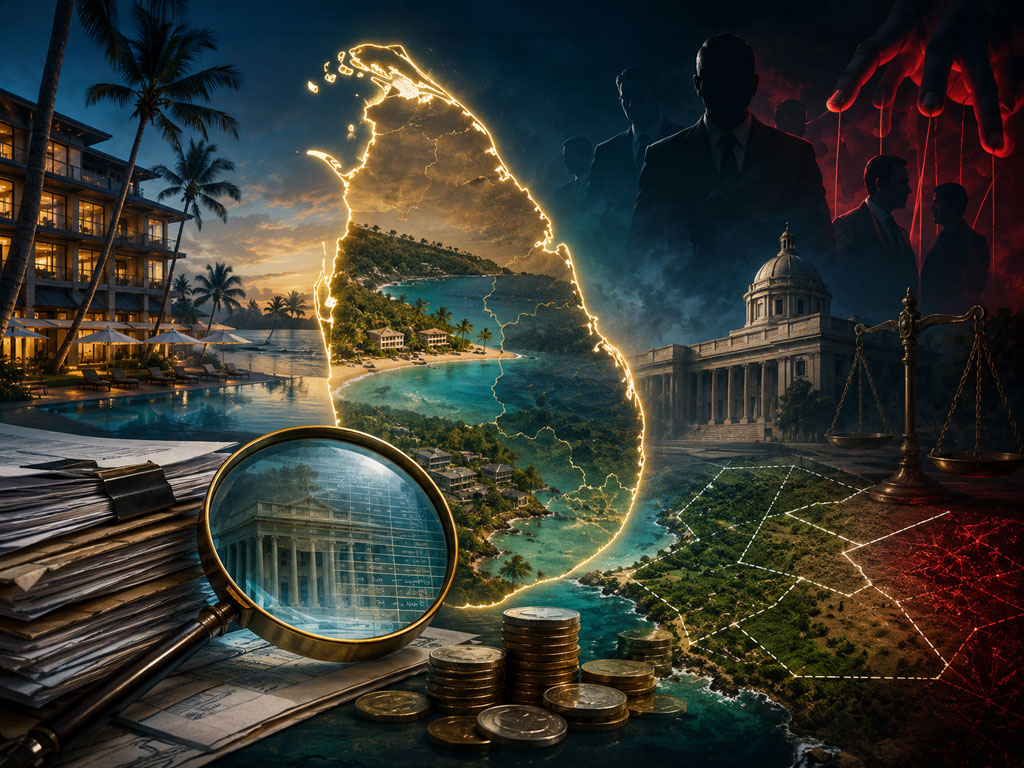
The Sri Lanka tourism fund and several valuable state-owned properties face serious scrutiny following allegations of political interference, questionable leases and organised financial abuse.
Tourism remains strategically important to Sri Lanka’s economic stability and foreign exchange earnings. The Tourism Act No. 38 of 2005 created a specialised institutional and financial framework to support its planned development.
When the Act took effect in October 2007, it divided tourism responsibilities among four independent state institutions. The Tourism Development Fund, established under Section 23(1), finances those bodies.
The fund receives money mainly from two sources. The first is one-third of the airport departure levy collected by the Civil Aviation Authority, equivalent to US$5. The second is a 1% Tourism Development Levy charged on the annual turnover of registered tourism businesses.
An analysis cited in the original account states that the promotional savings account contains Rs.17.5 billion. Authorities should use that money exclusively to market and promote Sri Lanka internationally.
The Tourism Development Authority account reportedly holds another Rs.7.5 billion for infrastructure planning, regulation and land-bank development.

Together, the two accounts maintain reserves of Rs.24.5 billion for tourism promotion and development. The departure and tourism development levies also reportedly generate between Rs.10 billion and Rs.15 billion annually.
Under Section 24(8), authorities must distribute the money according to statutory percentages. The Sri Lanka Tourism Promotion Bureau receives 70%, while the Tourism Development Authority receives 14%.
The Tourism and Hotel Management Institute receives 12%, and the Sri Lanka Convention Bureau receives the remaining 4%.
However, the original report alleges that politically connected business interests and public authorities are attempting to gain control of these funds and state assets. Those claims require a transparent and independent investigation.
Sri Lanka Tourism Fund Merger Raises Control Fears
Under the Act, the power to spend these funds rests with the relevant boards of directors. A chairman cannot independently authorise payments.
Internal sources cited in the account claim that the Government’s proposed merger of three institutions into a National Tourism Commission could place the fund under greater political and bureaucratic control.
Critics argue that such a restructuring could weaken the professional independence created by the existing legal framework.
One major dispute concerns the 5.5-acre property occupied by the Kingsbury Hotel in Colombo 01. The hotel is owned and controlled by businessman Dhammika Perera.
According to the account, the hotel has paid the Government annual rent of only Rs.2.5 million, or Rs.25 lakhs. That equals approximately Rs.38,000 per acre each month.
The report states that former Minister Harin Fernando agreed to increase the annual rent to Rs.5 million from 2026.
However, it claims the Government Valuation Department assessed the property’s annual rental value at Rs.325 million. On that calculation, accepting Rs.5 million would cost the State more than Rs.32 crore annually.
The article further alleges that negotiations concerning this arrangement are taking place at the Presidential Secretariat. No official response from the parties named was included in the supplied material.
Yala and Marble Beach Land Allegations
The account also raises allegations involving former Tourism Development Authority Chairperson Kimarli Fernando and businesses linked to her husband, Malik Fernando.
It claims her appointment during the Gotabaya Rajapaksa administration lacked the necessary qualifications and alleges that decisions made during her tenure benefited her husband’s commercial interests.
These are serious allegations and should be presented as claims unless supported by final official findings or court determinations.
During former President Mahinda Rajapaksa’s administration, the Tourism Development Authority leased land in Palatupana, Yala, to seven companies.
One parcel went to Wild Coast Leisure (Pvt) Ltd, identified in the account as a Dilmah subsidiary connected to Kimarli Fernando’s family.
Documents cited by the report allegedly show that the company occupied 155 perches within an environmentally sensitive protected area west of its allocated property.
During the Yahapalana administration, Cabinet reportedly approved a 50-year lease. However, the article alleges that Kimarli Fernando later issued the same company a 30-year lease for Rs.30,666.67 per month.
It further claims that authorities reduced a legally required 25-metre coastal buffer to 15 metres, resulting in an alleged 10-metre encroachment.
Separate allegations concern more than 21 acres of state land facing Marble Beach in Trincomalee. Activists and observers claim Kimarli Fernando transferred or facilitated control of the land for her husband’s benefit.
Section 62 of the Tourism Act No. 38 of 2005 and State Lands Ordinance regulations reportedly restrict the sale or transfer of land vested in the Tourism Authority without written ministerial approval.
Activists also allege that Malik Fernando is seeking ownership through a deed carrying a false or defective title. The account says photographs show signs advertising a “Dilmah – Luxury Hotel Project” at the location.
These allegations should be investigated by the relevant land, tourism and law-enforcement authorities. The people and companies named should also receive an opportunity to respond.
Governance Crisis Threatens the Pekoe Trail
The article also highlights an administrative crisis surrounding the 300-kilometre Pekoe Trail, created by Spanish trail-tourism expert Miguel Cunard.
Cunard reportedly warned about the project’s future in a detailed resignation letter.
He described the Pekoe Trail not as a private business, but as a cultural, environmental and community asset. However, he said weak governance and poor transparency were driving donors and private stakeholders away.
Cunard also warned that the Pekoe Trail Organization could become a politically influenced non-governmental organisation without clear accountability or adequate technical expertise.
To protect the project, he recommended formalising its institutional structure through a Presidential charter.
He also proposed rules preventing private parties from arbitrarily obstructing the trail. In addition, he called for a sustainable financing mechanism supported by the Tourism Development Levy.
Appeal for Immediate Presidential Intervention
The original account urges President Anura Kumara Dissanayake’s administration to investigate whether the tourism sector is operating according to national law or private commercial agendas.
It calls for immediate intervention to prevent any agreement that would undervalue the Kingsbury Hotel property and cause losses to the Government.
It also seeks a rapid investigation into the alleged occupation or transfer of land in Yala and Marble Beach. At the same time, it calls for protection for public officials who act lawfully.
Finally, it urges authorities to identify those responsible for weakening international projects such as the Pekoe Trail. It recommends creating a public-private trusteeship based on proposals from international specialists.
Sri Lanka’s tourism assets and reserves belong to the public interest. The Government must therefore subject every disputed lease, transfer and spending decision to transparent legal and financial scrutiny.
Independent investigations, documented responses from all parties and public disclosure of findings will be essential to establish the truth and protect national wealth.
SOURCE:- SRI LANKA LEADER