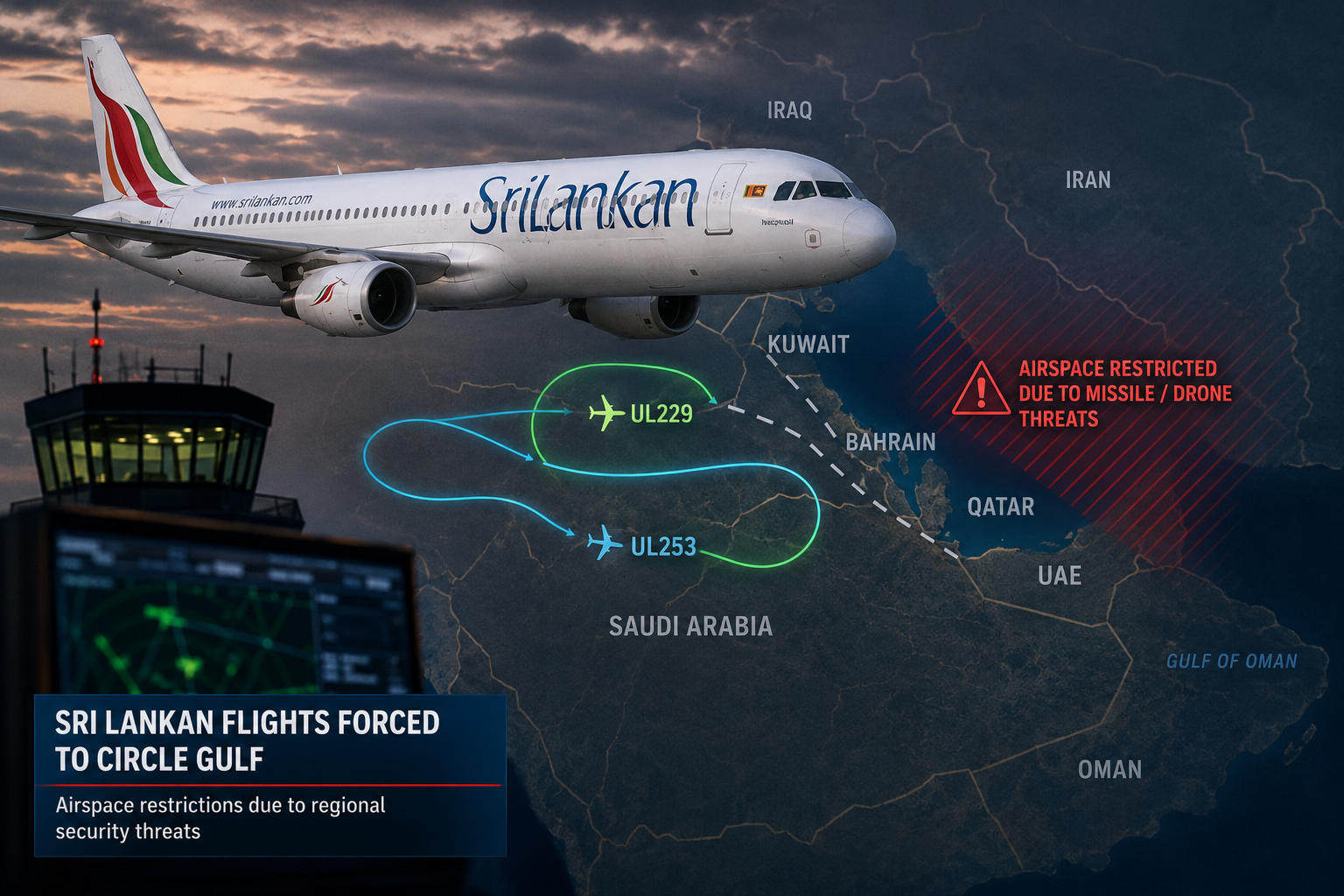
SriLankan Airlines flights delayed by Gulf airspace closures circled for over an hour as missile and drone attacks disrupted routes to Kuwait and Dammam.
Two SriLankan Airlines flights delayed by sudden Gulf airspace closures remained airborne for more than an hour on Tuesday as missile and drone attacks disrupted regional aviation.
Flights UL229 and UL253 were travelling from Colombo to Kuwait City and Dammam, respectively. Both aircraft were approaching the Gulf on July 14 when the rapidly changing security situation interrupted normal operations.

SriLankan Airlines Head of Corporate Communications Deepal Perera said the aircraft could not immediately continue to their destinations. Kuwait and Saudi Arabia had imposed temporary restrictions on their airspace.
Renewed military exchanges involving Iran had triggered heightened security alerts across the Gulf. Iran launched missiles and drones towards several regional locations. Meanwhile, countries hosting or located near United States military facilities activated their air-defence systems.
The European Union Aviation Safety Agency also strengthened its conflict-zone warning on July 14. It advised airlines to avoid the airspace of Kuwait, Bahrain, Qatar and the United Arab Emirates, along with the Gulf of Oman.
The agency said civilian aircraft could face danger from missiles and drones. It also warned of possible misidentification by military air-defence systems operating under heightened alert, particularly during fast-moving attacks involving several countries and overlapping military responses across crowded regional airspace.
SriLankan Airlines Flights Delayed in Holding Patterns
Flight UL229 departed Bandaranaike International Airport for Kuwait City shortly after 5.00 p.m. on July 14.
Flight-tracking records show that the Airbus A321neo operating the service left Colombo at approximately 5.22 p.m. That was around 12 minutes after its published departure time.
Flight UL253, also operated by an Airbus A321neo, departed Colombo for Dammam at approximately 6.36 p.m. Flight-tracking data shows that it landed in Dammam at about 9.23 p.m. local time. The aircraft spent approximately five hours and 17 minutes in the air.
Perera said both aircraft had to fly holding patterns near the affected region for approximately one hour and 10 minutes. The pilots waited for regional authorities to grant clearance.
He explained that the aircraft could not simply turn around and return to Colombo. Crews had fuelled them for their scheduled journeys. After reaching the Gulf region, they did not have enough reserve fuel to safely make an immediate return flight to Katunayake.
Therefore, the pilots remained in contact with regional air traffic controllers. They waited until authorities lifted the restrictions.
Once the relevant airspace reopened and controllers granted permission, both aircraft continued safely to their scheduled destinations.
Sudden Closures Disrupt International Aviation
The two SriLankan Airlines aircraft were not the only flights affected by the unexpected restrictions.
According to Perera, numerous international aircraft had to circle or wait for revised instructions. Airports and air traffic control authorities were trying to manage the developing security threat.
Sudden airspace closures can cause severe congestion. Aircraft already airborne must enter holding patterns, divert to alternative airports or return to their departure points.
However, crews must consider several factors before choosing an option. These include remaining fuel, distance to the destination, weather conditions and the availability of nearby diversion airports. Operators must also determine whether those airports can accept extra aircraft and passengers.
For UL229 and UL253, waiting for the airspace to reopen represented the safest operational choice.
Neither aircraft reported a technical failure. There were also no reports of injuries or other onboard emergencies.
Return Services Arrive Back in Colombo
After safely landing in Kuwait and Dammam, both aircraft later operated their scheduled return services to Sri Lanka.
Flight UL230 from Kuwait City reached Bandaranaike International Airport at approximately 7.03 a.m. on Wednesday, July 15.
The return service from Dammam arrived at approximately 6.04 a.m. It brought back passengers who had been waiting at the two Gulf airports.
As a result, the temporary closures delayed the services but did not force their cancellation. Passengers also avoided prolonged stranding at either destination.
Gulf Routes Remain Exposed to Security Risks
The incident highlights the growing operational risks facing airlines as military activity intensifies across the Middle East.
On July 14, the European aviation safety authority reinstated and strengthened its warning covering several Gulf airspaces. The notice remains valid until July 29. However, individual airlines may impose further restrictions based on their own security assessments.
A separate warning advising carriers to avoid Iranian, Iraqi and Lebanese airspace has been extended until the end of August.
The Gulf carries particular risk because it contains some of the world’s busiest aviation corridors. Aircraft travelling between South Asia, Europe, Africa and the Middle East frequently fly through or close to the affected areas.
SriLankan Airlines services to Kuwait, Dammam, Dubai, Doha, Riyadh and other Gulf destinations remain especially important for Sri Lankan migrant workers and their families.
Further restrictions could lead to longer journeys, diversions and cancellations. They could also increase operating costs for the national carrier.
Passengers travelling to or through the Middle East should check the latest flight status before leaving for the airport. They should also follow official travel alerts from SriLankan Airlines.
Although UL229 and UL253 ultimately landed safely, the incident shows how quickly military developments can disrupt civilian aviation. It also demonstrates how few options crews may have when authorities close airspace without warning.