The Trincomalee oil tank tender opens 29 tanks to investors as Sri Lanka, India and the UAE advance a wider regional energy strategy.
The Trincomalee oil tank tender is gathering momentum as Sri Lanka invites international investors to redevelop 29 storage tanks at the strategically important eastern port.
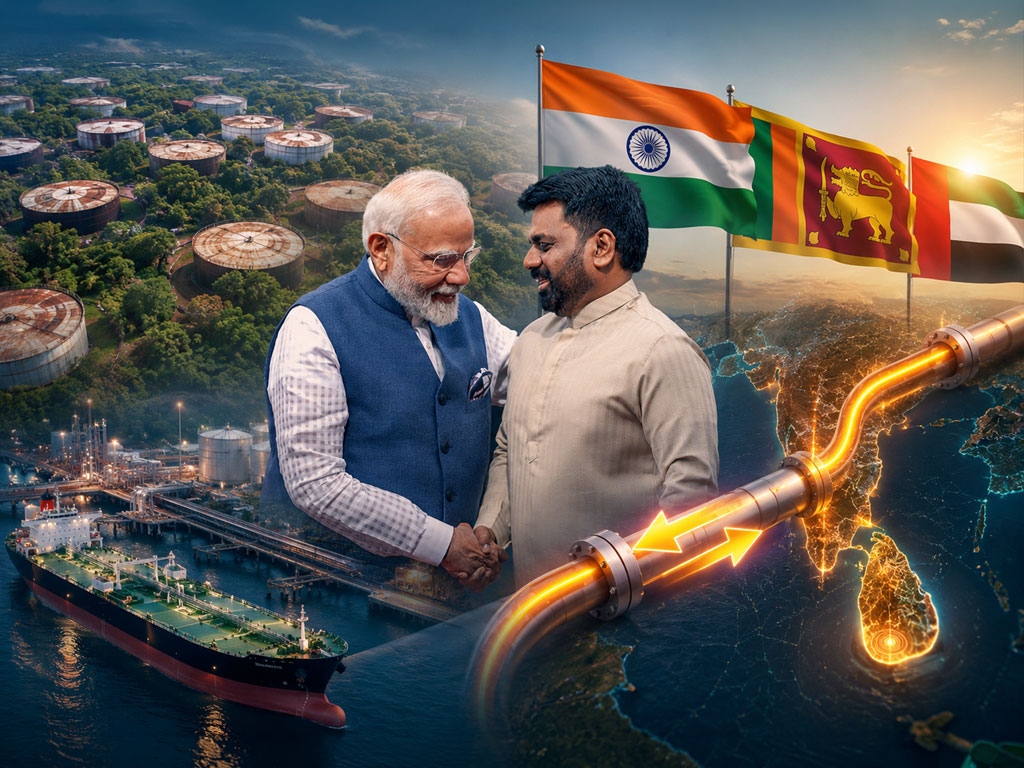
Behind the commercial bidding process lies a wider geopolitical strategy. The plan places Trincomalee at the centre of an emerging South Asian energy network involving Sri Lanka, India and the United Arab Emirates.
Trinco Petroleum Terminal Pvt. Ltd., known as TPTL, announced the international tender. However, the project extends beyond the rehabilitation of ageing fuel infrastructure.
It forms a key part of the tripartite energy framework signed by Sri Lanka, India and the UAE in April 2025. The agreement aims to connect regional fuel infrastructure and strengthen long-term energy security.

Trincomalee Oil Tank Tender Supports Pipeline Plan
A proposed bi-directional petroleum pipeline between southern India and Trincomalee sits at the heart of the wider strategy.
The pipeline would allow petroleum products to move in both directions. Sri Lanka could gain access to more stable supplies during shortages or periods of market disruption.
Meanwhile, India would secure an expanded energy logistics network in the Bay of Bengal.
Indian officials have openly supported faster progress on the project.
During recent talks in Colombo, Indian Foreign Secretary Vikram Misri urged officials to accelerate strategic initiatives connected to Trincomalee.
“There is no further time to lose,” he said while calling for rapid implementation.
His remarks reflected New Delhi’s growing focus on regional energy resilience as global oil markets become increasingly volatile.
Ownership Structure Protects Sri Lankan Control
The project structure maintains India’s long-term commercial involvement while preserving majority Sri Lankan ownership.
The Ceylon Petroleum Corporation holds a controlling 51 percent stake in TPTL. Lanka IOC, India’s state-linked energy company, owns the remaining 49 percent.
As a result, both partners would benefit from commercial revenue generated through the redevelopment of the 29 tanks.
However, the Sri Lankan Government would continue receiving the majority share of lease income and operational returns through its controlling stake.
The new bidding process does not affect the 14 storage tanks independently controlled by Lanka IOC under a separate lease agreement.
Those tanks remain under Lanka IOC’s management and continue supporting its fuel distribution and bunkering activities.
Trincomalee Could Become Major Energy Hub
Energy analysts say the neglected World War II-era storage complex has the potential to become a leading petroleum storage and ship-refuelling centre in the Indian Ocean.
Modernising the facilities could attract foreign investment, create employment and establish a significant economic corridor along Sri Lanka’s eastern coast.
The project also carries strong political significance.
Before coming to power, sections of the current ruling coalition had criticised aspects of Indian involvement in Trincomalee.
However, President Anura Kumara Dissanayake’s administration has chosen to continue the joint venture and the wider regional energy partnership.
New Delhi has welcomed that decision as evidence of policy continuity and a more predictable investment environment.
For Sri Lanka, the redevelopment could bring substantial foreign capital without increasing sovereign debt. It could also strengthen domestic fuel security and improve storage capacity.
For India, the project expands strategic influence over important energy infrastructure in the Bay of Bengal.
As international bidding begins, the Trincomalee oil tank tender is turning a dormant wartime facility into one of the region’s most important emerging energy projects.