By Dwayne Ferreira.
Federal Reserve rate hike lifts US rates to 3.75%-4% as policymakers confront persistent inflation and signal possible further tightening.
WASHINGTON — The Federal Reserve rate hike announced Wednesday has pushed US borrowing costs higher for the first time in more than three years, as policymakers renew their battle against persistent inflation.
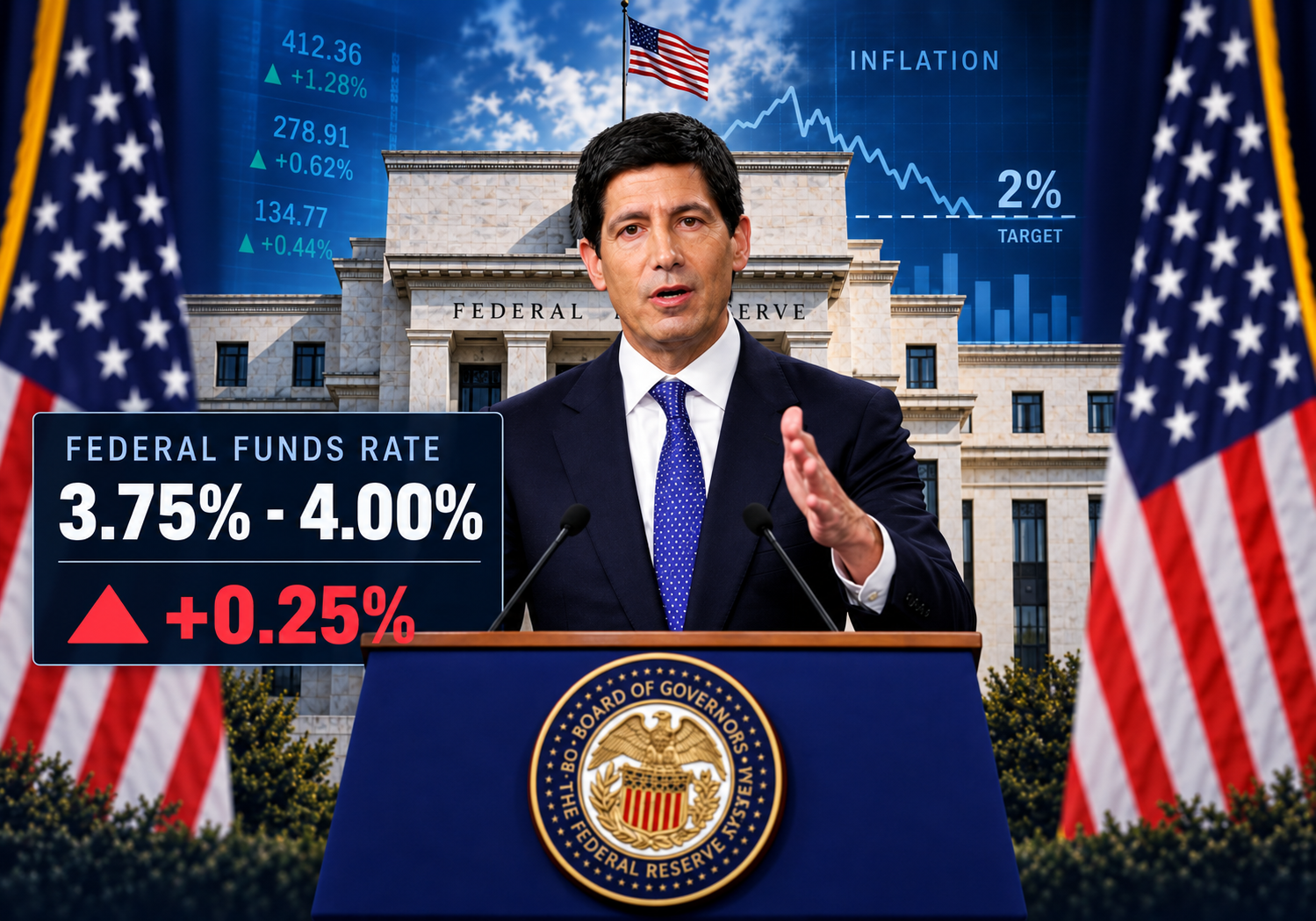
The Federal Open Market Committee unanimously approved a 25-basis-point increase on September 16. The decision lifted the target range for the federal funds rate from 3.50%-3.75% to 3.75%-4.00%.
It was the Federal Reserve’s first rate increase since July 2023.
All 12 voting members supported the decision, according to the central bank’s official statement. The Federal Reserve said economic activity continues to expand at a solid pace while inflation remains elevated.
The move represents a major shift after an extended period without rate increases. It also signals that officials believe inflationary pressures remain serious enough to justify higher borrowing costs despite the potential impact on households, businesses and financial markets.
Federal Reserve Chair Kevin Warsh backed the unanimous decision as the central bank attempts to steer inflation back towards its long-standing 2% target.

Federal Reserve Rate Hike Targets Persistent Inflation
The Federal Reserve said domestic spending remained resilient, while productivity growth and capital investment remained strong.
It also said job gains had broadly kept pace with growth in the workforce and that the unemployment rate had changed little.
However, inflation remains the central concern.
In its September statement, the Federal Open Market Committee said the latest policy action would support a more timely return of inflation towards its 2% objective.
Recent geopolitical developments have also increased economic uncertainty.
Energy prices have become particularly important because rising fuel costs can spread through transportation, manufacturing and consumer prices.
The central bank now faces the difficult task of deciding how much additional tightening may be necessary without damaging economic growth or employment.
Unlike a tax or government spending decision, an interest-rate increase works through the financial system.
Higher policy rates generally make borrowing more expensive. That can discourage consumers and companies from taking on new debt and can slow spending and investment.
The aim is to reduce excessive demand and, over time, ease pressure on prices.
However, monetary tightening also brings risks. If rates remain too high for too long, economic activity can weaken sharply.
That makes each incoming inflation, employment and growth report increasingly important.
Another US Rate Increase Could Follow
Wednesday’s increase may not be the final move of 2026.
Federal Reserve projections released alongside the decision indicated that most policymakers expect additional tightening.
Reuters reported that the Fed signalled further increases could come in the months ahead, while most policymakers projected at least one additional rate rise before the end of the year.
The Federal Reserve still has two scheduled policy meetings remaining in 2026.
Officials are due to meet on October 27-28, followed by another meeting on December 8-9. The December gathering is also scheduled to include a new Summary of Economic Projections.
However, the projected path should not be interpreted as a guaranteed increase.
Future decisions will depend on economic data and the balance of risks facing employment and inflation.
That means a further increase could become more likely if inflation remains stubbornly high.
Conversely, weaker economic activity or a significant deterioration in the labour market could alter the policy outlook.
The September decision therefore marks the reopening of a tightening cycle rather than guaranteeing a predetermined sequence of increases.
Fed Sees Inflation Remaining Above Target
The inflation outlook helps explain why officials acted.
The Federal Reserve’s latest projections put 2026 PCE inflation at 3.7%, considerably above its 2% objective.
Core PCE inflation, which excludes volatile food and energy costs, was projected at 3.4%.
The projections suggest inflation could fall substantially during 2027 but may take considerably longer to return fully to the central bank’s 2% goal. Reuters reported that Fed forecasts do not show inflation reaching that target until 2029.
At the same time, the American economy has remained more resilient than some policymakers previously feared.
That resilience creates a difficult combination for the Fed.
Strong spending, investment and employment can protect the economy from recession. However, sustained demand can also make inflation harder to bring down.
This leaves policymakers attempting to cool price growth without unnecessarily undermining the broader economy.
Trump Pushes for Much Lower Interest Rates
The Federal Reserve rate hike also comes amid public pressure from President Donald Trump, who has repeatedly called for substantially lower borrowing costs.
Trump has argued that lower rates would encourage investment and economic expansion.
Following Wednesday’s decision, he renewed his demand for rates of around 1% or lower, according to Reuters.
The disagreement illustrates the longstanding distinction between fiscal and monetary policymaking in the United States.
The White House sets broader administration economic policy, while the Federal Reserve makes monetary-policy decisions through the Federal Open Market Committee.
Warsh has stressed the importance of price stability while leading the central bank through an increasingly politically sensitive period.
The Federal Reserve’s September decision was nevertheless unanimous.
Therefore, despite political disagreement surrounding the direction of borrowing costs, all voting FOMC members supported Wednesday’s quarter-point increase.
What Higher Rates Mean for American Households
The federal funds rate does not directly set the interest rate consumers pay on every loan.
However, it influences financing conditions throughout the US banking and credit system.
As policy rates rise, borrowing can become more expensive for consumers with credit-card balances, variable-rate loans and certain other forms of debt.
Businesses can also face higher financing costs when borrowing money to expand operations, purchase equipment or refinance existing liabilities.
Mortgage rates do not automatically move point-for-point with the federal funds rate because longer-term bond-market conditions also influence them.
Still, expectations surrounding Federal Reserve policy can have a powerful effect across credit markets.
For indebted households, higher rates can place additional pressure on monthly budgets.
For savers, the effect can be more favourable.
Banks and other institutions may offer higher yields on savings accounts, certificates of deposit and money-market products when market interest rates increase.
As a result, the impact of tighter policy differs significantly depending on whether a household is primarily borrowing or saving.
Markets React to Renewed Fed Tightening
Financial markets quickly adjusted to the Federal Reserve’s change in direction.
Reuters reported that the US dollar strengthened after the announcement while short-term Treasury yields rose.
Major US equity indexes also came under pressure as investors assessed the prospect of further tightening and potentially higher borrowing costs for longer.
The market reaction reflects the central role Federal Reserve policy plays in asset valuations.
Higher government bond yields can make fixed-income investments more attractive relative to shares.
At the same time, more expensive borrowing can reduce corporate profits or discourage investment.
Growth-focused companies can be particularly sensitive because investors often value them partly on earnings expected years into the future.
Higher interest rates reduce the present value investors attach to those future earnings.
However, markets are likely to remain sensitive to new economic data rather than Wednesday’s decision alone.
Energy Costs Add to Fed’s Challenge
Energy prices remain another source of uncertainty.
Oil prices rose sharply ahead of the September meeting amid geopolitical tensions and disruptions to global energy supplies.
Reuters reported before the decision that oil had moved above $100 a barrel, adding to concerns about inflation and strengthening expectations that the Federal Reserve could raise rates.
Higher oil prices can spread far beyond petrol stations.
Transport companies face increased fuel bills. Manufacturers may encounter higher production and delivery costs. Airlines, logistics companies and retailers can also face increased operating expenses.
Businesses may then attempt to pass some of those costs to consumers.
That can make an energy-driven inflation shock broader and more persistent.
For the Federal Reserve, the critical question is whether higher energy prices remain temporary or begin influencing wages, services and other parts of the economy.
Fed Enters Another Delicate Phase
The September Federal Reserve rate hike marks a significant turning point in US monetary policy.
After more than three years without an increase, policymakers have again chosen tighter financial conditions to confront inflation.
Yet officials are not signalling that every future decision has already been made.
The Fed’s next meetings on October 27-28 and December 8-9 will provide policymakers with further opportunities to assess inflation, employment, consumer spending and broader economic conditions.
Another increase remains possible if price pressures fail to ease.
For households and businesses, that means borrowing costs could remain elevated as the central bank tries to restore price stability without triggering a sharp economic slowdown.
The stakes extend well beyond Wall Street.
Interest-rate decisions can affect mortgages, credit cards, company investment, savings returns, the US dollar and financial markets around the world.
After Wednesday’s unanimous decision, investors will now scrutinise every major economic release for clues about what comes next.
The Federal Reserve has restarted its inflation fight.
Whether one additional increase proves sufficient will depend on how quickly price pressures respond.