By Dwayne Ferreira.
Trump Iran war talks with Gulf leaders at the UN will focus on post-war strategy, regional security, shipping and energy risks.
WASHINGTON — Trump Iran war talks with Gulf leaders are expected to take place next week in New York, as Washington considers its next steps in the seven-month conflict and a possible strategy for the period after the fighting ends.
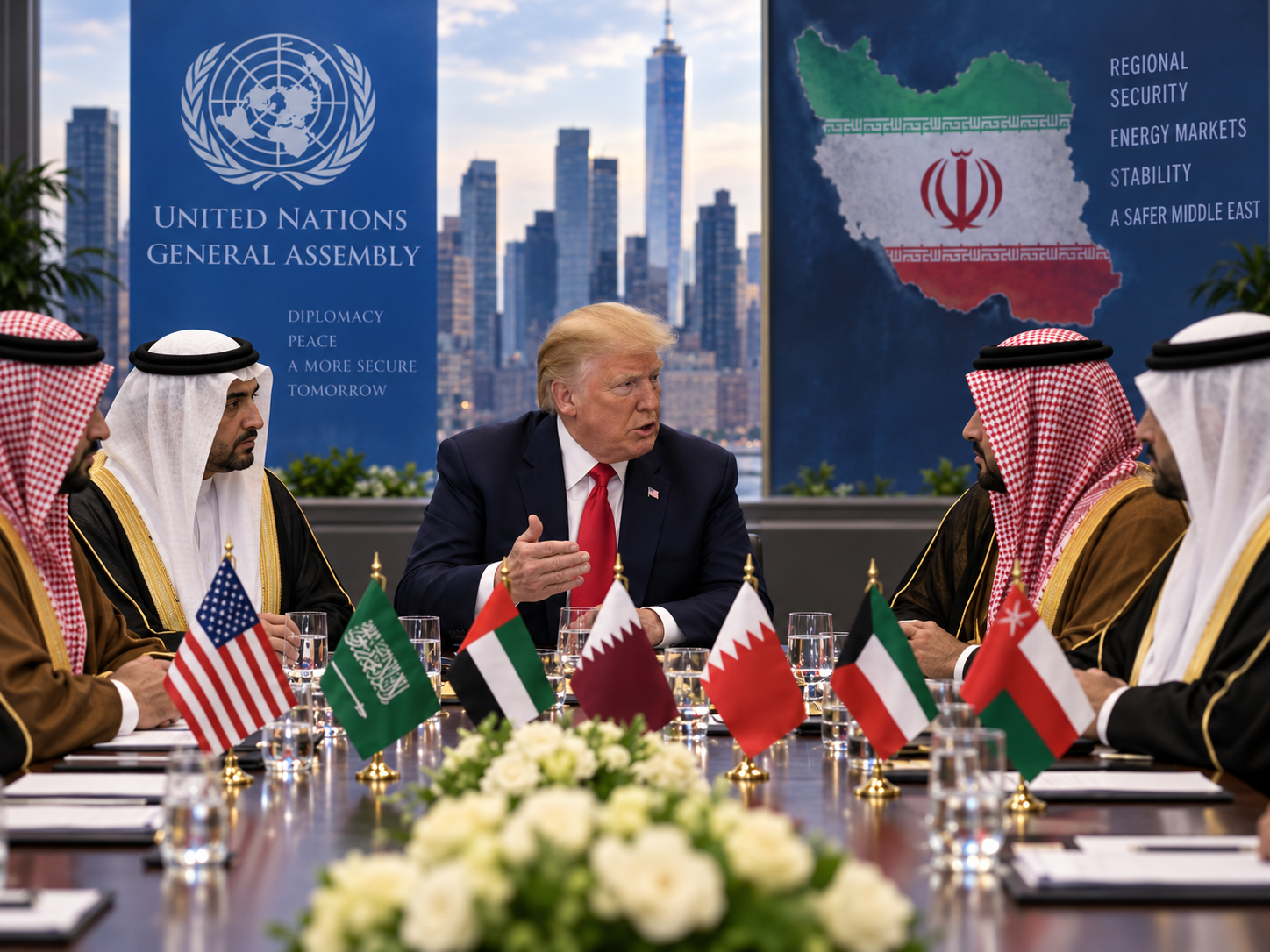
US President Donald Trump is expected to meet Gulf leaders on Tuesday on the sidelines of the United Nations General Assembly. The discussions are expected to focus on the Iran conflict and US proposals for what could follow it, according to Reuters, citing an Axios report.
The gathering is expected to involve representatives from the six Gulf Cooperation Council countries: Saudi Arabia, the United Arab Emirates, Qatar, Bahrain, Kuwait and Oman. The GCC officially comprises those six states.
The meeting comes at a sensitive point for Gulf governments. They face direct security risks from the conflict while also confronting its economic consequences.
Those concerns include threats to critical infrastructure, disruption to shipping routes and continued uncertainty across global energy markets.

Trump Iran War Talks Focus on Post-War Strategy
The discussions are expected to centre heavily on US ideas for a post-war strategy, although Washington has not publicly presented a detailed final framework.
Reuters reported that Trump said on September 16 that he hoped the conflict was nearing an end. He also said Iran appeared willing to reach a deal, although he gave no detailed explanation of what such an agreement would involve.
The conflict began on February 28 with US and Israeli strikes on Iran and has now entered its seventh month. Iran subsequently launched attacks against Gulf states, according to the Gulf Cooperation Council, which condemned missile and drone strikes targeting its member countries.
For Washington’s Gulf partners, the question is therefore not only how the fighting ends. They also need to know what security arrangements could follow and whether those arrangements can reduce the risk of another regional escalation.
The Gulf states have major interests in whatever political and security structure eventually emerges.
Several maintain important diplomatic and commercial relationships across the region while also cooperating closely with the United States on defence and security.
That position makes them central to any effort to build a durable regional framework after the conflict.
Hormuz and Energy Security Remain Major Concerns
Maritime security is likely to remain a major concern surrounding the talks.
The Strait of Hormuz has become one of the most important strategic issues arising from the conflict. Before hostilities erupted, roughly 20% of global oil supplies passed through the waterway, according to Reuters.
Continued restrictions or instability there could affect oil supplies, shipping costs and international energy markets.
The situation has become more complicated because of developments around Yemen and the Red Sea.
Iran-aligned Houthi forces have made significant gains along Yemen’s Red Sea coastline, including near the Bab el-Mandeb Strait, another strategically important passage for international trade and energy shipments.
Saudi Arabia has also faced renewed attacks connected to fighting in Yemen. Reuters reported this week that Houthi forces launched missiles and drones towards the Khamis Mushait airbase following Saudi strikes in Yemen.
These developments add urgency to Gulf efforts to prevent the wider Iran confrontation from creating another cycle of instability across the region.
For the Gulf governments, protecting oil facilities, ports, airports, military sites and commercial shipping will remain central to discussions about any future security arrangement.
Nuclear Issue Still Hangs Over Conflict
Iran’s nuclear programme also remains a central issue.
Trump has repeatedly identified Iran’s nuclear capabilities as a major US concern during the conflict. Tehran maintains that it does not possess nuclear weapons and says its nuclear programme is peaceful.
Diplomatic efforts have also produced mixed signals.
In August, Trump said talks involving Iran were taking place. Iranian officials disputed Washington’s account and said negotiations had not been arranged in the manner described by the US president.
The conflicting accounts highlight the uncertainty surrounding any possible negotiated route out of the conflict.
Gulf leaders are therefore expected to seek greater clarity over Washington’s plans, particularly whether the United States intends to pursue negotiations, maintain military and economic pressure, or combine both approaches.
Any eventual settlement could directly affect regional military deployments, trade routes and Gulf security calculations.
UN Meetings Offer Major Diplomatic Opportunity
The talks will take place during one of the year’s largest gatherings of international leaders.
The United Nations says its 2026 General Assembly High-level Week runs from September 18 to September 28, while the General Debate begins on September 22. World leaders traditionally use the gathering for bilateral and multilateral discussions alongside formal UN proceedings.
That setting gives Gulf governments an opportunity to communicate their priorities directly to Trump as Washington develops its approach towards Iran.
Those concerns are likely to include freedom of navigation, infrastructure security, energy stability and preventing the conflict from spreading further across the Middle East.
The Trump Iran war talks could also provide an indication of how much agreement exists between Washington and its Gulf partners over what should happen when major hostilities eventually end.
However, no detailed public agenda for Tuesday’s meeting has been released, and the United States has not announced a comprehensive post-war plan.
With the conflict affecting Gulf security, strategic waterways and global energy markets, the New York discussions could nevertheless become an important stage in determining how Washington and its regional partners approach the next phase of the crisis.