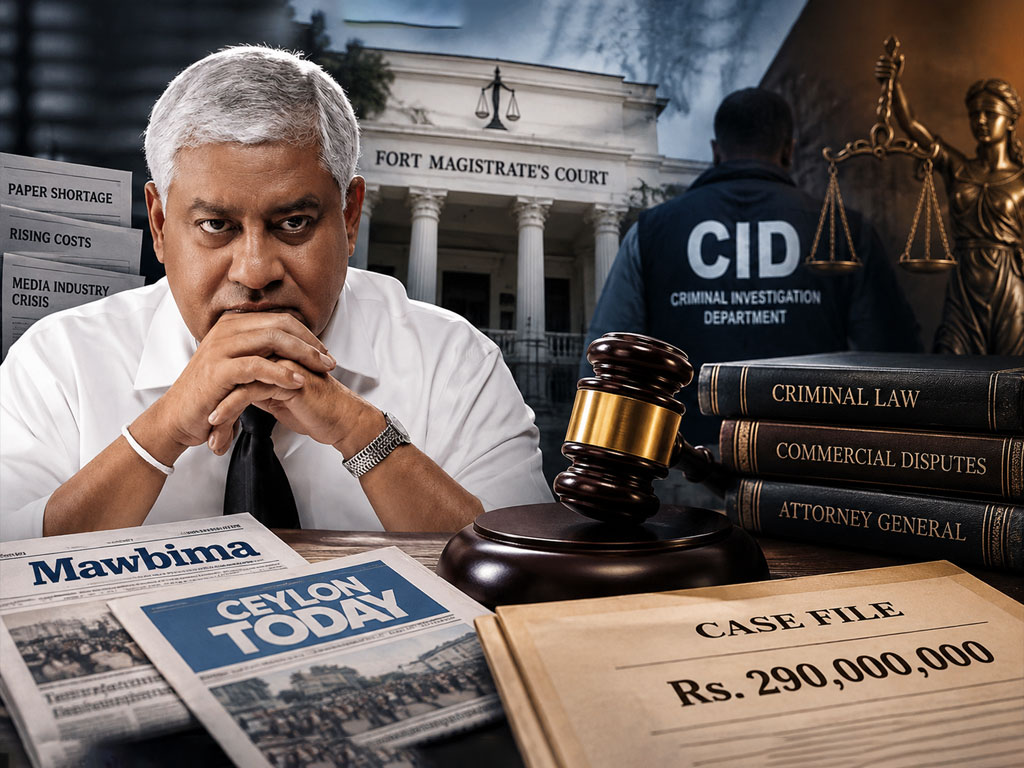
The Tiran Alles CID case over a Rs. 290 million business dispute has taken a new turn, with the Fort Magistrate seeking clarity on criminal charges.
The Tiran Alles CID case over an alleged Rs. 290 million financial dispute has taken a significant turn, with the Colombo Fort Magistrate seeking clarity from investigators on whether they intend to pursue criminal charges.
The case involves former Minister and Ceylon Newspapers Chairman Tiran Alles and a commercial dispute with LPL Kesara Lanka (Pvt) Ltd., a supplier of newsprint to Ceylon Newspapers.
At the centre of the legal controversy is a wider question: when does a breach of a commercial agreement become criminal fraud?

Rs. 290 Million Dispute Behind Tiran Alles CID Case
The dispute concerns an alleged Rs. 290 million debt involving Ceylon Newspapers, publisher of Mawbima and Ceylon Today, and LPL Kesara Lanka, its long-standing newsprint supplier.
The case arose against the backdrop of severe financial pressures that affected Sri Lanka’s print media industry following the 2022 economic crisis and steep increases in paper costs.
Ceylon Newspapers maintains that post-dated cheques issued under its arrangement with the supplier served as security and were not intended for presentation in the ordinary course.
The company has previously told the Court of Appeal that payments for newsprint were instead made through cash, letters of credit or ordinary cheques. It claimed fresh cheques would be issued when payment had not been completed by the date appearing on a post-dated cheque.
The supplier and the company remain parties to the underlying dispute.
Magistrate Questions CID’s Position
The most significant development emerged when the case came before Colombo Fort Magistrate Pasan Amarasena on September 16.
According to the account presented in the case, the CID informed court that the matter represented a commercial or civil transaction rather than a criminal offence.
That position has attracted attention because of the CID’s earlier actions.
On January 29, 2026, investigators named Alles as a suspect after he appeared before the CID. A foreign travel restriction was also imposed. Members of the Ceylon Newspapers management, including its accountant, had also faced arrest and were subsequently released on bail, according to the material presented in the case.
The Magistrate therefore directed the CID to clarify whether investigators intend to maintain criminal allegations against Alles.
The court postponed further proceedings until March 3, 2027, pending advice from the Attorney General.
That advice could prove important in determining how investigators proceed with the complaint.
When Does a Commercial Dispute Become Criminal?
The legal distinction between a failed commercial transaction and criminal conduct is central to the Tiran Alles CID case.
Sri Lankan Supreme Court jurisprudence has cautioned investigators to distinguish between commercial transactions that have gone wrong and situations where evidence supports an intention to defraud.
In Ganeshan Samson Roy v. M.M. Janaka Marasinghe and Others, the Supreme Court examined an arrest arising from a financial dispute and found violations of the petitioner’s fundamental rights.
The Supreme Court has subsequently cited that judgment when discussing arrests involving alleged white-collar crime. It stressed the need for investigators to determine whether a transaction was merely commercial or whether a suspect possessed fraudulent intent.
However, that principle does not mean every dispute involving a commercial agreement must automatically remain a civil matter. Whether criminal liability arises depends on the evidence and applicable law in each case.
That distinction is particularly relevant to the current proceedings.
Meanwhile, Ceylon Newspapers has pursued separate relief through the Court of Appeal.
The company filed a writ petition seeking to prevent police from arresting Alles, its directors and employees over the investigation into allegedly dishonoured cheques.
The Court of Appeal had already issued an interim order in connection with the matter. The petition named the Inspector General of Police, CID Director, Officer-in-Charge of the Commercial Crime Investigation Unit, LPL Kesara Lanka and the Attorney General as respondents.
Settlement Discussions Also Underway
Alongside the court proceedings, the parties may have another route available.
Counsel representing Alles informed the Magistrate’s Court that discussions were underway with the complainant company in an attempt to reach a settlement.
A settlement of the underlying financial dispute would, however, remain distinct from the legal question of whether investigators have evidence supporting any criminal offence.
The next major question is therefore whether the Attorney General advises the CID to continue criminal proceedings or whether the dispute ultimately remains within the civil and commercial sphere.
For now, no court has found Alles guilty of criminal wrongdoing in relation to this dispute, and the allegations against him remain unproven.
The Magistrate’s demand for clarification puts the central issue squarely before investigators.
After earlier naming Alles as a suspect, the CID must now explain its current position to court. The future of the Tiran Alles CID case will depend on that position, the Attorney General’s advice and developments surrounding any settlement between the parties.