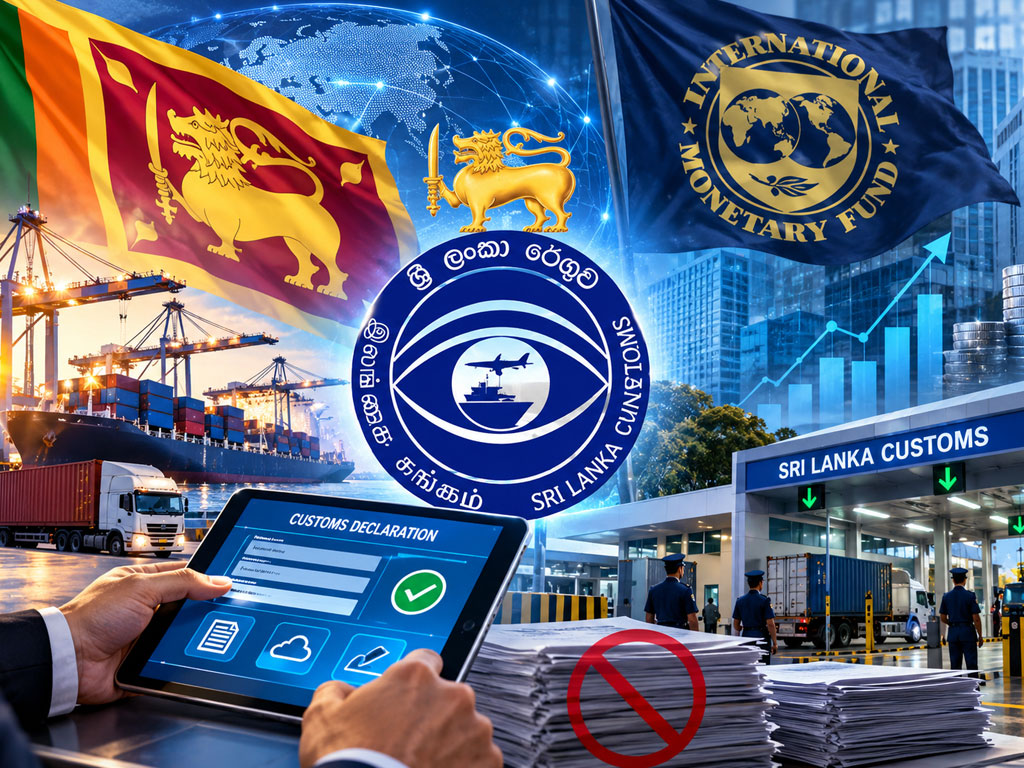
Sri Lanka Customs digitisation advances on October 1 as paperless declarations become mandatory amid wider IMF-backed governance reforms.
COLOMBO — Sri Lanka Customs will make paperless Customs declarations mandatory at its Long Room from October 1, requiring importers and declarants to submit Customs Declarations and supporting documents digitally using valid digital signatures.
- Paperless Customs declarations and supporting documents become mandatory at the Long Room from October 1
- Customs revenue has exceeded Rs. 2 trillion in 2026 as the IMF maintains its focus on revenue administration and governance reforms
The move forms part of a broader Customs modernisation programme intended to reduce manual document handling, limit unnecessary face-to-face interaction and improve the efficiency and transparency of revenue administration.
From October 1, manual processing and submission of Customs Declarations and their supporting documents at the Long Room will no longer be accepted.
Sri Lanka Customs began piloting paperless submission through the ASYCUDA World system in August 2025, initially allowing selected Authorized Economic Operators and declarants to submit Customs Declarations and supporting documentation electronically.

Digitisation and Institutional Transparency
Physical documentation has traditionally required multiple points of interaction during Customs processing, creating administrative delays as well as opportunities for discretionary decision-making.
Digitalisation is intended to reduce those interactions by moving documentation and approvals into electronic systems, while allowing Customs officers to concentrate resources on compliance and higher-risk consignments.
ASYCUDA World, digital signatures and electronic document submission are among the technologies being used as Customs expands its digital infrastructure.
The wider modernisation programme also includes electronic integration between Customs and external stakeholders. Cargo manifest submissions, for example, have been required to pass exclusively through the ASYHUB platform since May 2025.
Measures outlined as part of the broader reform programme also include tighter controls over duty-free goods entering the domestic market through Board of Investment operations and special economic zones, together with plans to use electronic bidding for the public auction of seized goods.
The reforms coincide with the IMF’s continued emphasis on stronger revenue administration, tax compliance and governance under Sri Lanka’s Extended Fund Facility programme.
Customs Revenue Passes Rs. 2 Trillion
Customs enters the next stage of digitisation after recording its highest-ever annual revenue in 2025.
Official Customs figures show revenue of approximately Rs. 2,557.5 billion in 2025. The revenue target for 2026 is approximately Rs. 2,207 billion.
Collections have already passed the Rs. 2 trillion mark this year. Customs data show accumulated revenue of approximately Rs. 2,064.8 billion by September 23, equivalent to more than 93% of the annual target.
Revenue exceeded the monthly estimate in each of the first eight months of 2026, according to the department’s published figures.
Strong collections, however, do not remove the wider institutional questions surrounding revenue administration.
For the IMF, improving the efficiency and fairness of the tax system, broadening the tax base, rationalising exemptions and strengthening revenue administration remain important elements of Sri Lanka’s economic reform programme.
IMF Keeps Governance Reforms in Focus
An IMF mission led by Mission Chief Evan Papageorgiou visited Sri Lanka from September 10 to 23 for discussions on the Seventh Review of the Extended Fund Facility and the 2026 Article IV Consultation.
The Fund said discussions were productive but would continue as the two sides work towards agreement on the parameters and policies required to complete the Seventh Review.
Sri Lanka’s recent economic indicators provided a stronger backdrop to those discussions. Economic activity expanded by 4.2% in the second quarter of 2026, while gross official reserves reached US$6.9 billion at the end of August.
Governance and anti-corruption reforms nevertheless remain an important part of the programme.
Papageorgiou has cautioned against weakening safeguards established through Sri Lanka’s anti-corruption reforms, including elements of the framework created under the Anti-Corruption Act of 2023 and subsequent reforms. IMF programme commitments have also placed emphasis on strengthening revenue administration and reducing face-to-face Customs declaration reviews for authorised operators.
The next test will therefore extend beyond whether Customs can collect more revenue or process documents electronically. The effectiveness of the reforms will also depend on whether digitisation produces more efficient administration, stronger compliance and greater institutional transparency as Sri Lanka continues discussions with the IMF and prepares its next Budget.