By Dwayne Ferreira.
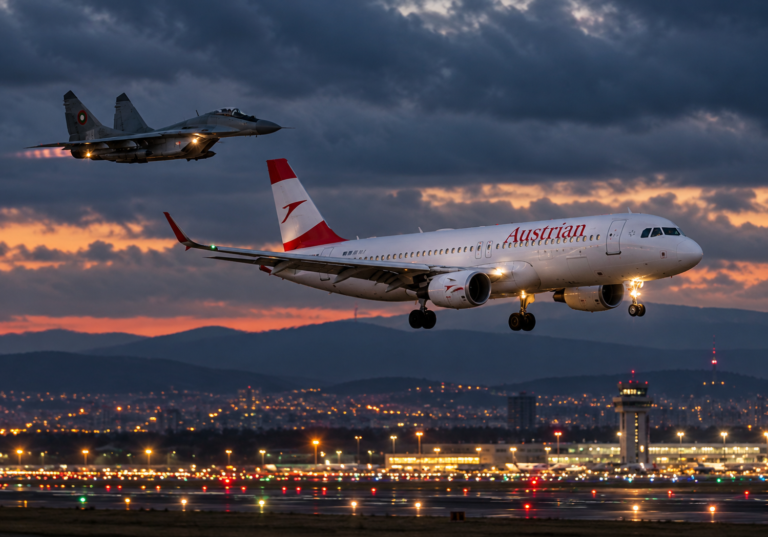
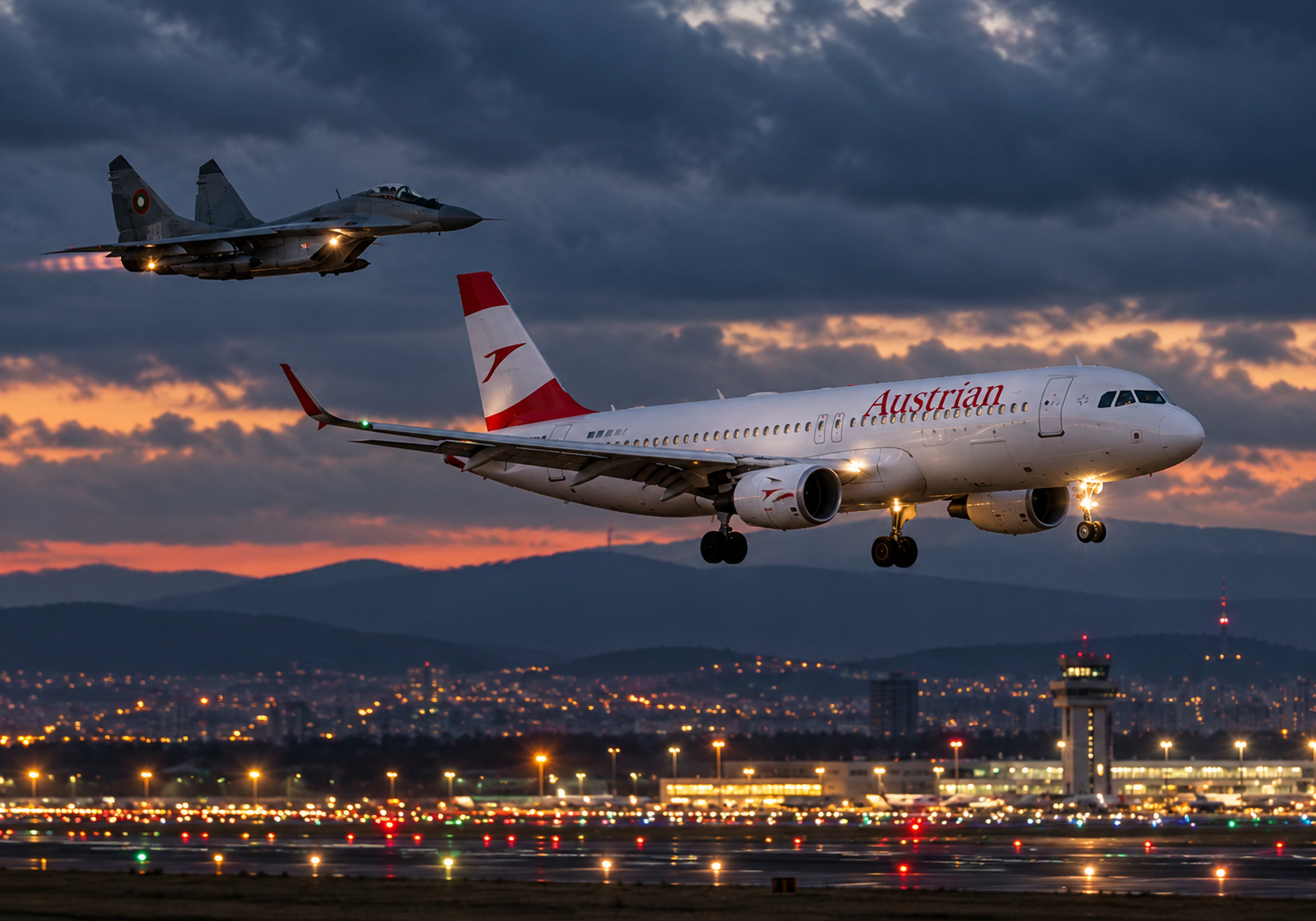
Bulgarian Air Force scrambles MiG-29 fighter jet as passenger aircraft carrying 57 people is diverted to Sofia following a mid-air security alert.
SOFIA, Bulgaria – An Austrian Airlines passenger aircraft travelling from Tel Aviv, Israel, to Vienna, Austria, was forced to make an emergency landing in Bulgaria on Sunday evening after a reported bomb threat triggered a major aviation security response, prompting authorities to scramble a military fighter jet to escort the aircraft to safety.
The Airbus A320, operating as Austrian Airlines Flight OS82, was carrying 51 passengers and six crew members when the threat was reported as the aircraft approached Romanian airspace.
The flight was diverted to Sofia, Bulgaria’s capital, where emergency services and security personnel were mobilised ahead of its arrival.

According to Bulgaria’s Ministry of Transport and Communications, the Bulgarian Air Force deployed a MiG-29 fighter jet to accompany the passenger aircraft as part of established aviation security procedures.
The aircraft subsequently landed safely at Sofia Airport, with all 57 occupants disembarking without any reported injuries.
Bomb Threat Triggers Mid-Air Emergency
The incident unfolded as Flight OS82 was travelling towards Vienna after departing Tel Aviv’s Ben Gurion International Airport on Sunday evening.
According to information released by Bulgarian authorities, the flight crew reported a bomb-related warning while approaching the Romanian border.
Faced with a potentially serious security threat, the pilots abandoned their planned route and diverted towards Sofia.
Flight-tracking information indicated that the aircraft transmitted emergency transponder code 7700, an internationally recognised signal used by pilots to alert air traffic controllers to an emergency requiring immediate attention.
Data from Flightradar24 showed that the aircraft, registered OE-LZE, had entered Romanian airspace before turning south towards Bulgaria.
The emergency declaration enabled aviation authorities to prioritise the aircraft’s arrival and coordinate the necessary ground response.
Bulgarian Fighter Jet Scrambled to Escort Aircraft
One of the most significant developments was the deployment of a Bulgarian Air Force MiG-29 fighter jet.
According to Bulgaria’s Ministry of Defence, the military aircraft was scrambled under established air-policing procedures to intercept and escort the civilian passenger aircraft towards Sofia.
Such deployments are precautionary measures designed to assist aviation authorities when an aircraft faces a potentially serious security situation.
Although a military escort can appear alarming, its deployment does not necessarily mean an aircraft is under attack.
Fighter aircraft can provide additional security monitoring and assist military and civilian authorities in maintaining control of the surrounding airspace.
The Austrian Airlines aircraft landed without incident, bringing the airborne phase of the emergency to a safe conclusion.
Passengers Evacuated as Security Teams Search Aircraft
Following the emergency landing, passengers and crew were taken off the aircraft while security personnel conducted an inspection.
Austrian Airlines confirmed that the flight had been diverted following a threat against the aircraft.
The airline said the Airbus A320 had landed safely at approximately 8:42 p.m. Central European Summer Time and confirmed that arrangements would be made to accommodate affected passengers on alternative flights.
Authorities also established a crisis response team to coordinate security procedures and investigate the circumstances surrounding the warning.
As of the latest verified reports on Monday morning, there had been no official confirmation that an explosive device had been discovered aboard the aircraft.
The precise nature of the threat and the outcome of the security inspection remained subject to clarification by the relevant authorities.
Reports Suggest Threat May Have Originated Outside Aircraft
Further details emerging from Israeli media have raised questions about the origin and credibility of the warning.
According to reports citing Israeli news outlet Ynet, the threat may have originated from an Austrian citizen who was not travelling aboard Flight OS82.
The individual reportedly communicated a bomb-related warning to authorities in Vienna, although the precise circumstances surrounding the communication remain unclear.
These claims have not been independently confirmed by Austrian or Bulgarian investigators.
Early media reports have suggested that the incident may have involved a false alarm. However, authorities have not publicly established a definitive conclusion regarding the alleged threat.
Investigators will need to determine whether the warning was genuine, maliciously fabricated or the result of another security concern.
Aviation Security Under Increasing Scrutiny
The incident has again highlighted the operational challenges airlines and aviation authorities face when responding to threats against commercial passenger aircraft.
Even an unsubstantiated bomb warning can require an aircraft to abandon its planned route, declare an emergency and land at an alternative airport.
Such incidents also demand close coordination between flight crews, air traffic controllers, airport emergency services, law enforcement agencies and, where necessary, military authorities.
The Austrian Airlines diversion demonstrates how seriously aviation authorities treat potential security threats, particularly when an aircraft is already airborne and the credibility of a warning cannot immediately be established.
While the emergency landing ended without reported injuries, the incident disrupted international air travel and triggered a significant military and civilian security operation involving multiple European authorities.
Investigation Continues
Bulgarian authorities have launched an investigation into the circumstances surrounding the threat, including how it was communicated and whether there was any genuine danger to the aircraft.
Questions also remain over the identity of the individual allegedly responsible for issuing the warning and whether criminal proceedings could follow if investigators establish that the threat was deliberately fabricated.
Austrian Airlines has indicated that affected passengers will be accommodated on alternative services following the necessary security procedures.
For the 57 people aboard Flight OS82, what began as a routine international flight ended with an unexpected diversion, a military fighter escort and an emergency landing in a foreign country.
Although the passengers and crew emerged safely, the incident serves as another reminder that even an unverified security threat can set off an extensive emergency response in modern commercial aviation.
Sources and References
1. Reuters – October 18–19, 2026. Austrian Airlines flight from Tel Aviv diverts to Sofia after ‘threat’. Airline confirmation, passenger numbers, flight details and the diversion. Read Reuters report.
2. Associated Press – October 18, 2026. Flight from Tel Aviv to Vienna makes emergency landing in Bulgaria after bomb threat. Reporting on the emergency landing and security response. Read AP report.
3. Al Jazeera – October 18, 2026. Flight from Israel makes emergency landing in Bulgaria after bomb threat. Details of the MiG-29 deployment, investigation and flight-tracking information. Read article.
4. RTÉ News / AFP – October 19, 2026. Bomb threat forces airliner from Tel Aviv to divert to Bulgaria. Details of the military escort, airline statement and security operation. Read article.
5. The Jerusalem Post – October 18–19, 2026. Vienna flight from Tel Aviv diverted to Bulgaria over bomb threat. Additional reporting on the circumstances and suspected origins of the warning. Read article.
Editorial note: The reported bomb threat and diversion are confirmed, but the presence of an actual explosive device and the identity or motive of the person allegedly responsible have not been officially established in the sources reviewed.