The NPP anti-corruption campaign has won public backing, but arrests, prosecutions and opposition pressure now raise bigger questions.
The NPP anti-corruption campaign has won significant public support, but its simultaneous confrontation with opposition forces has intensified debate over whether Sri Lanka is witnessing genuine accountability or political warfare.
The ruling National People’s Power (NPP) government last week made it clear that it would not tolerate the growing challenge from the Opposition.
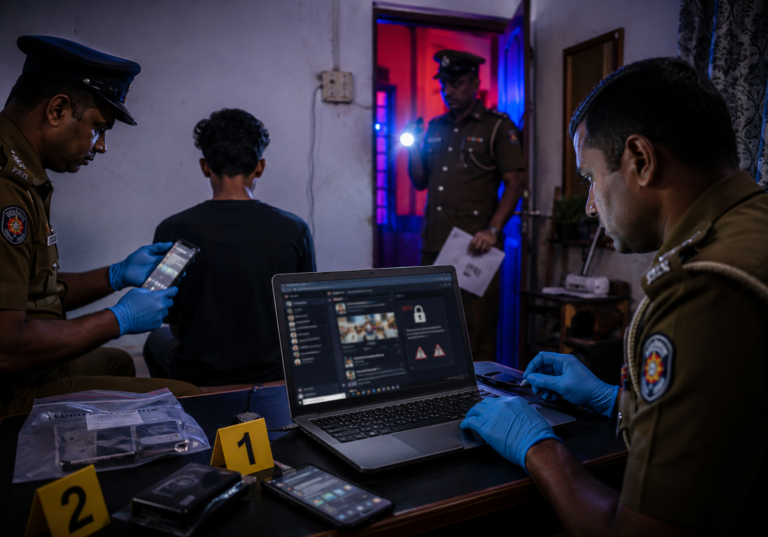
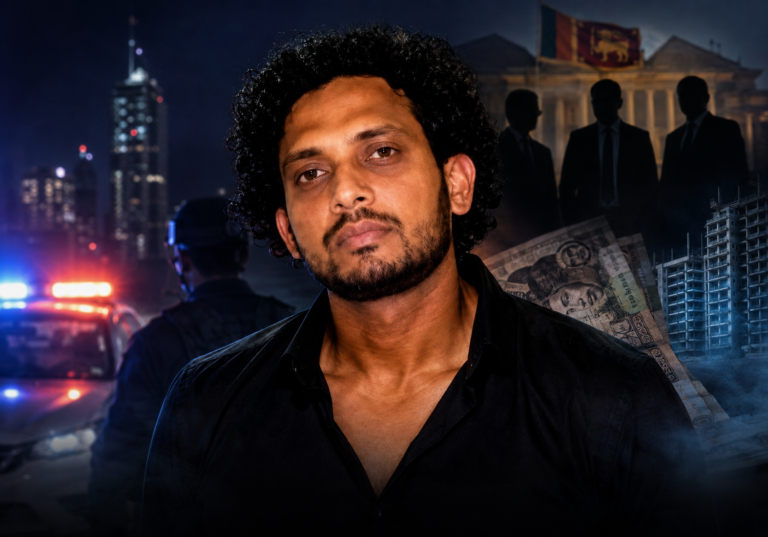
Amid the controversy over the continued detention of retired Maj. Gen. Suresh Sallay under the Prevention of Terrorism Act (PTA), in connection with investigations into the 2019 Easter Sunday carnage, police arrested Sugeeshwara Bandara, leader of the New People’s Front (NPF). The Central Crime Investigation Bureau (CCIB) arrested him on 18 June, and the Fort Magistrate’s Court remanded him until 1 July.

The CCIB also arrested Binoy Hettiarachchi, who was accompanying Bandara. Hettiarachchi had served as a media coordinator at former President Ranil Wickremesinghe’s Flower Road office. Police intercepted their vehicle at Kollupitiya in what appeared to be an action-packed operation. Hettiarachchi was released four hours later.
Bandara is better known as the former private secretary to President Gotabaya Rajapaksa and later as Director General of Special Projects at the Presidential Secretariat after Ranil Wickremesinghe assumed the presidency.
Accused of receiving two salaries simultaneously under the President’s Expenditure Head, Bandara, who handled media for Gotabaya Rajapaksa ahead of the 2019 presidential election, is under investigation for alleged abuse of government vehicles and using government workers for political activities.
Bandara began his political career as the Colombo District organiser of the New People’s Front, a breakaway faction of the UPFA, in February 2024. He contested the November 2024 parliamentary election on the New Democratic Front (NDF) ticket. More recently, as NPF leader, he became one of the most active opposition campaigners aligned with the grouping known as the People’s United Opposition, operating from Ranil Wickremesinghe’s Flower Road office.
Bandara angered the government when he led a noisy protest outside Finance Secretary Dr. Harshana Suriyapperuma’s residence at Akuregoda, Pelawatta, on 26 April, where he and his supporters were reportedly showered with excreta. The group demanded the Finance Secretary’s resignation over the theft of USD 2.5 million from the Treasury. President Anura Kumara Dissanayake himself reacted angrily to Bandara’s actions.
While acknowledging the right to legitimate protest, the President warned against demonstrations targeting the residences of officials. On 18 April, Bandara had also led a protest outside Agriculture Minister K.D. Lal Kantha’s recently built luxury residence at Weliwita, Kaduwela, questioning how the JVPer had built such a home after repeatedly claiming he lived a difficult life.
Police arrested Bandara as he was returning from a meeting between senior representatives of the People’s United Opposition and IMF officials in Colombo at the Tiki Bar, Shangri-La. Despite its limited parliamentary presence and the NDF members elected at the last parliamentary election not speaking with one voice, the Flower Road project has clearly become a headache for the government.
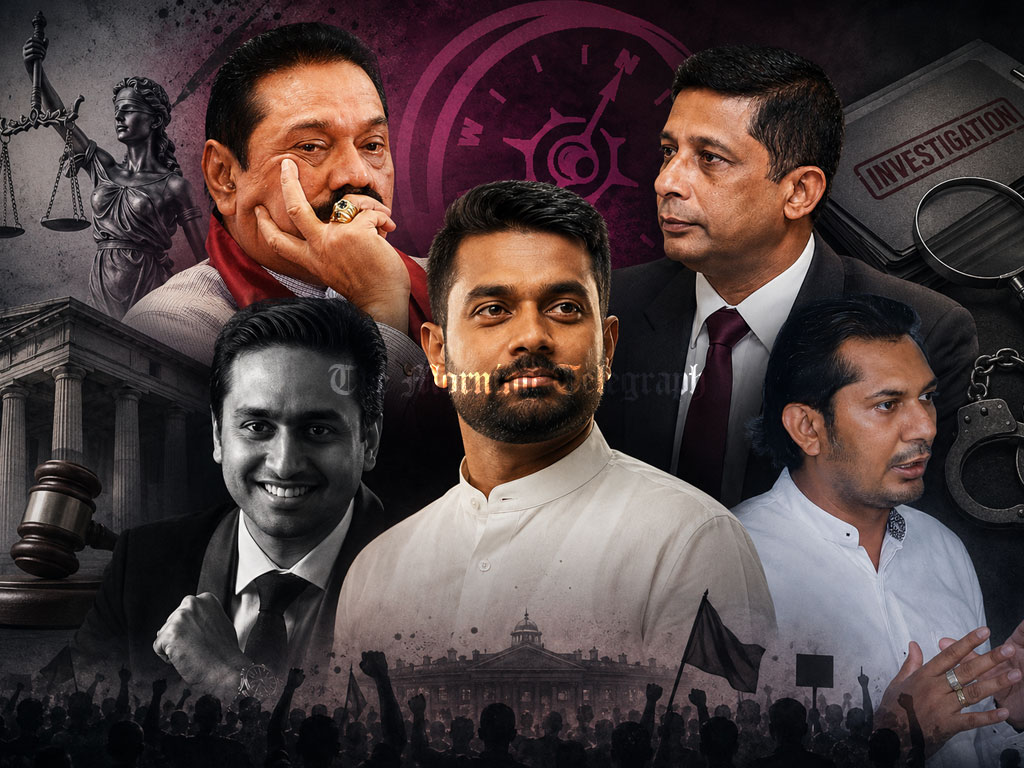
On 12 June, the Commission to Investigate Allegations of Bribery or Corruption (CIABOC) questioned former President Mahinda Rajapaksa over the politically sensitive USD 2 million Airbus bribery case linked to former SriLankan Airlines CEO Kapila Chandrasena. Chandrasena’s alleged suicide on 8 May sparked controversy, particularly over the circumstances of his bail and the identities of those who stood surety for him. Meanwhile, CIABOC intensified investigations into the Rajapaksa family by indicting former State Minister Shasheendra Rajapaksa and two others on 19 June for allegedly using official influence to obtain Rs. 8.85 million in compensation for a property built on state land and damaged during the Aragalaya unrest.
The Flower Road operation has continued to trouble the NPP, while the Samagi Jana Balawegaya (SJB) has struggled to play its expected role as the main Opposition. Instead of running a united campaign against the confident NPP government, SJB members appear to be moving in different directions, weakening the common opposition front.
Regardless of the Wickremesinghe-led grouping’s pledge to continue its campaign, Bandara’s arrest is clearly expected to have a negative impact on opposition activity.
It is also relevant that Bandara was among those who remained with President Gotabaya Rajapaksa at the President’s House in Colombo when the massive protest erupted on 9 July 2022. He was among the last to flee as the military withdrew under mounting pressure.
Police arrested Bandara as former President Gotabaya Rajapaksa moved the Court of Appeal under Article 140 of the Constitution to prevent his arrest under the PTA. The wartime Defence Secretary sought court intervention after police investigating the Easter Sunday carnage obtained a travel ban against him.
The court heard submissions from Romesh de Silva PC on behalf of the former President on 18 June and deferred the matter to 24 June. The central issue is that the former President fears the CID is preparing to arrest him based on a statement made in Paris by fugitive Azad Moulana, linking Sallay directly with the Easter Sunday carnage.
NPP Turns Up the Pressure
The NPP appears confident in its current strategy of pinning down the Opposition. Although unbridled corruption dominated post-war election campaigns, no political party had previously gone all-out against its opponents in this manner.
The NPP, however, allowed the judicial process to continue. The first major sentencing came on 2 April 2025, just six months after the parliamentary election that the NPP won comfortably. CIABOC successfully moved the Colombo High Court against former North Central Province Chief Minister S.M. Ranjith Samarakoon.
Colombo High Court No. 01 Judge Adithya Patabendige sentenced him under Section 70 of the Bribery Act. The court found that the former Chief Minister had committed malpractice by ordering fuel for his personal secretary’s vehicle. That personal secretary was Shanthi Chandrasena, wife of his brother S.M. Chandrasena, a former Cabinet Minister and one of the most powerful politicians from the North Central Province.
The former Chief Minister and the second accused, his personal secretary, were convicted on two charges. Both were sentenced to 16 years rigorous imprisonment and ordered to pay a fine of Rs. 200,000, with an additional two-year prison term in the event of default.
Deputy Director General Asitha Anthony appeared for CIABOC.
There had never previously been a truly coordinated CIABOC campaign against corruption. No political party or powerful family felt threatened by the commission. Those inside and outside Parliament acted with impunity. They feared no one because the powerful and influential operated above the law.
Just weeks after the sentencing of S.M. Ranjith Samarakoon and Shanthi Chandrasena, CIABOC arrested her husband, former Deputy Economic Development Minister and Special Projects Minister S.M. Chandrasena. He was taken into custody on 4 July 2025.
CIABOC accused the former minister of causing losses to the government by distributing seed corn, imported at a cost of Rs. 25 million in 2024, among farmers in the Anuradhapura district at a subsidised price. The distribution had taken place ahead of the 2015 presidential election contested by Mahinda Rajapaksa and former SLFP General Secretary Maithripala Sirisena. CIABOC alleged that Chandrasena exerted undue influence on the Director of Planning and other District Secretariat officials, distributing seeds through political allies to gain an election advantage and causing a loss to the government.
Chandrasena was granted bail on 1 August 2025 and indicted before the Colombo High Court on 12 June.
The CIABOC leadership consists of Justice W.M.N.P. Iddawela as Chairman, K.B. Rajapakse and Chethiya Goonesekera PC, with High Court Judge R.S.A. Dissanayake serving as Director General.
The sentencing of S.M. Ranjith Samarakoon did not deeply unsettle his political side. The arrest of his brother S.M. Chandrasena also did not significantly disturb those facing charges. But the sentencing of former Minister Mahindananda Aluthgamage and former Sathosa Chairman and former Trade Minister Nalin Fernando on 29 May 2025 sent shock waves through the Opposition.
The Colombo High Court Trial-at-Bar sentenced Aluthgamage and Fernando for corruption over the purchase of 14,000 carrom boards and 11,000 checkers boards through Sathosa, allegedly to distribute to schools and sports clubs selected by the Sports Ministry. Instead, the boards were distributed to government party offices during the 2015 presidential election campaign, causing a loss of more than Rs. 53 million to the government.
Aluthgamage was sentenced to 20 years rigorous imprisonment, while Fernando received 25 years rigorous imprisonment. Each was also fined Rs. 100,000 for each count.
CIABOC Assistant Director General Anuththara Jayasinghe and Assistant Director General Thushari Dayaratne conducted the prosecution.
During the Yahapalana government, Aluthgamage led a high-profile anti-corruption campaign called the Yahapalana Top 10 kamba horu. The then Joint Opposition group, led in Parliament by Dinesh Gunawardena, published a 750-page book targeting Yahapalana ministers. Aluthgamage, who spearheaded that campaign, is now serving a long prison sentence.
The Joint Opposition consisted of UPFA MPs who refused to support then President Maithripala Sirisena’s alliance with the UNP.
Yahapalana Corruption Claims
The Joint Opposition raised 10 major cases. The first involved the Treasury bond scams of 2015 and 2016, with accusations directed at Ranil Wickremesinghe, Ravi Karunanayake and Central Bank Governor Arjuna Mahendran. The losses were estimated at Rs. 26 billion.
The second involved losses of Rs. 10 billion through the fraudulent import of vehicles, with Ravi Karunanayake named as the chief culprit.
The third concerned the alleged misappropriation of Mahapola funds amounting to Rs. 1 billion, with allegations directed at Malik Samarawickrema.
The fourth involved alleged theft from an insurance scheme for workers seeking employment in West Asia. The Joint Opposition accused Thalatha Atukorale of misappropriating Rs. 1.5 billion.
The fifth involved allegations of receiving Rs. 1.5 billion through the leasing of Hambantota Port to China on a 99-year lease. Ranil Wickremesinghe, Malik Samarawickrema and R. Paskaralingam were named.
The sixth alleged that Kabir Hashim caused a loss of Rs. 54 billion by cancelling aircraft ordered from Airbus Industries for the national carrier.
The seventh concerned alleged fraudulent activity involving the release of government-held paddy stocks, with losses estimated at Rs. 10 billion.
The eighth involved a vehicle parts scam, with Ravi Karunanayake accused of causing Rs. 6.5 billion in losses.
The ninth had two parts. Dr. Rajitha Senaratne was accused of irregularities in leasing the Modera fisheries harbour and procuring eight fishing vessels, allegedly causing losses of up to Rs. 1 billion. He was also accused of a Rs. 1.5 billion fraud in medicine procurement.
The tenth allegation named Ranil Wickremesinghe, Malik Samarawickrema, R. Paskaralingam and Charitha Ratwatte over an alleged massive fraud in procuring coal for the Norochcholai coal-fired power plant, estimated at Rs. 5 billion.
Although the Joint Opposition later transformed into the Sri Lanka Podujana Peramuna (SLPP) and successfully contested the 2019 presidential election, none of the above cases were investigated. As far as is known, none were dealt with during SLPP rule from November 2019 to July 2022. Facing an externally backed regime change operation, the SLPP invited Wickremesinghe, whom it had named in three major corruption cases, to become Prime Minister in May 2022 and President in July that year.
So far, there is no indication whether those Joint Opposition allegations have received the attention of CIABOC or the Attorney General. As far as is known, Wickremesinghe is the only one facing imminent legal threat due to the case involving his September 2023 visit to the United Kingdom to join his wife Prof. Maithree at the University of Wolverhampton for her graduation ceremony.
Wickremesinghe is accused of squandering nearly Rs. 17 million at a time when the country was in deep economic turmoil. The Fort Magistrate’s Court is scheduled to take up the case on 8 July.
SLPP parliamentary group leader Namal Rajapaksa also faces a major legal challenge. The former minister has been indicted on charges of criminal misappropriation of Rs. 70 million in connection with the controversial Krrish project. The Attorney General has forwarded indictments to the Colombo High Court, alleging that Namal Rajapaksa misappropriated funds after receiving Rs. 70 million from the Indian real estate company for the development of rugby in Sri Lanka.
Yoshitha Rajapaksa has also been dealt with by CIABOC. The Rajapaksas have been accused of lowering qualifications required to join the Navy’s executive branch and then sending him to the Royal Naval Academy in the United Kingdom at taxpayers’ expense. Produced before the Colombo Additional Magistrate, Yoshitha was released on three personal bail bonds of Rs. 5 million each.
Producing Yoshitha before court on 17 June, Bribery Commission Deputy Director General Ruvini Wickramasinghe stated: “Your Honour, the complaint regarding this incident was received on June 25, 2016. Accordingly, the Commission initiated investigations. The complaint states that the suspect had participated in naval training programmes held in England and Ukraine by misusing government funds, while depriving qualified applicants of such opportunities. At that time, this individual, who is a civilian in the dock today, was also a civilian in 2006 when he was deemed eligible for the Royal Navy Young Officer training at the Royal Naval Academy in the United Kingdom. The opportunities to receive this training are extremely limited. Your Honour, selection to this prestigious course is usually based on being the most outstanding cadet officer during a two-year training period or based on performance during training. However, this suspect, although a civilian in 2006, was proposed and included in the list and was sent for the course in haste.”
The Deputy Director General also said Yoshitha Rajapaksa had undergone medical examinations required for overseas training even before being officially recruited into the Navy.
The court was told that although Sri Lanka had previously received scholarships from the UK, the Rajapaksa government funded Yoshitha’s training at a cost of Rs. 6.2 million.
Opposition Attacks CIABOC
The Opposition has repeatedly attacked CIABOC, with Director General R.S.A. Dissanayake becoming its primary target. Accusing Dissanayake of being a JVPer, the Opposition has questioned his conduct and demanded that CIABOC examine the conduct of the senior official, particularly regarding the alleged suicide of former SriLankan Airlines CEO Kapila Chandrasena. Chandrasena had been under investigation over the alleged receipt of a USD 2 million bribe to facilitate aircraft procurement from Airbus Industrie during Mahinda Rajapaksa’s second term.
Former Foreign Minister Prof. G.L. Peiris, a regular speaker at Flower Road media briefings, alleged that CIABOC had become a political tool in the hands of the NPP.
A section of the Opposition also questioned the circumstances surrounding the death of former JVP heavyweight Nandana Gunatilleke at Ragama Teaching Hospital in January this year, after accusing Dissanayake of pursuing an agenda beneficial to the JVP. The High Court judge denied the allegation. When the writer raised the accusations with Dissanayake, he emphatically denied any wrongdoing.
CIABOC has largely ignored allegations directed at its Director General, who has attempted to show through action that his public anti-corruption statements were serious.
Former Deputy Minister and ex-MP Sarana Gunawardena was sentenced to a total of 16 years rigorous imprisonment by the Colombo High Court on June 8, 2026.
During the Yahapalana administration, many cases filed by CIABOC and the Attorney General were either dismissed or withdrawn due to procedural lapses. The accused in such cases included ex-MP Sajin Vass Gunawardena, former Eastern Province Chief Minister Sivanesathurei Chandrakanthan alias Pilleyan, former Ministers Johnston Fernando, Rohitha Abeygunawardena, Basil Rajapaksa, Mahindananda Aluthgamage and Janaka Bandara Tennakoon, and former Attorney General and Chief Justice Mohan Peiris.
Despite opposition protests, the public appreciates tangible action against corruption. However, the NPP itself has not been free from serious allegations since the last general election. The release of 323 suspicious containers and two containers filled with ice in January 2025, followed by the massive coal scam in September 2025, the loss of more than USD 2.5 million from the Treasury, controversial Aswesuma payments and wealth accumulated by NPP ministers as revealed in declarations made to CIABOC, shocked the electorate.
The NPP has failed to effectively counter these allegations. The circumstances under which Energy Minister Kumara Jayakody resigned, along with Energy Secretary Udayanga Hemapala, on 17 April, just a week after the NPP defeated the no-confidence motion brought against the Energy Minister, dealt a serious blow to the party’s claim of integrity. The NPP could not explain why someone under CIABOC investigation over an alleged fraud during the Yahapalana government was included in President Dissanayake’s first Cabinet. Jayakody, now indicted before the Colombo High Court, saw his case begin last week.
The asset declarations of several NPP ministers have shocked the country. The SJB has called on CIABOC to investigate them without delay and prove that the commission is not only pursuing the Opposition. Ministers Lal Kantha and Wasantha Samarasinghe are among the senior JVP figures attracting scrutiny as the Opposition strikes back at the government.
SJB MP Mujibur Rahuman said the JVP/NPP owed the country an explanation on how its members amassed such wealth since 2024, especially after repeatedly claiming they could not even meet their basic needs. Their asset declarations, he argued, exposed what he described as blatant lies.