By Roy Denish.
They arrived as protectors, but behind the gates of Haiti’s UN bases, starving women and children were allegedly exploited for food, cash and survival while those accused escaped justice.
Behind the Gates of the UN Bases
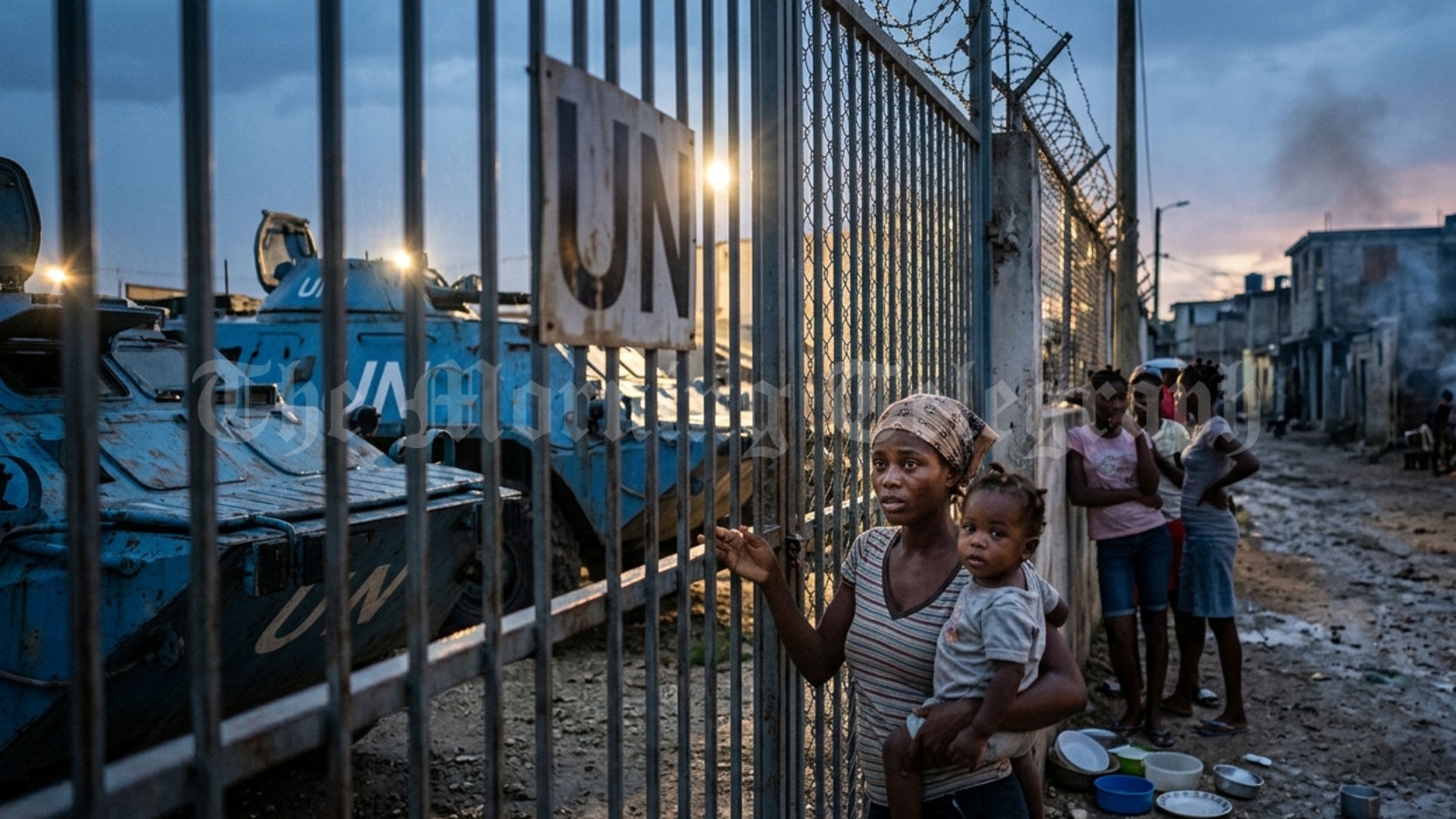
The iron gates of the United Nations military base in Cité Soleil did not merely separate the well-fed from the starving.
They marked the boundary of a hidden economy in which human dignity was systematically traded for survival.
When the United Nations Stabilisation Mission arrived in Haiti, its personnel were welcomed as protectors and as a global shield against political chaos, gang violence and the catastrophic consequences of natural disasters.
For thousands of women and adolescent girls living in the shadow of white armoured vehicles, however, the mission came to represent something far darker.
It became associated with a predatory system in which foreign soldiers allegedly exploited extreme poverty, demanding sexual favours in exchange for small amounts of money or a single plate of food.

Poverty Turned Into a Weapon
In the dust-choked streets of Port Salut and Cité Soleil, extreme poverty left families with no margin for error.
Following the devastating earthquake and subsequent hurricanes, infrastructure collapsed and food insecurity became overwhelming.
It was within this vacuum of basic human need that certain peacekeeping contingents allegedly established an abusive marketplace.
For a girl surviving on an average local wage of just 25 gourdes, approximately 26 US cents an hour, a single meal could become an instrument of leverage.
Peacekeepers receiving foreign stipends and protected by institutional authority were in a position of overwhelming power over the communities surrounding their bases.
Survival Was Rarely a Free Choice
Small amounts of cash or food were allegedly offered in exchange for sex.
For the women and children involved, these encounters could rarely be described as genuine choices.
Instead, they represented calculations of survival made by people facing hunger, homelessness and the collapse of social support systems.
Young girls, some reportedly as young as 11 or 12, were drawn into the areas surrounding military compounds, where they became exposed to sexual violence, exploitation and prolonged neglect.
Sri Lankan Contingent Accused of Organised Abuse
Although transactional sexual exploitation was reported across different sectors of the UN mission, the most organised and serious allegations involved the Sri Lankan peacekeeping contingent.
Between 2004 and 2007, investigators uncovered what was described as a structured sexual exploitation network operating within the Sri Lankan deployment.
The alleged operation systematically targeted local children.
An internal investigation reportedly found that at least 134 Sri Lankan peacekeepers, including senior officers, had been implicated in the exploitation of minors.
Abuse Allegedly Continued for Years
The alleged network operated with apparent impunity for several years.
Investigators concluded that the conduct was not limited to isolated individuals acting without the knowledge of others.
Instead, the scale of the allegations suggested that the abuse had become deeply embedded within the contingent’s operational environment.
The involvement of officers raised further questions about command responsibility and whether senior personnel knew, or should have known, what was happening.
Soldiers Repatriated Instead of Prosecuted
The institutional response created a dangerous precedent.
More than 100 of the implicated Sri Lankan soldiers were placed on flights and returned to Sri Lanka rather than being detained or prosecuted in Haiti.
Repatriation was presented as a disciplinary response.
For victims, however, it effectively removed the accused personnel from the reach of Haitian courts.
Once the soldiers returned home, the Sri Lankan military closed ranks.
Not one of the implicated personnel was publicly prosecuted, criminally charged or held accountable through a court of law.
Blue Helmets Became Symbols of Immunity
The lack of prosecutions sent a devastating message to survivors.
The blue helmet, supposedly a symbol of protection, had become a badge of legal invisibility.
Victims saw accused personnel removed from the country without facing trial, while the institutions responsible for deploying them avoided meaningful accountability.
The failure to prosecute also reinforced fears that peacekeeping personnel could commit serious abuses without facing consequences either in the host country or at home.
The Abuse Continued After Deployment
The consequences did not end when peacekeepers completed their deployments.
Across Haiti, women were left to raise children fathered by foreign personnel.
These children became known colloquially as the “children of the mission.”
Many grew up without contact with their fathers and without financial support from the men or institutions connected to their births.
Repatriation Became an Escape Route
When a pregnancy involving a peacekeeper became known, the international organisation’s standard response was often to repatriate the alleged father.
Although officially treated as disciplinary action, this practice frequently operated as an escape route.
It removed the soldier from Haitian jurisdiction and made it far more difficult for the mother to pursue paternity recognition or child support.
The father returned home, while the woman and child were left to face the consequences.
Young Mothers Abandoned to Poverty
Many young mothers were pushed to the edges of Haitian society.
Some were forced out of school, rejected by their families or subjected to intense social stigma.
Without child support, they were unable to pay for food, healthcare or school fees.
The poverty that had made them vulnerable to exploitation in the first place was passed on to their children.
Mothers Forced Back to the Bases
In one of the most tragic consequences of the scandal, some abandoned mothers reportedly returned to the gates of UN bases.
With a child to feed and no financial assistance, they again engaged in transactional sex with new rotations of soldiers.
The system therefore reproduced the same cycle of exploitation.
A woman abused or abandoned by one contingent could later be forced into another exploitative encounter simply to keep her child alive.
Human Rights Lawyers Fight for Justice
For years, human rights organisations have attempted to break through the institutional barriers protecting the accused personnel.
One of the leading organisations has been the Bureau des Avocats Internationaux.
The group filed formal paternity cases in Haitian courts on behalf of children allegedly fathered and abandoned by peacekeepers.
The objective was to establish legal responsibility and secure child-support payments for affected families.
Diplomatic Immunity Blocks Local Cases
The greatest barrier was not the absence of law but the use of diplomatic immunity.
Immunity was repeatedly invoked to shield foreign personnel from legal proceedings in Haitian courts.
This left victims unable to pursue ordinary remedies available in other paternity and child-support cases.
The legal protection originally intended to allow international personnel to perform official duties became a barrier preventing vulnerable families from obtaining justice.
UN Accused of Withholding DNA Evidence
Human rights advocates have also accused the international organisation of refusing to cooperate with basic requests for evidence.
In some cases, officials allegedly declined to release the results of DNA paternity tests to Haitian courts.
The organisation was also accused of failing to comply with local judicial orders.
Without access to DNA evidence, mothers faced enormous difficulties proving the identity of the fathers and enforcing claims for financial support.
Organisation Accused of Undermining Rule of Law
The institutional resistance has attracted fierce criticism from human rights campaigners.
They argue that an organisation publicly committed to promoting the global rule of law cannot simultaneously obstruct the legal system of a country hosting its mission.
By withholding evidence, invoking immunity and removing accused personnel from Haitian jurisdiction, the institution is accused of placing its own reputation above the rights of victims.
Haiti’s Most Vulnerable Paid the Price
The women and children affected by the scandal remain among the poorest and most vulnerable people in the world.
They were promised protection but instead encountered exploitation.
They were promised justice but faced bureaucracy and institutional silence.
The lasting legacy of the mission is therefore not limited to the abuses committed during deployment.
It also includes fatherless children, abandoned mothers and a justice system repeatedly prevented from holding powerful international actors accountable.
#Haiti #HaitiNews #UNPeacekeepers #UNScandal #PeacekeepingAbuse #SexualExploitation #HumanRights #JusticeForVictims #WomenAndChildren #ChildrenOfTheMission #SriLankanPeacekeepers #MINUSTAH #CiteSoleil #PortAuPrince #DiplomaticImmunity #PeacekeeperAccountability #UNAccountability #InstitutionalFailure #AbuseOfPower #HumanRightsViolations #SurvivorJustice #PovertyAndExploitation #InternationalJustice #RuleOfLaw #TheMorningTelegraph