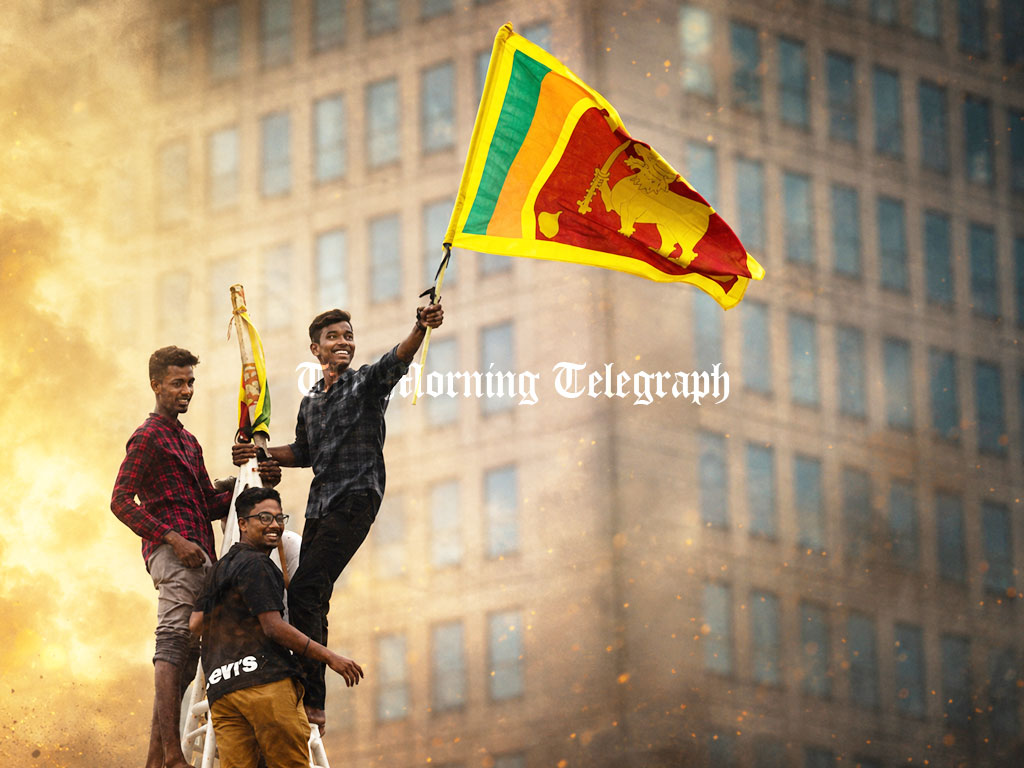
Sri Lankan Aragalaya remains an open political question as society debates its victories, failures and democratic legacy.
Sri Lankan Aragalaya remains one of the most debated political moments in recent history, especially as one question continues to return: “Did the Aragalaya achieve its objectives?”
Many people try to answer this through visible outcomes. They point to the resignation of the President, the change of government, economic reforms and shifts in political culture.
However, a deeper political and philosophical question sits inside that debate. Did the political event known as the “Aragalaya” ever have one single, clear objective?
Usually, analysts examine a political movement as a process moving toward a specific goal. Yet the Sri Lankan Aragalaya does not fit neatly into that simple framework.
Different social groups gathered under the main slogan “Gota Go Home.” But they did not all share the same political vision for the country’s future.

Sri Lankan Aragalaya Had Many Meanings
For one person, the Aragalaya was a struggle to remove the President. For another, it was a battle against the executive presidential system.
For others, it became a response to corruption, family rule and the old political culture. Some saw it as a political awakening of the younger generation.
There were also citizens who understood it as an urgent public demand to escape the economic crisis.
Therefore, it is difficult to identify one specific demand as the “objective of the Aragalaya.” It was not an organized project guided by one political ideology.
Instead, it became an event where many grievances, hopes and alternative political dreams temporarily came together in the same space.
In this sense, one of the strongest political messages within the Aragalaya concerned the idea of “the people.”
In politics, leaders often present “the people” as one united force speaking with one voice. But the Aragalaya showed something more complex.
It revealed that the people can also be a temporary agreement between diverse groups with different expectations.
Measuring Success Is Not Simple
This makes the success of the Aragalaya difficult to measure.
For one person, it succeeded because the President was removed. For another, it failed because the political system did not undergo deep structural change.
For yet another person, its greatest victory was that it reminded ordinary citizens of their own political power.
The deeper question, then, is this: what yardstick should society use to measure success?
If the Aragalaya did not have one single objective, its victory or defeat cannot be judged by one simple measure.
This situation can be understood more deeply through the idea that the Aragalaya itself became its own objective.
Usually, a movement serves as a means to achieve another outcome. But within the Aragalaya, politics did not exist only in the final result.
Politics also happened inside the process itself.
At the Galle Face protest site, people discussed ideas, exchanged views and brought art and politics together.
They also experimented with a different kind of social relationship. In that space, politics appeared as something larger than voting in an election.
It became direct participation. It became collective action.
An Unfinished Democratic Question
As Jacques Derrida pointed out, democracy is never a project that becomes fully complete. It is a promise that is always arriving.
In that sense, the Aragalaya can also be understood not as a completed political project, but as a political event that opened new questions.
The Aragalaya removed a President. But it did not deliver all the structural changes it demanded.
It questioned the old political culture. But the challenge of turning that questioning into permanent institutional change remained.
It challenged traditional leadership. However, it also exposed the difficulty of building an alternative political organization.
Therefore, every victory of the Aragalaya contains some incompleteness. Every failure also contains a future political possibility.
So, the deeper question is not only, “Did the Aragalaya win?”
The more important question may be this: “Does it remain alive because it was completed, or because it remains incomplete?”
The true legacy of the Aragalaya may not lie only in the political outcomes it achieved. Instead, it may lie in the questions it left behind for Sri Lankan society.
It forced the country to rethink old ideas about power, democracy and citizenship.
Therefore, it is not easy to declare the Aragalaya a success or a failure.
It was not a movement that ended in victory alone. It remains an unfinished political question about Sri Lanka’s democratic future.