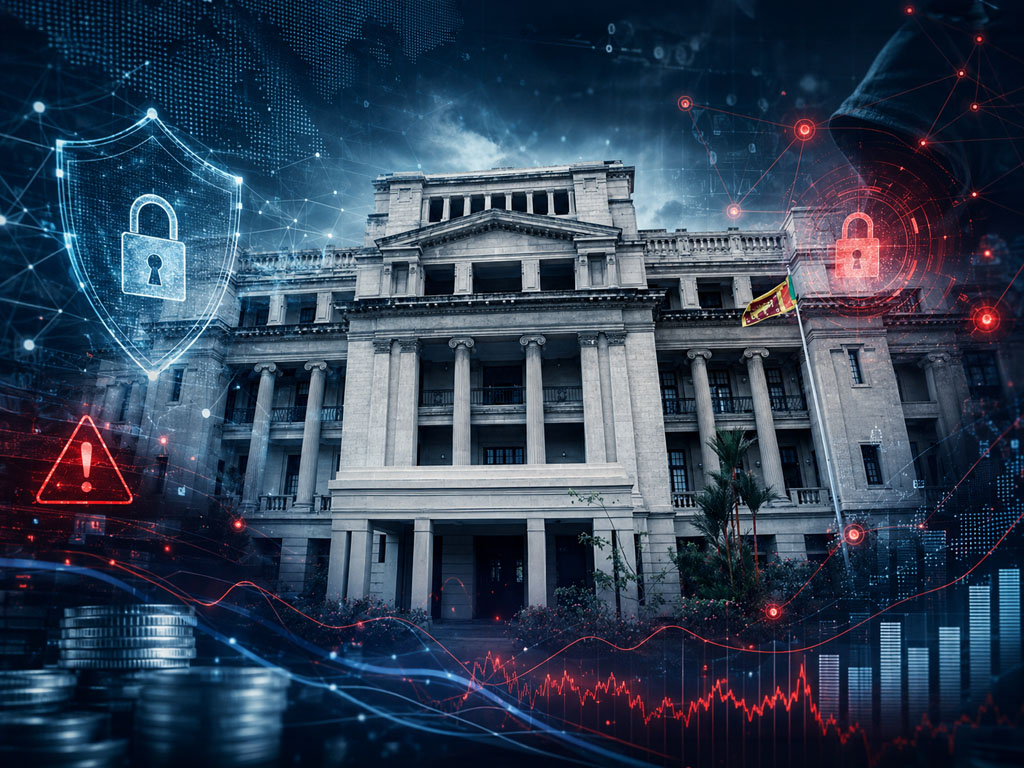
Sri Lanka cyber scams are exposing Treasury inefficiencies, weak coordination and outdated systems across the country’s financial infrastructure.
Sri Lanka cyber scams are exposing more than technological weaknesses. They are revealing deeper failures within the State’s financial administration and placing the wider financial system at risk.
Central Bank Deputy Governor K.G.P. Sirikumara delivered that warning at the Sri Lanka Economic Association Economic Forum. His comments came amid concerns over Treasury inefficiency, weak governance and poor operational coordination.
Together, these failures continue to leave Sri Lanka’s financial infrastructure vulnerable to sophisticated cyber fraud.
Sirikumara said institutions could no longer measure resilience only through capital adequacy, liquidity and profitability. Instead, financial stability increasingly depends on how effectively institutions anticipate threats, share intelligence and respond.

Treasury Weaknesses Increase Sri Lanka Cyber Scam Risks
Cybercrime has become one of the world’s fastest-growing financial risks. However, Sri Lanka’s public financial management system still relies on outdated administrative practices.
Fragmented oversight and slow decision-making remain common. Treasury institutions also depend heavily on manual procedures in several areas. Meanwhile, digital transformation has progressed unevenly across government agencies.
These weaknesses give organised cybercriminals opportunities to target government payment systems, financial databases and public-sector transactions.
International cybersecurity reports have repeatedly warned that financial fraud often exploits institutional inefficiency rather than advanced technology alone.
Sirikumara warned that operational weaknesses amplify external shocks. His observation carries particular importance because cyberattacks often succeed when governance failures prevent institutions from quickly detecting irregularities or coordinating an effective response.
The Central Bank has sought to improve financial resilience through the Central Bank of Sri Lanka Act No. 16 of 2023. It has also introduced stronger banking legislation and new policy coordination mechanisms.
These reforms represent important progress. However, legislation alone cannot remove vulnerabilities caused by poor implementation.
Traditional Indicators May Understate Digital Threats
Former Deputy Governor J.P.R. Karunaratne also warned that existing financial-sector indicators do not adequately reflect operational risks and cyber vulnerabilities.
His assessment suggests that conventional measurements continue to underestimate emerging digital dangers facing the banking system.
Commercial banks significantly increased cybersecurity investments after the economic crisis. However, financial experts argue that weaknesses in government financial administration could undermine wider sector resilience.
That danger will remain if Treasury systems fail to maintain comparable security and operational standards.
Investigators say Sri Lanka cyber scams increasingly exploit delayed reconciliations, weak verification procedures, fragmented databases and inadequate staff training.
These weaknesses are administrative failures, not simply technological problems.
The risks also extend beyond direct financial losses. Successful attacks can damage public confidence in banks, delay government services and interrupt economic recovery.
Sri Lanka’s growing dependence on digital payments makes institutional resilience increasingly important.
Financial Stability Requires Wider Coordination
Sirikumara emphasised that regulators, policymakers and financial institutions share responsibility for financial stability.
That principle may now need to extend beyond banking. Sri Lanka requires comprehensive reform across Treasury operations, procurement systems and digital governance.
Institutions must improve intelligence-sharing, verification systems, staff training and response coordination. Otherwise, criminals will continue targeting the weakest points in public financial management.
Unless officials address administrative inefficiency with the same urgency as banking reform, Sri Lanka cyber scams will remain a serious threat.
Improved capital strength and profitability cannot fully protect the system when poor governance, outdated processes and operational failures leave critical financial infrastructure exposed.