Gaza ceasefire violations intensify after Israeli strikes reportedly kill civilians at a Nuseirat funeral and homes across the enclave.
The latest Gaza ceasefire violations have intensified fears that the fragile truce is unravelling, after Israeli strikes reportedly killed civilians at a funeral and in residential areas.
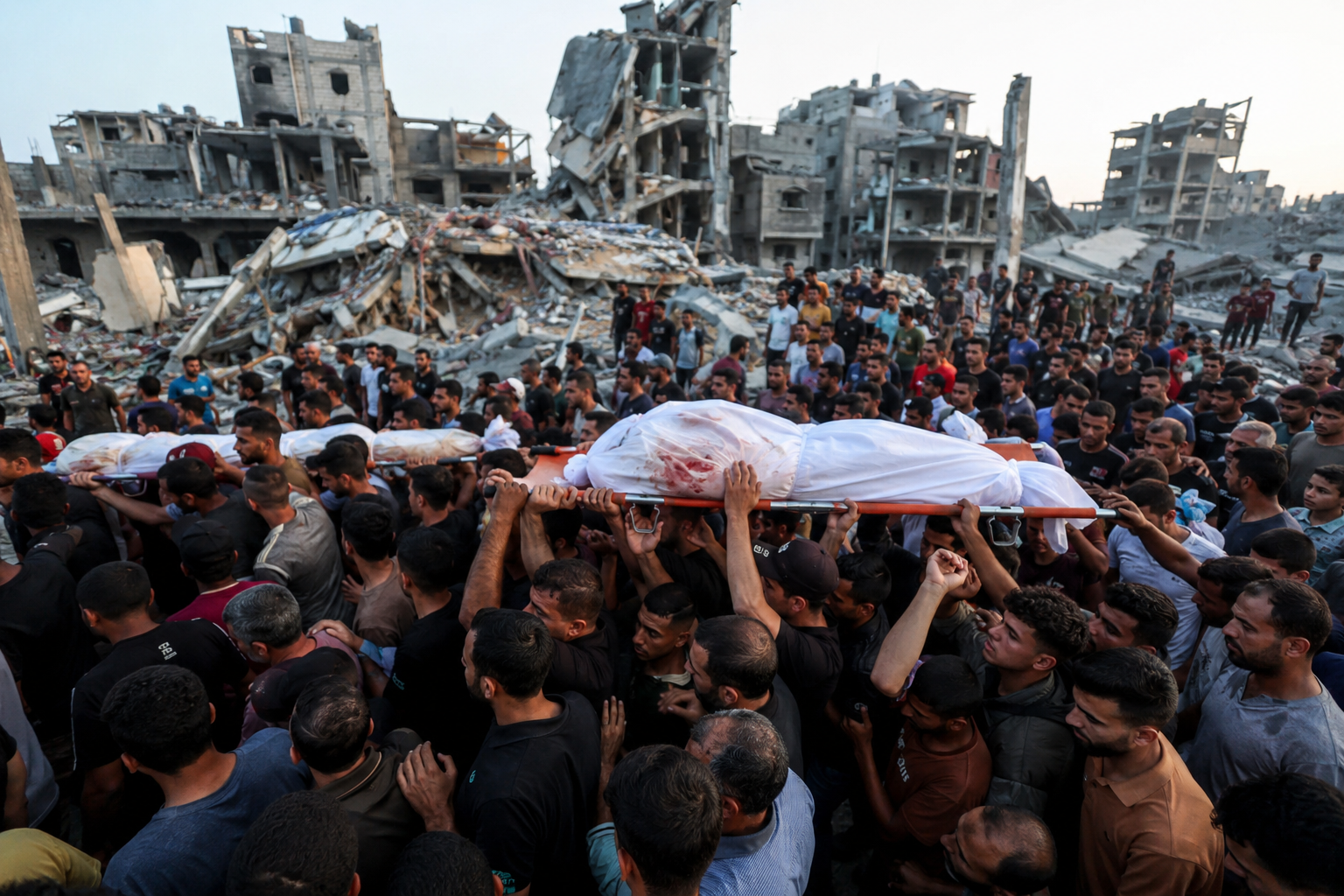
An Israeli airstrike killed at least eight Palestinians attending a funeral in Nuseirat, central Gaza, on Friday, Gaza health officials told Reuters. The strike also wounded at least 20 people.
Those gathered were mourning a Palestinian killed in an earlier Israeli strike on the area that day, according to the officials.
Medics said separate strikes elsewhere in the Gaza Strip killed at least three more Palestinians. The reported deaths brought Friday’s overall toll to at least 12.

The Israeli military said it had targeted militants in some of the attacks. It accused armed Palestinian groups of operating near civilians and violating the ceasefire.
However, Palestinian officials and Hamas accused Israel of repeatedly breaching the agreement through airstrikes, shelling and continued military operations.
The competing accusations have placed further pressure on a ceasefire that has failed to deliver a complete end to the violence.
Gaza ceasefire violations leave funeral mourners dead
The strike on the funeral became one of the deadliest incidents reported during several days of renewed violence.
Gaza health officials said mourners had assembled in Nuseirat for the funeral of a person killed in an earlier attack. An Israeli strike then hit the gathering.
Reuters reported at least eight deaths and 20 injuries, citing Gaza health officials. Other accounts gave slightly different casualty totals, reflecting the difficulty of gathering information during continuing attacks.
The Israeli military did not immediately provide Reuters with a detailed response about the funeral strike.
However, the military said its operations elsewhere had targeted members of Palestinian armed groups. Israel has repeatedly said it takes steps to reduce civilian harm and accuses militants of operating from populated areas.
In another account of Friday’s attacks, the Israeli military said it targeted a Palestinian Islamic Jihad cell. It also acknowledged reports that civilians may have suffered harm.
Palestinian officials rejected Israel’s justification for the wider bombardment. Hamas condemned the funeral attack and accused Israel of committing a serious crime against civilians.
Additional Israeli strikes reportedly killed people in Gaza City, northern Gaza and Khan Younis. The casualties included women, according to hospital officials and medics cited by international news agencies.
The attacks followed earlier strikes that also caused civilian deaths.
On July 15, an Israeli strike hit an apartment in Deir al-Balah, according to Palestinian medics. It killed Omar Abu Qassem, his wife Asma and their six-year-old daughter, Habeeba.
Their three-year-old son, Sami, survived with injuries, the medics said.
The Israeli military said it had targeted a Hamas militant in that operation. Another Palestinian reportedly died in a separate strike in Gaza City that day.
Civilians caught between Israeli and Hamas accusations
The latest deaths underline how civilians remain exposed despite the ceasefire agreement.
Israel says Palestinian militants have fired at troops and carried out other attacks since the truce began. Israeli officials argue that the military retains the right to respond when its forces face threats.
Palestinian groups, meanwhile, accuse Israel of using isolated incidents to justify wider attacks that kill civilians.
Gaza’s health authorities say more than 1,100 Palestinians have died since the ceasefire took effect in October 2025. International organisations have not independently verified every reported casualty.
Five Israeli soldiers have also reportedly died during the ceasefire period.
The violence has included airstrikes on residential buildings, tents, police personnel and people travelling through areas controlled by Israeli forces.
Israel has described some police officers killed in previous attacks as Hamas operatives. Hamas says Gaza’s police also perform civilian law-enforcement duties and should not automatically be treated as combatants.
The United Nations has previously raised concerns about attacks on Gaza’s police because of their role in protecting aid deliveries and maintaining basic public order.
Meanwhile, humanitarian agencies continue to warn that repeated military operations threaten civilians already living in damaged homes, tents and overcrowded shelters.
Most of Gaza’s population has suffered displacement during the conflict. Israel also retains control over much of the territory and its entry points.
Second phase of Gaza negotiations remains stalled
The renewed Gaza ceasefire violations come as negotiations over the agreement’s second phase remain stalled.
That phase is expected to address some of the conflict’s most difficult issues. These include Hamas’s disarmament, further Israeli withdrawals, Gaza’s future administration and international security arrangements.
The United States has backed the plan, while Egypt, Qatar and Turkey have taken mediation roles.
However, the parties remain divided over which commitments must come first.
Hamas argues that negotiations cannot advance unless Israel fulfils its obligations under the earlier phase, including military withdrawal commitments.
Israel insists that Hamas must disarm and that Gaza cannot return to the group’s military control.
The two sides have also exchanged allegations over attacks, military movements and restrictions imposed during the ceasefire.
As a result, the agreement has reduced the overall scale of combat without ending the deaths.
The funeral strike highlights the danger of that unresolved position. Each new attack increases the risk of retaliation and makes political compromise more difficult.
It also leaves Gaza’s civilians trapped between a ceasefire that exists on paper and violence that continues around homes, shelters and gatherings.
Without progress in the second-phase negotiations, the truce may remain vulnerable to further breakdowns. The latest killings have therefore become more than another casualty report.
They represent a warning that the ceasefire could continue to erode unless mediators secure enforceable commitments from both Israel and Hamas.