By Roshan Jayasinghe
A Knowledge Trust for Humanity and Every Life That Follows
After writing about kakistocracy, my thoughts continued beyond the word itself. Naming what happens when the worst among us acquire power is necessary, but naming the condition does not show us how to prevent its return. We may remove one leader and welcome another, yet the same doorway remains open. If the peace, freedom, dignity and future of millions can be redirected by the character of one individual or a small circle around that individual, then the deeper problem lies within the structure that allowed so much human responsibility to become concentrated in so few hands.
This led me to a larger question. Why does humanity continue placing its future in the hands of a few people when so much of the knowledge needed to examine their actions already exists within history, science, nature and lived human experience? Why do we continue beginning each generation from almost the same point, teaching children how to function inside the world we created before giving them a clear understanding of what it means to be human within it?

Humanity does not lack knowledge. We have learned how to study the smallest parts of matter, travel beyond Earth, treat diseases, communicate across the world and create machines capable of responding to human language. Yet much of this knowledge remains scattered across institutions, governments, universities, nations, cultures and private systems. An ordinary person searching for an answer is often met with a mixture of evidence, opinion, political persuasion, commercial interest, religious belief, national pride and information repeated so frequently that it begins to resemble truth.
The Knowledge Trust
What we lack is not another place containing more information. We lack a common and trusted place where information is separated, examined and presented according to what it truly represents. We need a place where any human being can ask what is known, how it became known, where it has been tested, what results it produced, who benefited, who was harmed and what remains uncertain.
I have come to think of this as the Living Human Manual.
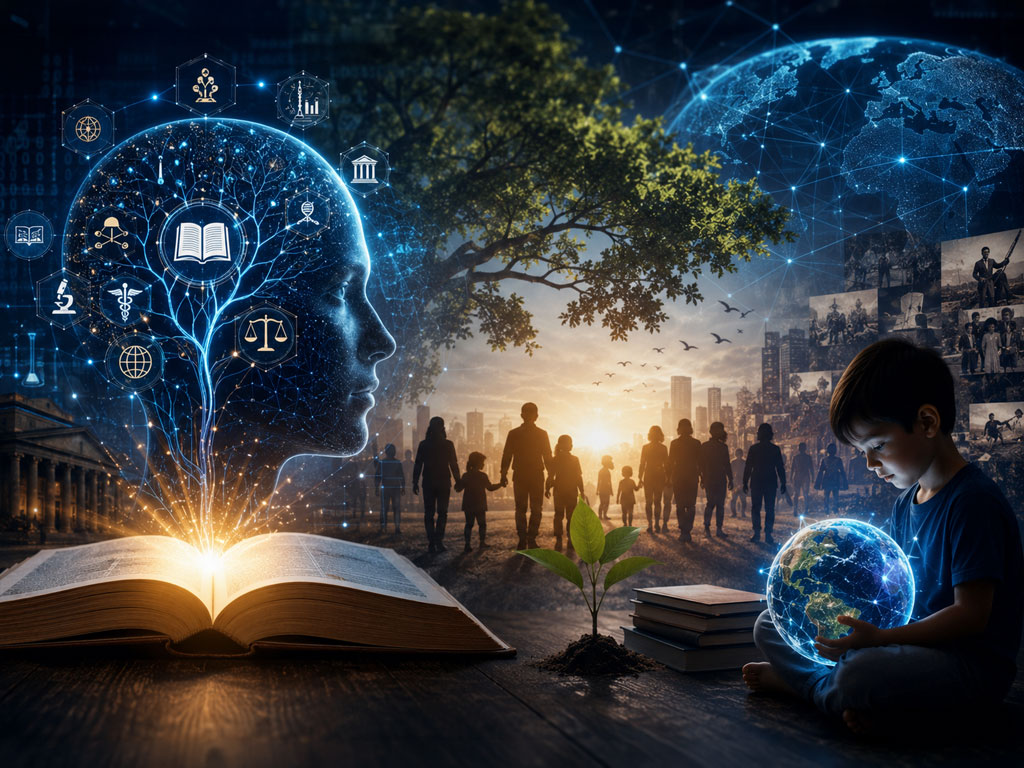
Rather than a book written once and protected from change, or a new religion, political ideology or authority standing above humanity, it would be a continuously corrected public trust of verifiable human knowledge, grounded in observable reality, nature, lived experience and demonstrated outcomes. It would belong to no government, corporation, political party, religious institution, nation or artificial intelligence provider, and it would remain available to every person, in every language and at every level of understanding.
The Living Human Manual would not claim ownership of truth. Its purpose would be to protect humanity’s continuing responsibility to seek truth without allowing it to become hidden beneath power, persuasion or belief.
For this to work, truth would need to be presented with greater discipline than we commonly use today. A fact should be identified as a fact only when supported by traceable evidence. A conclusion drawn from evidence should be identified as an interpretation. A prediction should be presented with its uncertainty. A personal or cultural belief may carry deep meaning for those who hold it, but it cannot be presented as a universal fact when it cannot be independently verified. When evidence remains incomplete, the Manual must be able to say that humanity does not yet know.
This does not remove belief, hope or imagination from human life. It gives each one its rightful place. Belief in its best form can offer personal meaning without demanding that everyone accept it as fact. Hope in its best form is not fantasy, but a possible future connected to realistic action, knowledge and human effort. Understanding in its best form includes context, consequence and the experience of those affected. Civilization in its best form is not measured only by wealth, monuments, military strength or technological achievement. It is revealed through the way human beings protect life, preserve dignity, resolve differences and care for the conditions that allow future life to continue.
The Manual would neither attack religion nor permit religious language to become factual evidence for everyone. Religions can be understood as parts of human history, culture, psychology and civilization, including the observable good and harm created through their practice. But a supernatural claim that cannot be independently verified must remain within the category of belief. The same standard must apply to political ideology, national mythology, corporate messaging and personal opinion. No authority should receive a special exemption from truth.
This distinction is not a judgment on the worth of belief. Some of what matters most in a human life, including love, meaning, devotion and the sense of something larger than oneself, has never depended on being independently verifiable. The Manual is not built to diminish any of it. It exists only to keep one category from being sold to people as the other.
The same discipline must reach the systems humans created to derive profit. Trading, investment and the pursuit of financial freedom can be legitimate human undertakings, but they too must be truthful about what they are: their intent, their working methods, where the profit comes from and who carries the loss when it arrives. A person who invests with a clear understanding of the risks as well as the rewards is exercising informed choice. What the Manual would expose is not risk, but deception: the hidden fee, the obscured method, the reward promised without its probability and the system whose profit depends on the other party not understanding it. Financial freedom built on another person’s blindness is not freedom being created. It is freedom being transferred.
What is true of finance is true of every discipline humans have built around their needs. Medicine must be truthful about what a treatment can do, what evidence supports it, what harm it may cause and what remains unknown. The body is where the difference between verified knowledge and sold belief is felt most directly, and often paid for most permanently.
Law must remain readable and accessible to the people it governs. A system of justice that ordinary people cannot understand or afford becomes knowledge concentrated in a few hands, which is the same condition this Manual exists to prevent. Work must be truthful about what it asks of a person, what it does to their body and their years, and how the value created through work is distributed among those who perform, organize and own it.
The systems that compete for human attention must be held to the same standard as any other market. A platform whose profit depends on people not understanding how their attention is being captured, shaped and sold is practicing the same deception in a newer form. The Manual would not condemn medicine, law, work, finance or communication. They are among humanity’s necessary creations. It would insist only that none of them earn their living from what people are prevented from knowing.
Nature would remain the first physical reference of the Manual. Humanity does not live outside nature, even when our cities, economies and technologies make us feel separated from it. Every society depends upon air, water, soil, energy, biological life and a habitable environment. Nature is not a moral authority in itself, because it can also be violent and unforgiving. But it establishes the physical reality that human ambition cannot negotiate away. A system that destroys the conditions supporting life cannot be considered successful merely because it produces temporary wealth or power.
The Human Continuum
The Manual must also carry the memory of how humanity arrived here. History should not remain a collection of dates, rulers, wars, inventions and victories. It should become a visible record of human cause and consequence, in which every important discovery, institution, movement, decision and creation is examined according to what it placed into the continuing current of human life.
I think of this part of the Manual as the Human Continuum, a catalog of the great events, discoveries and creations that changed their own time and continue influencing present life. It would preserve not only what happened, but why it happened, what human need it attempted to answer, what it achieved and what it caused as it travelled through later generations.
The controlled use of fire gave human beings warmth, protection and a new way to prepare food, while the same knowledge could be used to destroy. Agriculture supported permanent communities and larger populations, while also changing land, ownership and the distribution of power. Printing expanded access to knowledge while allowing propaganda to travel further. Industrial development increased production and transformed living conditions while creating exploitation, pollution and forms of inequality that remain built into many societies. Modern communication connected the world while also creating new ways to manipulate attention, spread falsehood and observe people without their full understanding.
None of these developments belongs entirely to one side of the coin. The same human intelligence can protect life or damage it. A truthful Manual should therefore resist the temptation to describe history only through celebration or condemnation. It should reveal the complete inheritance.
For every major human development, we should be able to see its original purpose, the circumstances in which it arose, the benefits it created, the damage it caused, the people who gained from it, the people who carried its burden and the ways its influence remains present today. We should also be able to see where a good purpose was left unfinished, where an idea arrived before humanity possessed the means to continue it and where an initially useful practice became harmful as the world changed around it.
From this record, different responses become possible. Some human achievements deserve to be preserved. Others should be advanced beyond what their originators could complete. Valuable paths that were abandoned can be reconsidered under present conditions. Systems that created both benefit and harm can be repaired. Practices whose damage now outweighs their usefulness can be retired. Knowledge that repeatedly produced severe harm must remain visible so that humanity can prevent its return.
Nothing should be erased from human memory. We may need to remove the continuing influence of a harmful practice, but we must preserve the record showing how it began and what it caused. When history is removed, its patterns can return under different words, symbols and leaders.
There is also a large part of the human story made from what we failed to carry forward. Some worthy ideas were interrupted by war, lack of resources, political opposition, economic interest or the limits of the knowledge and technology available at the time. The Living Human Manual could recover these unfinished directions and bring them into present examination. It could ask why they stopped, whether the original need still exists, whether modern knowledge has removed the earlier obstacle and whether the idea can now be tested safely and responsibly.
We should not present an unrealized possibility as though it were historical fact. What might have happened cannot be verified in the same way as what did happen. But we can examine the evidence surrounding an abandoned path, understand why it was interrupted and construct responsible ways of testing its value today. This would allow humanity to recover what deserves another opportunity without turning possibility into fantasy.
The 2026 FIFA World Cup final offers a living example of what the Human Continuum should preserve and later examine. During the first halftime show in the history of a World Cup final, Shakira and Burna Boy performed Dai Dai, the official song of the tournament. Shakira committed her royalties from the song to the FIFA Global Citizen Education Fund, which seeks to expand access to education and football opportunities for children in underserved communities.
Within an event built around nations competing, music carried another human possibility. People could remain proud of where they came from while sharing joy, hope and love beyond borders. For a short time, language, nationality and political division became secondary to a common human rhythm.
Yet the Living Human Manual would not stop at the beauty of the moment or the promise attached to it. It would return later to verify how much was raised, where the money went, how many children were reached and whether their lives were measurably improved. Love in its best form is not only what humanity sings together, but what the song causes humanity to do.
Within the same stadium sat President Donald Trump, whom I discussed in my earlier reflection on kakistocracy. His presence made the contrast harder to ignore. Yet the Living Human Manual should not inherit my judgment or anyone else’s. It should preserve what can be verified: what was promised, what was done, who was affected and how the record compares with the rhetoric. Citizens may examine the same verified record and still arrive at different moral judgments. What the Manual protects is their equal access to that record.
The paradox belongs inside the Human Continuum for this reason. It shows that ceremony and power can occupy the same room, and that presence at a moment of unity is not, by itself, evidence of alignment with it. Alignment is demonstrated through decisions and their measurable human consequences, not through attendance.
The possibility of change does not erase the record of what came before, and the record of past wrongdoing should not prevent the recognition of genuine correction when it occurs. No human being, including any leader, is beyond correction, and none is beyond accountability. The Manual’s task is not to render that verdict on anyone’s behalf. It is to make sure the verdict, whatever it becomes, has to answer to the same evidence for everyone.
The amount of knowledge needed to build such a living record is beyond the capacity of any single person or institution. This is where artificial intelligence can serve a purpose that was never previously possible. It can help gather, translate, compare and connect information across time, disciplines, cultures and languages. It can trace how an earlier decision entered later institutions, reveal contradictions between public claims and recorded outcomes, and bring forgotten human efforts back into view.
But artificial intelligence cannot become the ruler of the Manual. It was created from human language, knowledge, records, assumptions and mistakes, and it can reproduce the same bias contained within what humanity has given it. Several artificial intelligence systems may even agree while relying upon the same incomplete or incorrect source. Agreement between machines cannot replace evidence.
For this reason, no single artificial intelligence system should declare the final answer. Independently governed systems should examine the same information, challenge one another, reveal their sources and show where their conclusions differ. Their role would be to make the reasoning visible, while relevant human knowledge, affected communities and real outcomes remain part of the examination.
Artificial intelligence can recognize descriptions of grief, fear, love, anger, dignity and suffering, but it does not experience them as a human being does. It may help us see where harm occurred, but human conscience must still understand why that harm matters. It can carry the memory, compare the evidence and illuminate the consequences, but it cannot become the feeling through which humanity values life.
Any person entering the Living Human Manual should be able to ask a direct question and receive a clear response without passing through unnecessary clutter. They should be able to see what is strongly supported, what is probable, what is contested, what remains unverified, what has been disproved and what is still unknown. The explanation may be adapted to the person’s language and level of understanding, but the evidence itself should not change according to their politics, wealth, religion, nationality or personal profile.
The Manual should contain no advertising and no purchased position of truth. It should not track people in order to manipulate what they are shown, and it should not give one version of reality to one political group and another version to its opposition. It should allow disagreement without manufacturing confusion and protect human difference without protecting falsehood from examination.
Such a Manual would need to be held as a living public trust. No founder, donor, company, nation, political movement or technology provider should possess permanent control over it. Every correction should remain visible. Every important change should include the evidence supporting it, the objections raised against it and the reasons it was accepted. Its foundation should remain stable while its knowledge continues to grow.
It could never truthfully promise to be completely free from error. The claim of perfection would immediately place it beyond questioning and turn it into another authority. Its greater promise would be that errors remain discoverable, corrections remain possible and no person can quietly rewrite what humanity has learned.
The system should not attempt to identify a permanent category of bad human beings and remove them from participation. Whoever gained the power to decide who belonged in that category could eventually use it against anyone who challenged them. The safer design is to make sure no person, including one with corrupt intent, can gain unchecked control over the evidence, the rules or the process of correction.
This is where the Living Human Manual would respond directly to kakistocracy. It would not choose political leaders or command citizens how to vote. It would make it harder for power to survive through hidden information, altered history, manufactured belief and public forgetfulness. A citizen could examine what a candidate promised, what that person previously did, who supported them, which interests benefited from their decisions and how their proposals compare with real outcomes elsewhere.
The answer to kakistocracy is not simply waiting for a better leader. It is creating a society in which no leader can easily separate power from verifiable knowledge and public examination.
The First Education
Government is not the first or most immediate purpose of the Living Human Manual. By the time an adult enters political life, many layers of fear, belief, identity, competition and social conditioning have already been placed within them. If humanity genuinely wants to change its direction, the Manual must begin with every new human life.
A newborn does not arrive carrying a political party, nationality, religious doctrine or economic theory. The newborn first encounters the body, sensation, hunger, comfort, fear, touch, voice, safety and relationship. Long before formal education begins, the child is already learning what it means to exist among other human beings. This is why the Living Human Manual must become humanity’s First Education.
The newborn would not receive it through a screen or a spoken lesson. The Manual would first educate the parents, caregivers and communities surrounding the child. Its earliest form would be lived through safety, responsive care, nourishment, physical closeness, emotional regulation, movement, play, language and contact with nature. The first Human Educator would be the relationship itself.
This returns me to a principle I have considered before: regulate first, interpret second. Before a child can understand the story being told about an experience, the child experiences what occurs within the body. A child who is frightened, overwhelmed or distressed cannot begin from the same place as one who feels safe and connected. Understanding the body must therefore come before placing judgment upon the story.
As children grow, the Living Human Manual could meet them in a form suited to their development. It would help them name emotions without being ruled by them, distinguish what occurred from what they imagined, understand boundaries and consent, recognize cause and consequence, question information and learn how their actions affect other life.
The purpose would not be to infuse children with another fixed set of conclusions, because that would create a new form of conditioning. We should instead give them the capacities through which truth can be recognized: curiosity, observation, emotional regulation, compassion, reasoning, cooperation, awareness of consequence and the willingness to correct themselves. What they carry forward should be a way of thinking, not a set of answers handed to them.
This First Education does not require us to delay language, mathematics, art, history or science. It becomes the human foundation beneath every subject. Mathematics can teach accuracy and consequence. Science can teach observation, testing and correction. History can reveal the inheritance of human choices instead of presenting national victory alone. Language can teach truthful communication without manipulation. Art can deepen perception and expression. Technology can be understood as capability joined with responsibility.
The values surrounding a child’s first education should not begin with competition, wealth or achievement, but with relationship, dependence and responsibility. A child should first understand what it means to depend on others and to be depended upon. These values do not oppose competition or the building of a life. They are what make those pursuits worth anything.
A society still needs builders, earners and people who strive. What the Manual asks is that striving rest on a foundation where a person already knows that their worth is not up for negotiation. Then, when they compete, measure or achieve, they are choosing to do so rather than trying to prove that they deserve to exist.
Before a child is asked what they want to become, they should be allowed to understand what they already are: a living human being among other living beings, dependent upon nature and capable of influencing the lives that will follow. Being born human is natural, but becoming humane is a conscious choice, and education should help that choice become possible.
As children become old enough to access the Manual directly, artificial intelligence could become an age appropriate Human Educator. It should explain without indoctrinating, invite questions without punishing doubt and distinguish clearly between fact, interpretation, belief and the unknown. It should never advertise, secretly persuade, promote political loyalty, impose religion or replace human affection. It should continually direct the child back toward real relationships, physical experience, nature, observation and lived participation.
Every child, whether born in a powerful nation or a struggling one, should have access to the same foundation of human knowledge. Their cultures and languages should remain alive within it. Universal access does not require cultural uniformity. It requires that no child be denied humanity’s verified learning because of birthplace, wealth, religion or social position.
A child should not have to inherit all our divisions and then spend adulthood trying to understand how they were placed there. Each generation should receive the clearest account we can provide of what humanity has discovered, what it created, what worked, what failed, what caused harm, what remains unfinished and what must never be repeated.
This would allow education to become more than the transfer of information. Information becomes transformation only when it enters conduct, relationship and daily life. A child may memorize the meaning of compassion without learning to act compassionately. A student may repeat the definition of truth while learning to hide it for personal advantage. The Manual must therefore remain connected to lived practice. Its success would not be measured only by what a person can repeat, but by what that understanding enables them to do.
Meaning Within Nature
At its deepest level, the Living Human Manual would help us approach the question beneath all other human questions: how do we find meaning in being alive without destroying what had to exist for our lives to become possible?
The Manual should not prescribe one meaning of life for every person. Meaning cannot be manufactured by an institution, programmed by artificial intelligence or imposed through religion, politics or culture. Each human life will encounter meaning through its own relationships, responsibilities, experiences, creativity, service and understanding. But no search for meaning should depend upon domination, unnecessary destruction or damage to the natural systems supporting us all.
Human beings cannot live without affecting nature. We take nourishment, use materials, occupy land and transform energy. The responsibility is not to pretend that we can exist without leaving any mark. It is to understand the mark we leave, reduce unnecessary harm, restore what we use and remain within the ability of the living world to continue renewing itself.
The universe is not merely a collection of separate objects arranged for human use. Human life exists within relationships between matter, energy, air, water, soil, plants, animals and countless natural processes that were present long before any human economy, border, religion or political system. To destroy those relationships while calling ourselves successful would be to misunderstand both intelligence and survival.
Meaning in human life may therefore be found not through standing above nature, but through learning how to participate within it consciously. It may be found in understanding what we inherited, caring for what is presently alive and leaving the conditions of life undamaged for those who have yet to arrive. Purposeful survival is not merely continuing the human species. It is learning how to continue without destroying the larger living fabric to which we belong.
The Living Human Manual would move beside humanity rather than standing above it. It would carry our verified knowledge without pretending that our understanding is complete. It would preserve our achievements without hiding their costs. It would recover worthy work that was abandoned, expose inherited harm that still requires correction and prepare every new generation to continue from a clearer place than the one before it.
We have spent much of human history hoping that wisdom would appear in those who gained power. We now possess the tools to place knowledge directly within reach of the people and beside every new life. The purpose is not to remove humanity from its own future. It is to help humanity become more conscious of what it is carrying into that future.
The correct side of the coin will never be chosen by intelligence alone. It will be chosen through the purpose for which intelligence is used. Artificial intelligence can help us remember, examine, connect and correct. But truthfulness, responsibility, compassion and the decision to protect life must remain human.
The Living Human Manual would therefore be more than an archive, constitution or educational system. It would become humanity’s continuing trust with itself and with the natural universe that made us possible: a promise that what we have learned will not be lost, what we have harmed will not remain hidden, what we have left unfinished will not be forgotten and every child who follows us will inherit a clearer understanding of how to live meaningfully without destroying the living world into which they were born.
Author’s Note
The Living Human Manual is not offered as a finished system or a new authority. It is a human possibility born from one question: how can we preserve what humanity has learned, correct what has caused harm and give every new life a clearer place from which to begin? Like the knowledge it seeks to protect, this idea must remain open to examination, correction and contribution by all who seek to carry it forward responsibly.
About the Author
Roshan Jayasinghe is a writer and observer of human systems. His work explores the gap between man made constructs and lived humanity, with a focus on how economics, trade and everyday choices intersect with questions of fairness, responsibility and inner alignment. Through essays for publications in The Morning Telegraph, he aims to remind readers that they are not passengers in a fixed machine, but active custodians of a shared world.