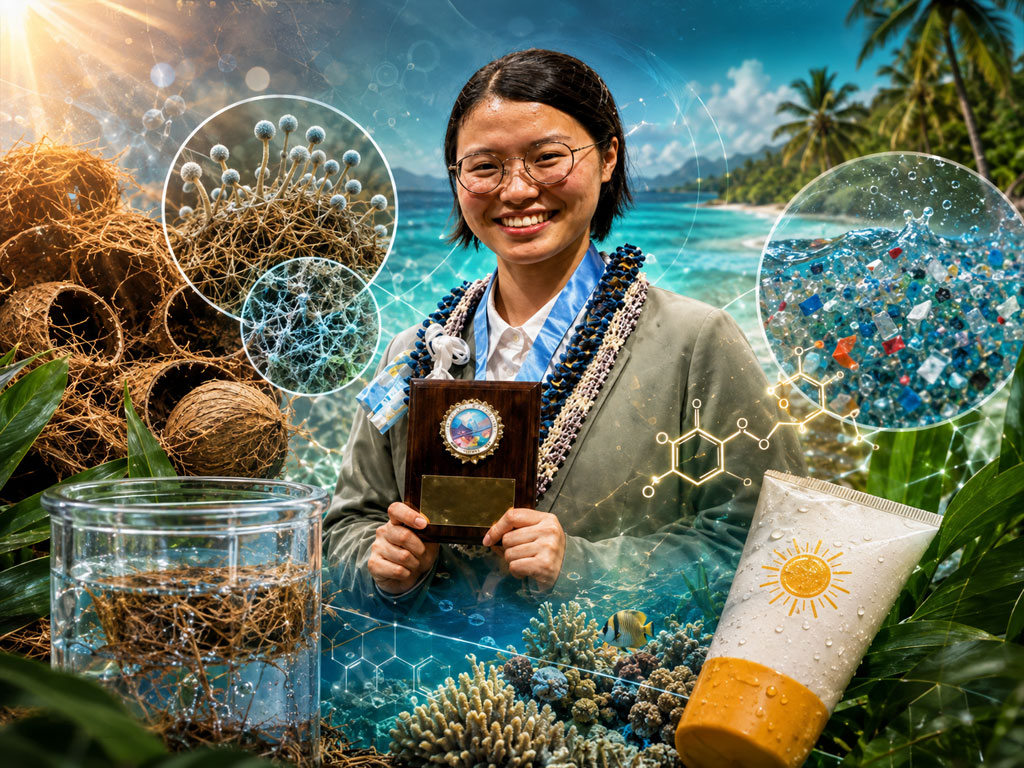
Coconut husk plastic research by a 17-year-old Hawaii student suggests fungi inside coconut fibres may help break down plastics and sunscreen chemicals.
A coconut husk plastic experiment by a 17-year-old schoolgirl in Hawaii is drawing attention to an unlikely natural tool in the fight against marine pollution.
At home, most people either burn coconut husks as fuel or leave them somewhere in the garden to decompose.
Few would look at one and imagine that it could contain a possible answer to one of the world’s biggest environmental problems.
We often assume that major environmental solutions must come from advanced technology or expensive machinery. However, Vera Wang looked at an ordinary coconut husk differently.
Vera is a student at Kaiser High School in Hawaii.
Living close to the ocean, she regularly saw plastic waste washing onto beaches. She also became concerned about damage to coral reefs and other marine life from chemicals in sunscreen used by tourists.

Coconut Husk Plastic Experiment Began With a Simple Filter
In the 10th grade, Vera started with a relatively simple idea.
She created a natural water filter using coconut husks found on the beach. Her goal was to remove microplastics and sunscreen chemicals from seawater.
However, while testing the filter, she noticed something more significant.
She began to suspect that coconut husk was not simply a collection of useful filtering fibres. Instead, she realised it might contain an entire microbial ecosystem.
To investigate further, Vera joined the laboratory of Dr. Anthony Amend at the University of Hawaii.
There, together with researcher Kylie Christensen, she conducted experiments that produced an unexpected finding.
Some fungi that naturally grow inside coconut fibres appear capable of biochemically breaking down plastic particles that can persist for hundreds of years.
The fungi could also break down complex chemical compounds found in sunscreens.
Researchers also found that tannins, natural chemicals present in coconut husks, appear to help these plastic-degrading fungi grow rapidly.
DNA Tests Suggest Previously Unknown Fungi
The research produced another striking result.
When scientists examined the DNA of some of the fungi, the genetic profiles did not match information contained in major global gene databases.
That raises the possibility that coconut husks could contain microorganisms that scientists have not previously identified.
In other words, organisms unknown to science may be living inside something as ordinary as a coconut husk found in a backyard.
Scientists call the use of microorganisms to control environmental pollution “bioremediation.”
Vera’s work earned her first place in the microbiology category at the Hawaii State Science Fair.
It also secured her the opportunity to participate in the international ISEF competition.
Research Remains at an Early Stage
Despite the promise of the coconut husk plastic research, the work remains at an early laboratory stage.
It will take more research before scientists can determine whether this approach can be developed into a practical solution for large-scale plastic pollution.
It is certainly not yet a method capable of solving the world’s waste problem overnight.
However, the experiment offers a wider lesson.
As technology advances, some solutions to human-created problems may still be found in natural systems that have existed around us for generations.
Sometimes the breakthrough may not require increasingly complicated machinery.
Instead, it may begin with curiosity, careful observation and the willingness to look differently at something most people would normally throw away.