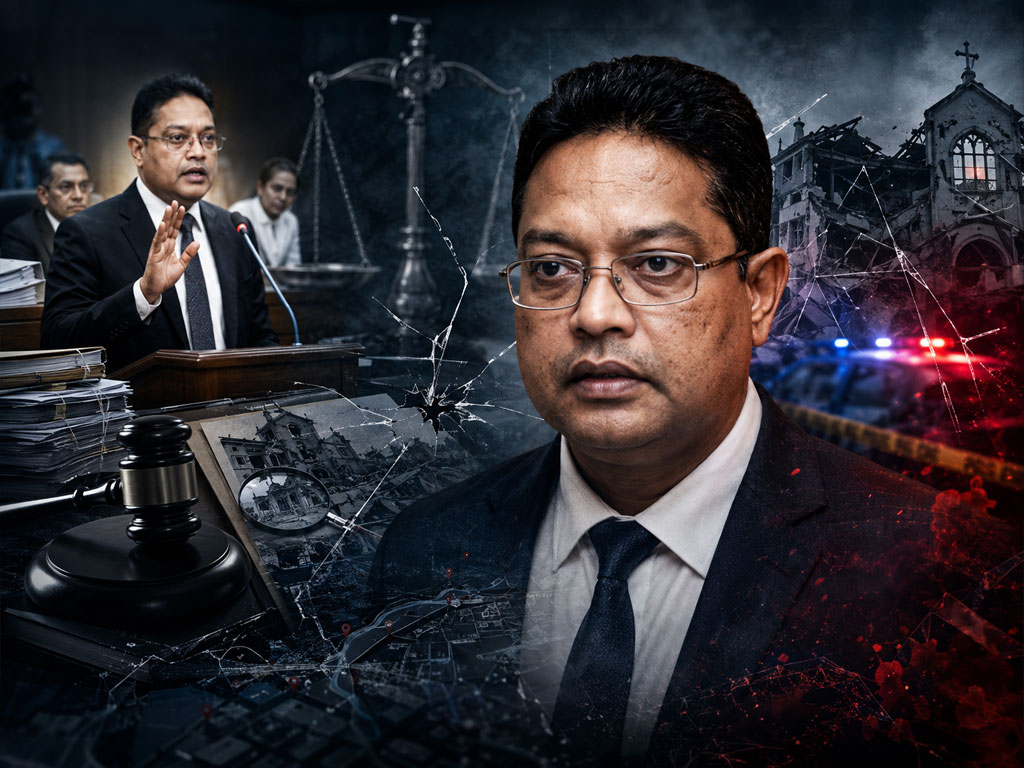
Nilantha Jayawardena accountability faces scrutiny over intelligence failures and his role as the main witness in the Easter attack cases.
Nilantha Jayawardena accountability has returned to the centre of debate as Sri Lanka’s Easter Sunday attack proceedings enter another decisive legal phase.
The controversy follows the Supreme Court ruling in SC TAB 02/2023 concerning former Defence Secretary Hemasiri Fernando and former Police Chief Pujith Jayasundara.
The Supreme Court overturned the Colombo High Court Trial-at-Bar decision that acquitted both men without calling their defence. It ruled that the prosecution had presented sufficient evidence to require them to answer the charges.
After the resumed proceedings, the High Court convicted Fernando and Jayasundara on July 31, 2026. However, the wider question surrounding former State Intelligence Service Director Nilantha Jayawardena remains unresolved.
Is he primarily the prosecution’s main witness, or should authorities also treat him as an official who bears responsibility?
Get Breaking News First
on WhatsApp

Nilantha Jayawardena’s Role as the Main Witness
Jayawardena served as the prosecution’s first witness, identified as PW1, in the cases against Fernando and Jayasundara.
A foreign intelligence agency reportedly provided an advance warning on April 4, 2019. Jayawardena then informed the Chief of National Intelligence and the Defence Secretary on April 7.
Court proceedings also examined intelligence communications issued on April 8, 18, 20 and 21.
Following an explosion in Kattankudy on April 16, Jayawardena reportedly concluded that Zahran Hashim’s group had conducted a rehearsal. He informed senior officials about the incident on April 18.
However, the Police Chief distributed the highly sensitive intelligence to only four senior officers.
The Defence Secretary also failed to brief the tri-forces commanders or the Chief of Defence Staff during the April 9 intelligence coordination meeting.
The Supreme Court found that the High Court had made a serious legal error by acquitting the defendants without calling their defence.
The Attorney General did not charge the two officials as principal offenders who directly committed murder. Instead, the prosecution alleged that they abetted the offences through an “illegal omission.”
The court concluded that the prosecution had established a prima facie case requiring a defence.
Intelligence Reports and Questions of Responsibility
Against this background, Nilantha Jayawardena accountability presents a difficult legal question.
According to the original article’s account of the Malalgoda Committee findings, Jayawardena submitted nearly 170 reports to senior authorities from 2015 concerning the spread of ISIS ideology.
Sri Lanka’s principal intelligence agencies also operated without a comprehensive statutory framework defining their duties, authority and reporting responsibilities.
That institutional weakness may support an argument that Jayawardena primarily collected intelligence and passed it to officials who held decision-making power.
However, inquiries heavily criticised the failure to circulate SIS intelligence beyond a limited group within the Defence Ministry.
A parliamentary investigation also found serious failures in sharing intelligence and coordinating responses before the attacks. It concluded that earlier and wider communication could have allowed authorities to take preventive action.
Commissions have therefore recommended legal or disciplinary action against Jayawardena.
Meanwhile, the Attorney General’s Department relied heavily on his evidence to establish the cases against Fernando and Jayasundara.
Can the Main Witness Escape Accountability?
Within the state security structure, the Defence Secretary and Police Chief possessed greater authority to order action.
Therefore, prosecuting an intelligence director who describes himself as an information collector and reporter may create complex legal challenges.
Yet that argument does not automatically remove all responsibility.
In January 2023, the Supreme Court found that Jayawardena had violated fundamental rights through failures connected to the Easter Sunday attacks and ordered him to pay compensation. More recently, courts allowed civil compensation cases filed by victims against him and Jayasundara to continue.
The central issue is no longer whether he possessed intelligence. The question is whether he communicated it adequately, urgently and to everyone capable of preventing the attacks.
Future criminal, civil and disciplinary proceedings must determine whether Nilantha Jayawardena remains primarily a witness or becomes an accused.
Justice for the Easter Sunday victims requires courts to examine every level of responsibility, regardless of rank, institutional position or value to the prosecution.