Written by Dwayne Ferreira.
Canada EU associate membership gains momentum as Mark Carney welcomes deeper European ties, although major legal questions remain.
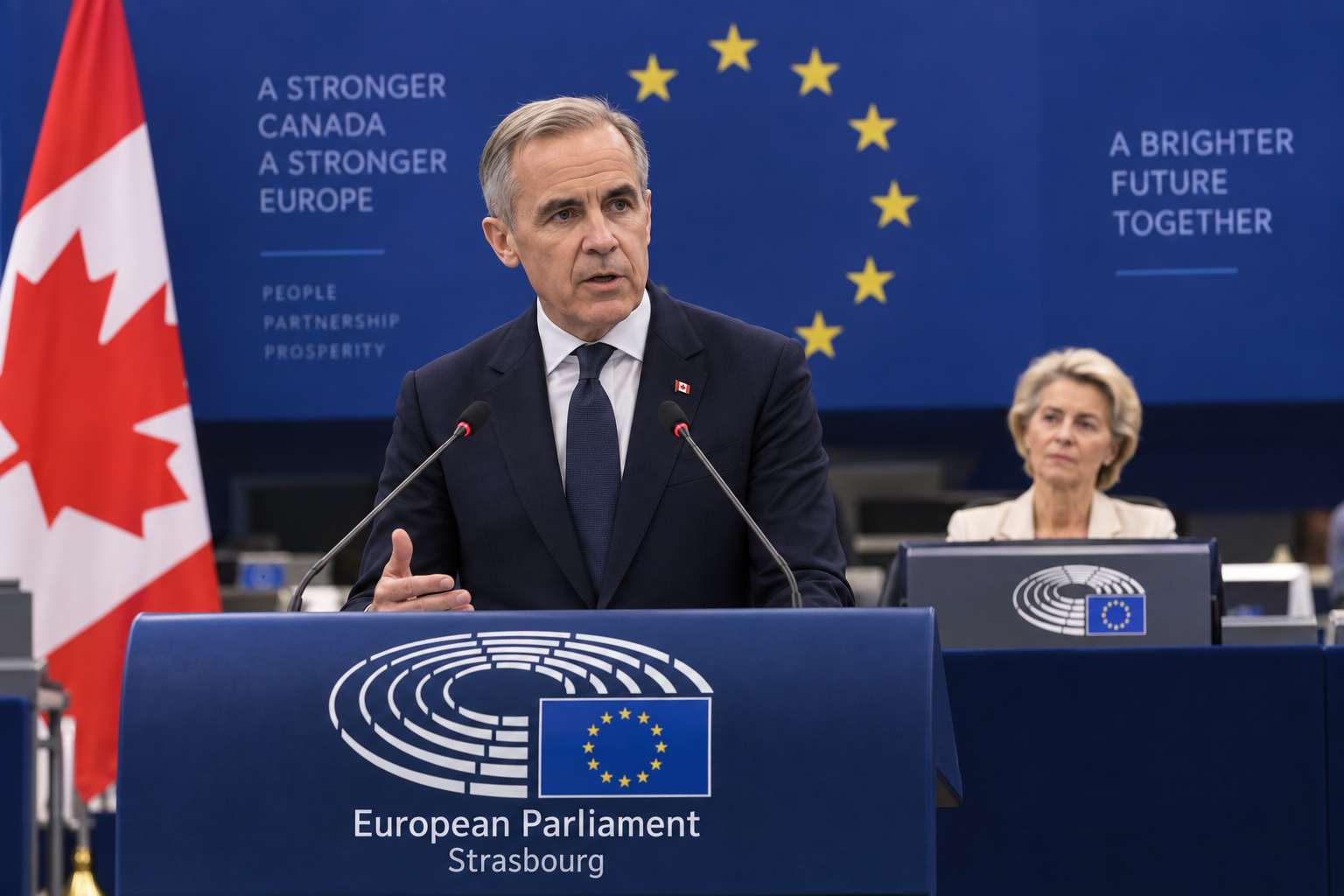
STRASBOURG — Canadian Prime Minister Mark Carney has welcomed a European Union proposal that could make Canada the bloc’s first “associate member”, describing closer cooperation between Canada and Europe as a potential “beacon for other democracies”.
Speaking before the European Parliament in Strasbourg on Thursday, Carney backed European Commission President Ursula von der Leyen’s proposal for a substantially deeper partnership between Canada and the EU.
“Canada and Europe are each strong. Europe and Canada are stronger together,” Carney told European lawmakers, arguing that closer cooperation could strengthen the economic and strategic resilience of both sides.
Von der Leyen opened the door to the unprecedented arrangement a day earlier, proposing that Canada become the EU’s first associate member as part of what European officials have described as an “alliance for the future”.

However, the concept remains largely undefined.
No formal category of EU “associate membership” currently exists under the bloc’s treaties, meaning European governments would have to determine precisely what rights, obligations and institutional arrangements such a relationship would involve. Any substantial new agreement would also require the support of the EU’s 27 member states.
Carney made clear that Canada was neither seeking nor preparing to become a conventional full member of the European Union.
Instead, he emphasised the substance of the proposed relationship, saying the precise terminology was ultimately a matter for European governments to determine. He also indicated that any final arrangement would be subject to consideration and a vote in Canada’s Parliament.
Wider Economic and Strategic Cooperation
Carney said deeper cooperation could cover critical minerals, defence manufacturing, artificial intelligence and computing, energy security, space technology and payment systems.
He also called for progress towards more seamless digital trade in non-agricultural goods and services and proposed greater opportunities for young Canadians and Europeans to work, study and live on either side of the Atlantic.
Canada could also seek closer participation in European programmes such as Erasmus+, the EU’s education and exchange scheme.
The proposed partnership would build on an already substantial economic relationship.
Canada and the EU operate under the Comprehensive Economic and Trade Agreement, known as CETA, while cooperation has expanded into security and defence. Canada has also become the first non-European participant in the EU’s Security Action for Europe, or SAFE, defence initiative.
Carney argued that Canada and Europe possess complementary strategic resources.
Europe brings a vast consumer market, research capabilities, advanced manufacturing and an expanding defence industrial base, while Canada offers major energy resources, critical minerals and expertise in areas including artificial intelligence, quantum technologies, finance and space.
Questions Remain Over ‘Associate’ Status
Despite enthusiasm for strengthening Canada-EU ties, several European officials have expressed reservations about describing the proposed relationship as “associate membership”.
Germany has indicated support for exploring new forms of cooperation with Canada while suggesting that the terminology surrounding associate membership may need reconsideration.
Diplomats have also noted that the phrase has no established legal meaning within existing EU treaties, leaving substantial negotiations ahead over issues such as trade access, regulation and participation in European programmes.
Questions could also emerge over how far Canada might gain access to the EU’s single market, particularly because the bloc traditionally links free movement of goods, services, capital and people with adherence to common European rules.
Canada Looks to Deepen European Ties
The proposal comes as Canada and European governments seek to diversify trade, defence and technology partnerships amid growing global economic competition and geopolitical uncertainty.
Relations with the United States have also formed part of the wider backdrop.
US President Donald Trump criticised the proposed EU-Canada arrangement and threatened additional trade measures if Washington concluded that the initiative was directed against US interests. Carney responded that Canada would determine its own international partnerships and stressed that closer cooperation with Europe was not designed as an initiative against another country.
Carney also rejected the idea that closer Canada-EU cooperation was intended to establish another competing geopolitical bloc.
“The objective is not self-sufficiency. It is collective resilience,” he said, presenting the proposed relationship as a framework through which democratic partners could reduce strategic vulnerabilities while continuing to cooperate with other allies.
Further details are expected as Canadian and European officials work to determine what an unprecedented associate relationship could actually involve.
For now, the proposal represents one of the most ambitious attempts in decades to redefine Canada’s economic and strategic relationship with Europe — although its final structure, legal status and scope remain to be negotiated.