By Roshan Jayasinghe
An Observation on Looking Inward and Carrying Humanity Forward
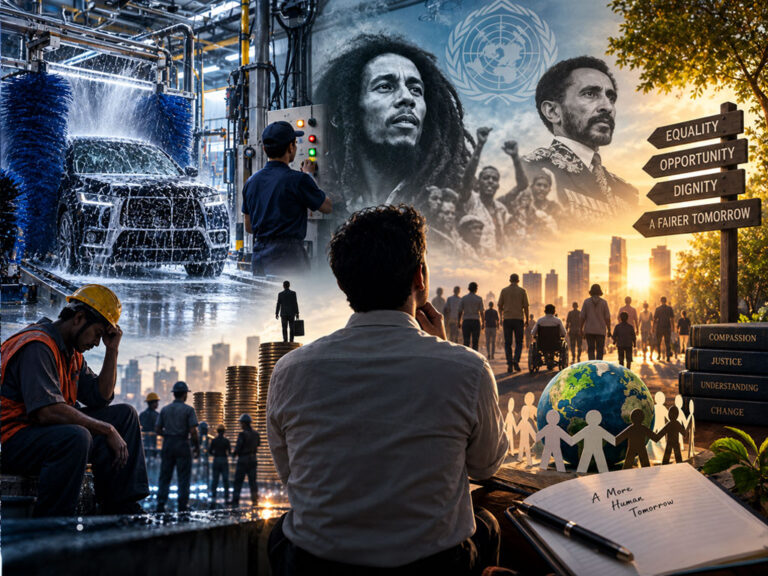
My work in the car wash industry takes me into express tunnels, the conveyor areas where vehicles move through a sequence of chemical applications, washing, protection and rinsing. During a visit, an operator may tell me that a presoak appears weaker, a protective product is not reaching the vehicle evenly or an applicator is not dispensing its chemical correctly. The control board may show that the function has been activated, yet an illuminated signal does not prove that the correct amount of chemical has been delivered. The applicator may still activate while a restriction or blockage somewhere in the delivery system prevents the chemical from reaching the vehicle as intended, and the cause may be found anywhere between the injector and the applicator nozzle, or in the signal controlling the function. Operators raise these concerns because identifying and correcting the problem benefits the wash. My task is to listen, observe the actual result and trace the process from the control board to the vehicle.

These visits have caused me to think about more than car wash equipment. A system can indicate that it is working while failing to deliver what it was created to provide. Every component may appear active when examined separately, yet the final result can remain incomplete. The truth cannot be determined only by looking at the control board. I have to observe the application, measure what is being delivered and follow the connections until the reason becomes visible. Over time, I have begun to wonder how often the same distance exists within our human arrangements. We may activate the language of equality, dignity, opportunity and service while the person passing through the system receives less than those words appear to promise.
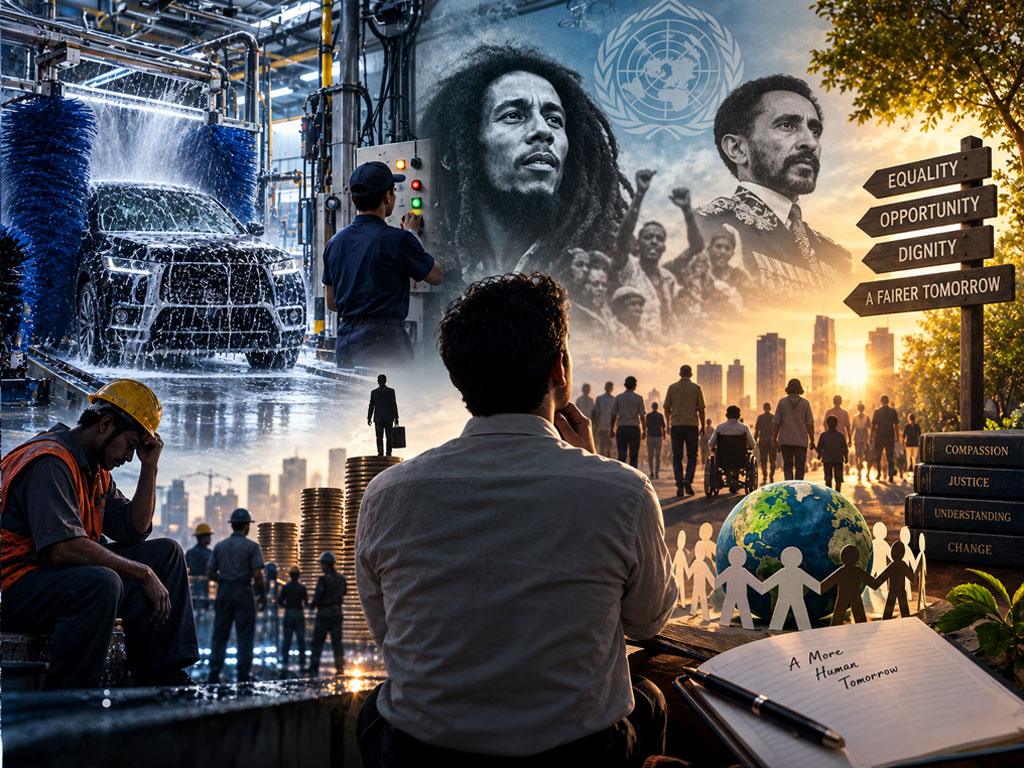
When I consider that distance, I find myself returning to Bob Marley’s “War.” The song draws much of its message from the address Emperor Haile Selassie delivered to the United Nations in 1963 and speaks directly against racial superiority and the treatment of one people as inferior to another. That historical meaning deserves to remain clear. At the same time, the moral question carried by the song has led me to look at the other ways human beings assign greater importance to one life than another through wealth, authority, occupation, nationality and social position. We can recognize the truth of a message, repeat it and admire the person who carried it while continuing to participate in arrangements that produce the opposite result.

We Are Still The Authors
Roshan Jayasinghe reflects on artificial intelligence, human inheritance and our responsibility to shape what AI serves over the next fifty years.
The Morning Telegraph • September 8, 2026 • 14 min readThis is the distance I am trying to understand: the space between what we know and how deeply we have allowed that knowledge to change us. Humanity has already developed powerful language around fairness, dignity, rest, care and equal human worth. Yet the presence of those ideas in our language does not mean they have fully entered our conduct or the structures through which we live. The question that stays with me is not only whether we know what is right, but why knowledge that appears so clear can remain separated from practice.
Looking outward makes it easy to identify failures in governments, corporations, political parties and other people. Looking inward is more uncomfortable. I have to ask whether I listen differently when the person speaking has less influence, and whether I defend an arrangement because it is fair or because my own place within it is comfortable. I ask these questions from within the conditions I am examining. I live within them, benefit from some of them and may repeat parts of them without immediately recognizing that I am doing so.
For me, truth seeking requires this movement in both directions. It asks me to look outward at what is happening and inward at the position from which I am interpreting it. It also asks me to examine both sides of the coin instead of choosing the side that confirms what I already think. One side may reveal effort, knowledge, investment and risk. The other may reveal vulnerability, hardship and consequences hidden by the appearance of success. One side does not have to be erased for the other to become visible. A fuller understanding begins when both remain present long enough for their relationship to be examined.
Money is one of the clearest places where I see this tension. It allows people to exchange value, recognize contribution, plan for the future and coordinate activity beyond the limits of a family or village. Differences in knowledge, skill, effort, responsibility and risk can reasonably produce differences in income. Equality, as I understand it, does not require every person to earn the same amount, and achievement does not become wrong because it brings greater financial reward.
The imbalance appears to me at a more fundamental level. It begins when a person gives a full working day and remains unable to meet the ordinary cost of living. One person may absorb an increase in rent, food or healthcare without losing stability, while another person performing necessary work can be placed in crisis by a single unexpected expense. The difference is not only in what they can purchase. It is in what each person can survive, refuse, question or recover from. This is what I have come to understand as unequal vulnerability.
A person with greater income may have savings, alternatives and time to reconsider a difficult situation. A person whose earnings barely meet basic expenses may have no such room. This does not mean the person with greater income acquired it unfairly. It means the person lower on the economic scale experiences ordinary life with far less protection from its consequences. When essential work does not provide enough stability for the person performing it, I find it difficult to see the problem only as an individual failure. It may also reveal a disconnection between the value assigned to the work and the cost of maintaining the life of the person doing it.
The calculation is not simple. A business has costs, risks and limits of its own, and a wage that makes a useful enterprise impossible to sustain will eventually affect everyone who depends upon it. At the same time, an enterprise that can survive only while people working a full day remain unable to meet basic needs also reveals an incomplete arrangement. No single employer can correct every connected cost, but no honest examination can exclude the life of the person whose work keeps the activity moving.
This is why the eight hour working day carries a human meaning for me. A working day is only one part of a human day. Time is also needed for sleep, travel, meals, health, family, relationships, care and thought. There will be emergencies, demanding periods and personal choices to work longer. What concerns me is the point at which additional hours stop being an exception and become an ordinary requirement for survival. When a person must continually surrender rest, health and family life to obtain basic security, I begin to question whether the arrangement is supporting human life or consuming it.
My work has also taught me to follow a process from its beginning to its result. A chemical cannot reach a vehicle correctly unless every part of the system works together in the right sequence. Human activity moves through connected stages as well. Materials are sourced, knowledge is applied, something is manufactured or prepared, assistance is coordinated, and a product or service eventually reaches another person. When the movement from one stage to the next is not understood, we often try to correct the final failure by demanding more speed from the person standing nearest to it.
Authority looks different when I follow a process this way. Decisions have to be made, responsibilities coordinated and knowledge organized, but the knowledge needed for a sound decision does not always belong to the person holding the highest position. In a car wash tunnel, an operator who watches the wash throughout the day may notice a weakening application before any report reveals it. I may understand the chemical system, the owner understands the business and the customer experiences the final result. Each person sees the process from a different position.
This has made me think about leadership as an ability to gather knowledge rather than proof that one person possesses all of it. A title identifies responsibility, but it does not change the human worth of the person holding it. Authority becomes more useful when it can receive correction without treating correction as disrespect. I have also noticed how easily any of us, including myself, can listen more closely to the person with greater influence. The more authority a person holds, the more lives their decisions can affect. That connection has led me to see greater power as carrying a greater responsibility to observe its consequences.
The same question reaches beyond work. A public service may appear efficient to the person reviewing its numbers while creating repeated difficulty for the family trying to obtain it. A healthcare system may possess remarkable knowledge while a person cannot reach the treatment. A family decision may appear reasonable until the experience of its quietest member is heard. In each case, the signal may indicate that the system is functioning while the human result tells a different story.
The first correction will not always be right. A humane intention can still produce an unforeseen burden. This is where evidence, analysis and lived experience become important. I try to understand the purpose, observe the result, listen to the people carrying the effects and return to see what happened after a decision was made. When the result differs from the intention, preserving the truth requires a willingness to revise the conclusion. That willingness is not weakness or uncertainty without direction. It is responsibility continuing beyond the first answer.
I have begun developing what I call the Living Human Manual through these articles and the observations behind them. At this stage, I am giving it its initial form by looking inward at my own conduct and outward at human life, our constructions and their consequences. Its future, however, cannot belong to my understanding alone. As more people encounter it, it should remain open to their lived experiences, evaluation and correction. Its purpose is not to gather agreement around my conclusions, but to encourage truthful participation. My hope is that readers will also look inward at their own conduct and outward at the conditions around them, then bring what they observe into a wider human conversation through which the Manual can be questioned, corrected and carried forward. That continuing contribution is what can make it a living manual within our human continuum.
Humanity does not need to be invented before this process can begin. I see it when someone cares for an ill parent, shares knowledge without protecting status, accepts correction or uses an advantage to reduce another person’s burden. I see it when people look inward before assigning blame and when they look outward far enough to notice a consequence they were not required to see. These choices may appear small beside the size of the systems we have created, yet every system is eventually carried through human conduct.
When I return to the tunnel, the lesson becomes simple again. The control board can indicate that a function was commanded, but I still have to look at the vehicle. Did the chemical reach the surface? Was it applied in the correct amount? Did the complete process deliver what it was designed to provide? If the result is missing, the honest response is to trace the connections rather than defend the signal.
Bob Marley’s “War” has endured because humanity recognizes the truth within its message, yet recognition alone has not ended the conditions it condemns. Every generation inherits truths that were spoken clearly while their opposites continued to be practised. I cannot know what a finished humanity would look like, nor is it mine to define. I can only continue looking inward, looking outward and placing what I observe before others, in the hope that the signals we have learned to trust may one day match what truly reaches human life.
AUTHOR’S NOTE
This reflection grows from observations made through my work and from the questions they have led me to ask. I include myself in those questions. It contributes to the Living Human Manual, an ongoing work intended to remain open to evidence, lived experience and correction.