By Dwayne Ferreira.
Strait of Hormuz attacks threaten commercial tankers and global energy shipping routes across the Gulf
Three Strait of Hormuz attacks on commercial tankers within roughly 24 hours have turned one of the world’s most important energy corridors into a new front line in the escalating confrontation between the United States and Iran.
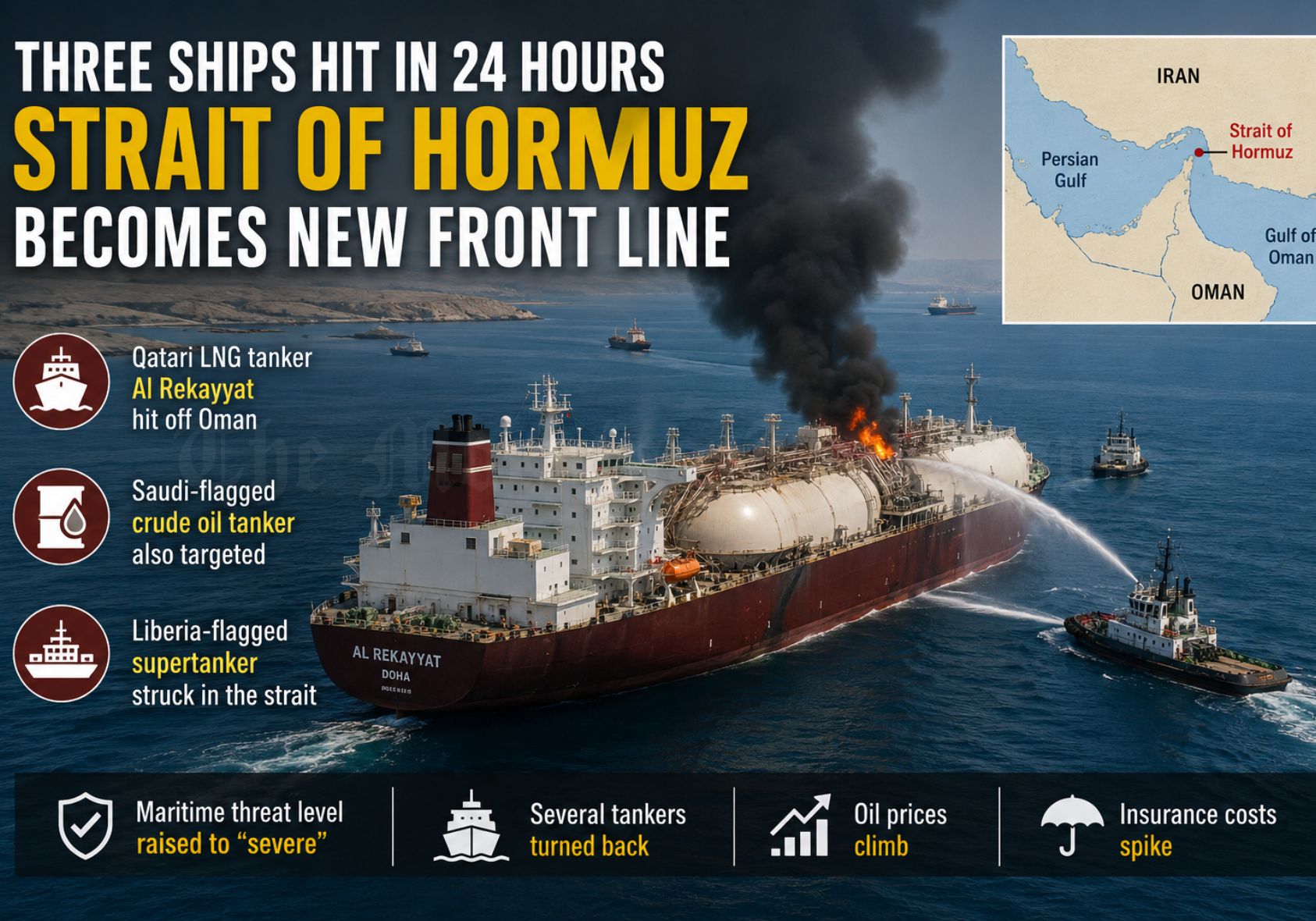
The strikes have triggered fresh alarm over the safety of commercial shipping through the narrow waterway. Maritime authorities have raised the threat level for vessels to “severe,” while some tankers have abandoned planned passages through the area.
The incidents involved a Qatari liquefied natural gas tanker, a Saudi-flagged crude oil tanker and a Liberia-flagged supertanker, according to maritime and shipping reports. The attacks came as Washington and Tehran returned to open hostility after a fragile ceasefire temporarily eased a wider Gulf conflict.
The Qatari LNG tanker Al Rekayyat was left stranded off Oman after a projectile hit the vessel and caused a fire in its engine room. The crew evacuated safely, and the ship’s LNG cargo remained intact while salvage operations were being prepared.
However, the attack carried meaning far beyond the damage to one vessel.
It marked the first reported strike on a Qatari LNG ship during the conflict. It also raised fears that Gulf commercial energy infrastructure could be pulled deeper into the confrontation.

Strait of Hormuz Attacks Shift the Gulf Crisis
The Strait of Hormuz has long been one of the world’s most dangerous geopolitical pressure points. But the latest attacks suggest the waterway has moved beyond a strategic threat and into an active maritime battlefield.
Before the war, roughly one-fifth of global oil and liquefied natural gas supplies passed through the narrow route between Iran and Oman. Any sustained disruption could therefore affect oil prices, shipping costs and supply chains across Asia and Europe.
The latest series of strikes has already changed the behaviour of ship operators.
At least four oil and gas tankers turned back while attempting to transit Hormuz after the attacks. Three empty LNG carriers controlled by QatarEnergy were heading towards Qatar’s Ras Laffan export facility when they reversed course. Meanwhile, an Indian-flagged supertanker carrying two million barrels of Kuwaiti crude also made a U-turn near Oman.
Those movements show how repeated attacks can disrupt the waterway even without a formally declared blockade.
A shipping route does not need to be legally closed to become commercially dangerous. If shipowners refuse to sail, crews fear entering the area and insurance costs rise sharply, the practical impact can begin to resemble a shutdown.
Some war-risk insurers have already advised shipowners to pause voyages through Hormuz. Others are reviewing their terms. Insurance premiums for vessels operating in the region have also climbed as underwriters reassess the threat.
Qatari Tanker Strike Raises Regional Stakes
The strike on Al Rekayyat has added another dangerous dimension to the crisis.
Qatar has played an important diplomatic role in regional negotiations. It is also one of the world’s most important LNG exporters. Therefore, an attack on a vessel linked to its energy industry risks increasing pressure on Gulf governments that want to protect their economies while avoiding deeper involvement in the conflict.
The damaged tanker was awaiting salvage support off Oman after the engine-room fire. Two support vessels were assisting the ship, while officials said the LNG cargo remained intact.
Yet the wider consequences were immediate.
The United States revoked a conditional authorization that had allowed Iran to sell oil. Washington also launched another wave of military strikes against Iranian targets. US Central Command said its operations targeted Iranian military capabilities, including infrastructure linked to missiles, drones and naval operations.
Washington said the attacks on commercial shipping violated the ceasefire and threatened freedom of navigation. Iran, meanwhile, condemned the US strikes as aggression and warned against American interference in the management of the strait.
As a result, the cycle of attack and retaliation has placed merchant vessels directly inside the wider conflict.
Tanker Operators Face a Dangerous Choice
For tanker operators, the decision over whether to enter Hormuz is becoming more difficult.
The danger is no longer theoretical.
Commercial vessels have been hit. Tankers have reversed course. Insurers are reconsidering risk exposure. Shipping traffic also remains far below normal pre-war levels.
The disruption is especially serious for LNG markets.
Satellite imagery from July 7 showed 14 LNG tankers anchored offshore near Qatar’s Ras Laffan export complex. Some vessels were also reported to have switched off their Automatic Identification System transponders.
Before the wider conflict, the Strait of Hormuz carried enormous volumes of crude oil, refined products and LNG every day.
The route is especially important for Gulf exporters whose main terminals sit inside the waterway. Although some regional producers have pipeline alternatives that bypass Hormuz, those routes cannot match the huge volumes normally moved by tanker.
The renewed violence therefore raises a critical question. Can commercial traffic return to normal while vessels continue to face attack?
Energy Markets Watch Hormuz Closely
Energy markets have responded quickly to the renewed hostilities.
Oil prices rose as traders assessed the danger of further military escalation and prolonged disruption to shipping through Hormuz. Brent crude and US West Texas Intermediate both climbed after the fresh attacks and renewed American military action. The Energy Information Administration has long identified Hormuz as a critical global energy chokepoint.
The greatest concern is not only the loss of individual vessels.
The larger danger is a sustained campaign that convinces shipping companies the route is too dangerous to use.
Even a small number of attacks can create an outsized impact. Vessels may wait offshore. Cargoes may be diverted. Insurance costs may rise. Confidence in the shipping corridor may also weaken rapidly.
That is why the latest three strikes matter.
They suggest that the Strait of Hormuz is no longer simply a place where the United States and Iran threaten each other with economic consequences. It is increasingly becoming the place where the conflict itself is being fought.
A New Front Line in the Gulf
For decades, the Strait of Hormuz has been described as a potential flashpoint.
Now, that flashpoint appears to have ignited.
Commercial crews are navigating waters shaped by missile threats, drone attacks, naval operations and rapidly changing military calculations. The International Maritime Organization remains a key reference point for global maritime safety standards. Gulf states that depend on the route face rising pressure, while Washington and Tehran are again trading military action and warnings.
The immediate focus will be whether more vessels are attacked. Shipping companies will also watch whether tanker operators continue to abandon planned passages.
If the attacks stop, traffic may slowly recover.
If they continue, the consequences could reach far beyond the Gulf.
Three ships hit within roughly one day have already shown how quickly the world’s most important energy corridor can move from fragile reopening to renewed crisis. With tankers turning back and insurers warning shipowners about the risks, Hormuz is once again at the centre of the conflict.
This time, however, the danger is not only that the strait could become a battlefield.
The latest Strait of Hormuz attacks suggest it already has.